
How to Identify Your Target Audience for a Small Business
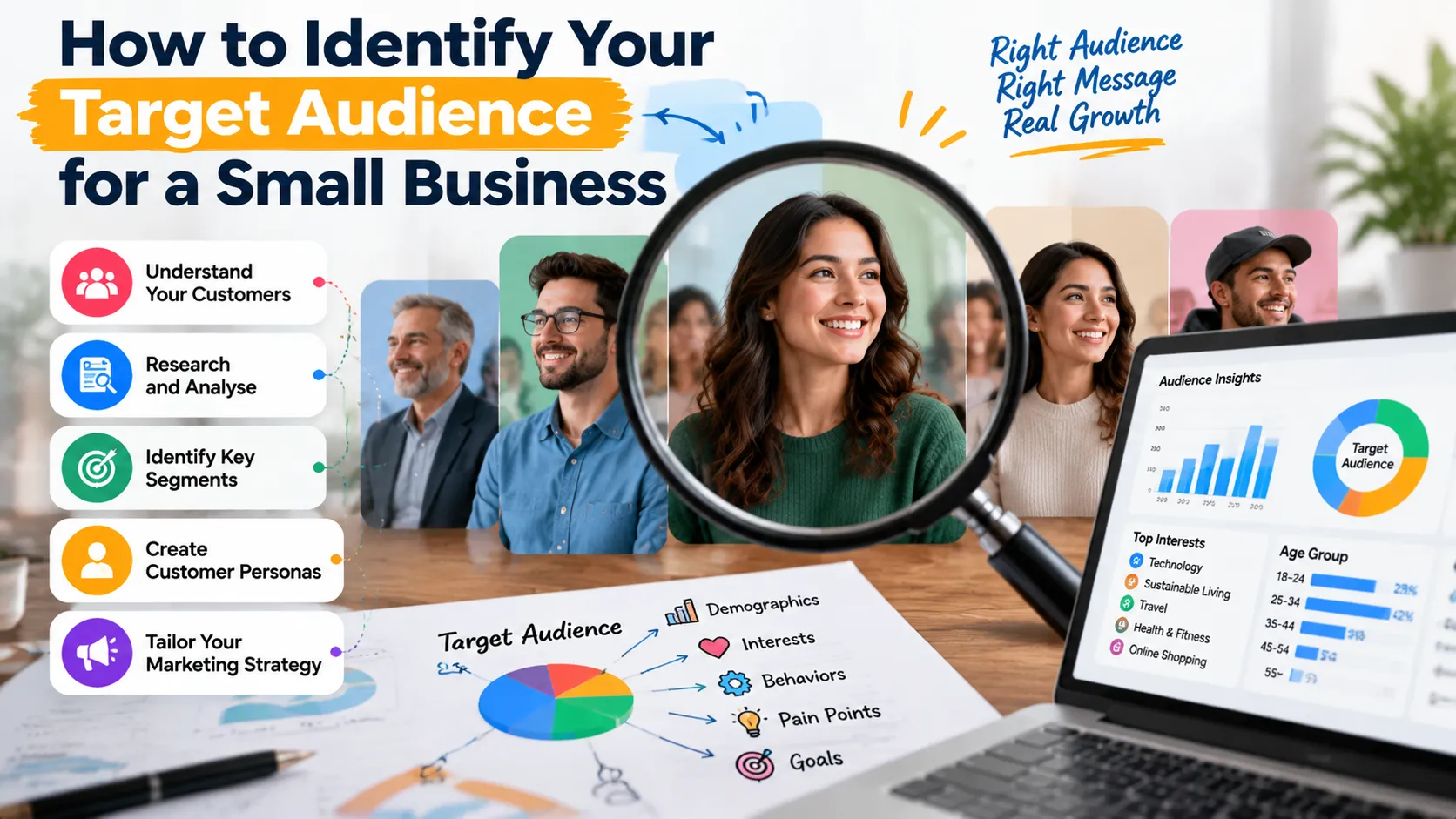
Learning how to identify your target audience helps a small business stop guessing, focus limited marketing resources, and reach people most likely to become customers.
Identifying your target audience starts with understanding who needs your offer, why they need it, and what influences their buying decisions. This guide explains practical market research, customer segmentation, buyer profiles, competitor analysis, marketing-channel selection, and performance measurement so small businesses can build more focused, evidence-based marketing strategies.
What Is a Target Audience?
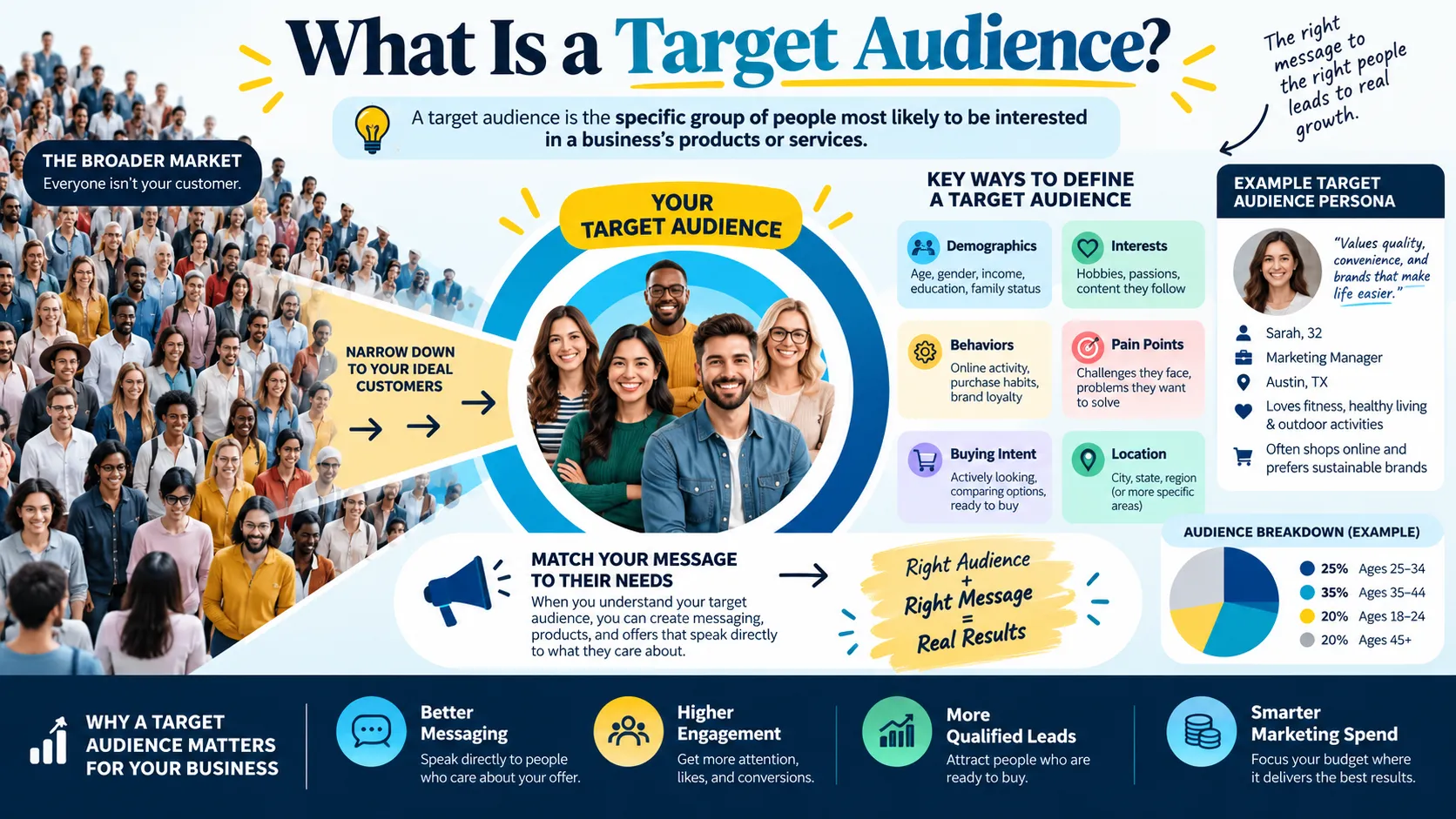
A target audience is a specific group of people or organizations that a business wants to reach with a particular message, product, service, or marketing campaign.
These people share characteristics that make the offer relevant to them. They may experience similar problems, have comparable buying motivations, work in the same industry, or respond to similar marketing messages.
For example, a business selling accounting software could target small business owners who manage their own finances. However, its audience for a particular campaign might be narrower: service-based businesses that need to automate invoicing and reduce administrative work.
The narrower audience gives the campaign a clearer message. Instead of advertising generic accounting features, the business can explain how the software helps service providers send invoices, track payments, and understand outstanding balances.
Understanding how to identify your target audience therefore involves more than collecting demographic information. It requires evidence about customer needs, purchasing behavior, decision-making processes, and the value your business can realistically deliver.
The U.S. Small Business Administration’s market research guidance recommends examining demand, market size, economic conditions, location, competition, and pricing when evaluating a market. These factors help businesses understand whether a potential audience represents a viable opportunity.
Target Market vs. Target Audience vs. Ideal Customer Profile
These terms are related, but each serves a different purpose. Understanding the distinction prevents businesses from defining their customers too broadly or targeting campaigns too narrowly.
| Concept | Meaning and practical use |
|---|---|
| Target market | The broader group of potential buyers who could benefit from and purchase your products or services |
| Target audience | The specific group you want to reach with a particular message, campaign, or communication |
| Ideal customer profile (ICP) | A description of the customer or organization that best fits your offer, economics, and ability to deliver value |
| Buyer persona | A research-informed representation of a customer type, including motivations, goals, objections, and decision-making behavior |
Example: A Digital Marketing Agency
Imagine a digital marketing agency that offers SEO, website development, paid advertising, and creative services.
Its potential target market could include small and medium-sized businesses across several industries. However, that definition is too broad to guide every campaign effectively.
Its ideal customer profile might focus on established service businesses that already have a website, have a clear commercial offer, and need more qualified enquiries.
A specific target audience for an SEO campaign could be owners or marketing managers at those businesses who are researching ways to improve organic visibility.
A buyer persona might describe a marketing manager who needs to demonstrate measurable results to company leadership but lacks sufficient internal SEO expertise.
Each definition informs a different decision: business positioning, customer qualification, campaign targeting, or message development.
Why the Distinction Matters
Your target market does not need to change every time you publish a new article or launch an advertisement. Your campaign audience can change according to the problem, offer, channel, and stage of the buying journey.
For example, a campaign promoting a beginner’s SEO guide might reach people researching SEO fundamentals. A campaign promoting an SEO audit could focus on businesses that already have websites and need help diagnosing technical or performance problems.
Both audiences may belong to the same broad market, but their immediate needs differ.
Why Small Businesses Need a Clearly Defined Audience
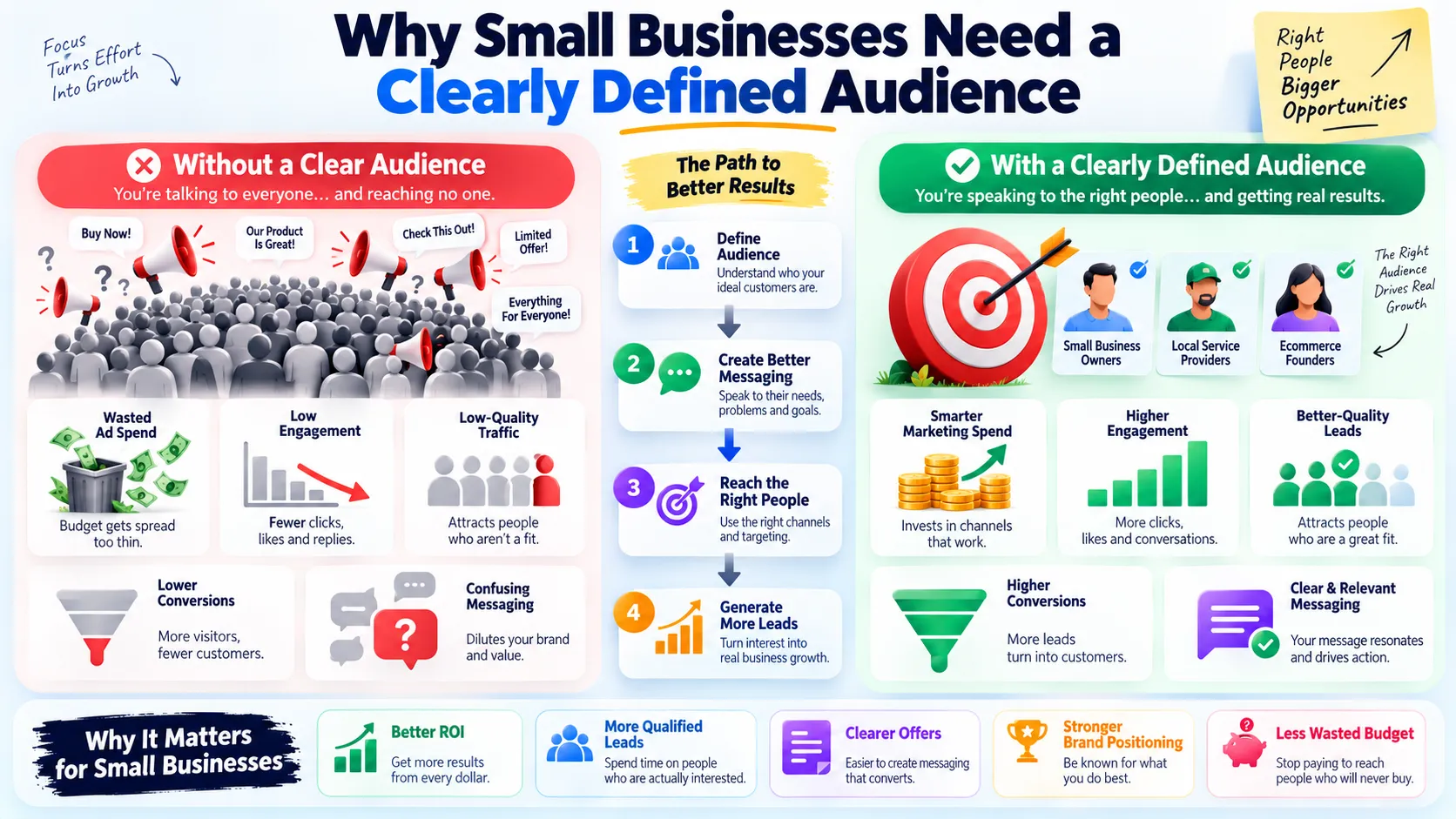
Small businesses often have limited budgets, small teams, and competing priorities. Without a clear audience, they risk investing in marketing activities that attract attention without generating meaningful business opportunities.
More Relevant Marketing Messages
A message becomes more useful when it addresses a problem the intended customer recognizes.
Consider two headlines for a website development service.
The first says, “We Build Professional Websites.”
The second says, “Help Your Service Business Turn Website Visitors Into Qualified Enquiries.”
The first describes a service. The second communicates a potential business outcome to a more specific audience.
The second headline will not automatically perform better in every situation, but it creates a testable hypothesis about what matters to the intended customer.
More Efficient Marketing Spending
Audience research helps businesses decide which channels deserve attention.
A local repair service may benefit from local search visibility, customer reviews, and a well-maintained business profile. A B2B software company may need educational content, industry-specific landing pages, and professional networking.
Spending money on every available channel makes little sense when only a few reach the people most likely to buy.
Better Products and Services
Customer research can reveal gaps between what a business thinks customers need and what customers actually value.
People may care less about a feature than the time it saves, the risk it reduces, or the problem it solves.
Understanding these priorities can improve product decisions, service packages, pricing communication, onboarding, and customer support.
Stronger Lead Quality
More enquiries do not necessarily mean more revenue. If a campaign attracts people who cannot afford the service, do not need it, or are not ready to buy, the sales team may spend considerable time on unsuitable prospects.
A defined audience helps businesses attract more relevant enquiries and assess lead quality instead of focusing only on lead volume.
How to Identify Your Target Audience Step by Step
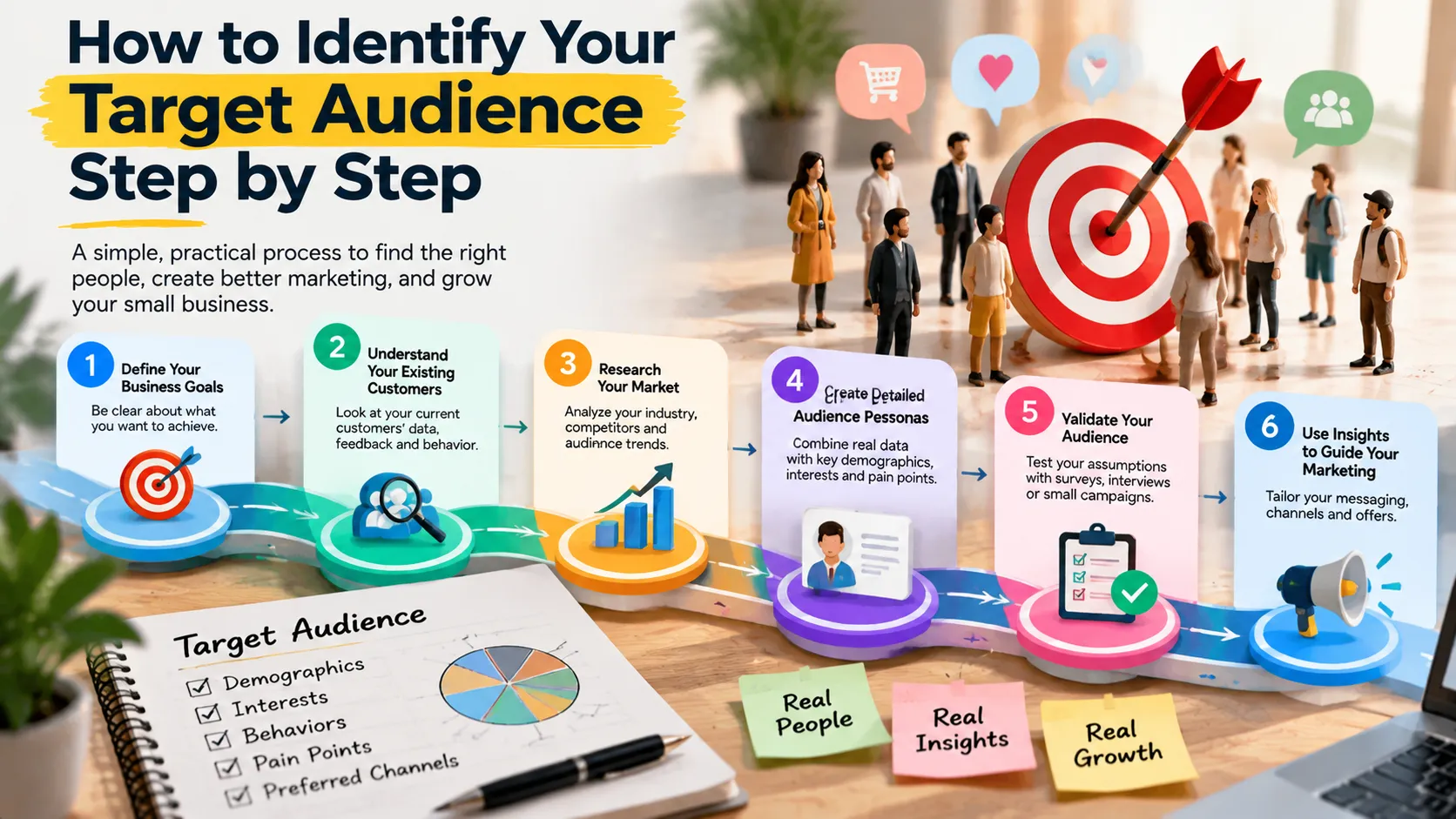
The following process combines market research, customer evidence, segmentation, and practical validation. A small business can begin with existing records and a few customer conversations before investing in expensive research tools.
Step 1: Define the Problem Your Business Solves
Start with the customer’s problem rather than the product or service you want to sell.
Ask what triggers someone to look for your offer, what they currently do to solve the problem, and what makes existing alternatives frustrating or inadequate.
For example, a business website design company might assume that customers want modern layouts and attractive colors. Research may reveal that the stronger concern is an outdated website that produces very few enquiries.
That distinction changes the message, the service presentation, and the evidence needed to persuade customers.
Write a simple problem statement that identifies the customer, the challenge, and the outcome your business helps them pursue.
A useful statement might be: “Established service businesses need a clearer website experience to explain their services and encourage suitable prospects to contact them.”
This statement is a starting hypothesis, not a proven customer insight. You must test it against real evidence.
Step 2: Analyze Your Existing Customers
If your business already has customers, start there. Existing customers can reveal which audience characteristics correlate with successful sales, repeat purchases, positive feedback, and manageable service delivery.
Review your sales records, enquiry forms, customer conversations, invoices, reviews, support requests, and website analytics.
Look for patterns in customer type, location, purchase size, service requirements, reasons for buying, and common objections.
Do not assume that the customer who spends the most money is automatically the ideal customer. A large project may generate substantial revenue but also require disproportionate support or involve poor margins.
Compare revenue with delivery effort, customer fit, retention, and the likelihood of repeat business.
If you are launching a new business without customers, use competitor research, industry data, interviews with potential buyers, and small experiments to develop initial hypotheses.
Step 3: Research Your Market and Competitors
Market research helps establish whether a potential audience is large enough, accessible enough, and willing to pay for the solution.
The Australian Government’s guide to identifying your target market recommends examining customer characteristics, interests, values, buying habits, and market segments.
Competitor research adds another perspective. Identify businesses that serve similar customers, then examine their offers, pricing signals, positioning, customer reviews, and communication.
Pay particular attention to unmet needs. Customers may complain about slow responses, confusing pricing, limited customization, poor after-sales service, or difficulty understanding a technical product.
These gaps can suggest opportunities, but competitor reviews represent only part of the market. Verify important observations through your own customer conversations and sales data.
Step 4: Segment the Market
Market segmentation divides a broad group of potential customers into smaller groups with relevant similarities.
A useful segment should be identifiable, measurable enough to evaluate, reachable through realistic channels, large enough to support your business objectives, and sufficiently distinct to justify a different marketing approach.
The Penn State Extension guide to target-market identification discusses measurable segments, purchasing power, accessibility, profitability, and stability as important considerations.
Common segmentation methods include demographic, geographic, psychographic, and behavioral analysis. For B2B businesses, firmographic information such as industry, company size, revenue range, and business model may be more useful than consumer demographics.
Do not collect every possible characteristic. Focus on variables that change a business decision, such as the offer, price, channel, sales process, or message.
Step 5: Understand Customer Motivations and Objections
Two customers with similar demographic characteristics can make different purchasing decisions.
One may prioritize price. Another may care more about reliability, convenience, support, or compatibility with existing systems.
To understand how to understand customer needs, investigate the circumstances that lead customers to search for a solution.
Ask what happened before they started looking, what alternatives they considered, which factors influenced their decision, and what nearly stopped them from buying.
Pay attention to customers’ own language. The phrases they use to describe a problem may be more useful for advertising copy and website content than internal industry terminology.
For example, a customer might say, “I spend hours following up with people who never respond,” rather than, “I need an improved lead-management process.”
The first statement reveals an operational frustration that could inform a clearer marketing message.
Step 6: Build an Ideal Customer Profile
Turn your research into a practical profile that your marketing and sales teams can use.
For a B2B business, the profile might include industry, company size, current systems, budget range, buying authority, business problem, urgency, and ability to benefit from your service.
For a B2C business, relevant factors might include the purchase occasion, budget, product preferences, buying frequency, location, and the problem the product solves.
Avoid adding fictional details merely to make the profile feel realistic. A person’s favorite movie or preferred coffee may have no bearing on whether they need your service.
Your ideal customer profile should help answer three questions: whom should you prioritize, what problem should you address, and what evidence would make the customer more likely to trust your offer?
Step 7: Choose the Most Relevant Marketing Channels
Once you understand the audience, identify where people discover options, evaluate providers, and make decisions.
Search engines may be useful when customers actively research a problem. Social media may support discovery and conversation. Email can nurture prospects who need more information before buying. Professional networks may be important for B2B services.
Choose channels based on customer behavior and your ability to execute consistently, not simply because a platform is popular.
GrowthAxis Solutions explains this broader approach in its Digital Marketing Strategy for Small Businesses guide, which connects audience definition with channel selection, content planning, and conversion measurement.
Step 8: Test Your Audience Assumptions
A target audience is a working hypothesis that should improve as you collect evidence.
Test your assumptions with a focused landing page, a small advertising campaign, customer interviews, an email campaign, or a relevant piece of educational content.
Measure whether the intended audience responds, understands the offer, takes the desired action, and meets your business’s customer qualification criteria.
A campaign can produce many clicks while attracting few suitable prospects. Conversely, a smaller audience may produce fewer enquiries but a higher proportion of qualified opportunities.
Review the quality and commercial value of responses before deciding whether to expand or change your target audience.
Demographics, Psychographics, Geography, and Behavior
The most useful customer demographics and psychographics are those that help explain customer needs and decisions. Combine them with geographic and behavioral information to build a more complete picture.
| Segmentation type | Questions to investigate and how the answers help |
|---|---|
| Demographic or firmographic | Who are the buyers? Consider age, income, occupation, company size, industry, and decision-making role where relevant |
| Geographic | Where do customers live or operate? Consider service coverage, language, local demand, and market conditions |
| Psychographic | What motivates customers? Explore priorities, values, attitudes, goals, and concerns |
| Behavioral | How do customers act? Examine purchase history, search behavior, usage patterns, buying frequency, and response to offers |
Demographic and Firmographic Segmentation
Demographics can help describe consumer audiences, while firmographics provide a similar foundation for business customers.
For example, a premium home-service provider might serve homeowners in particular service areas who need reliable work and can afford the required service level.
A B2B software provider might prioritize companies with a certain operational complexity, an identifiable decision-maker, and a need for integration.
Use these characteristics to guide research and qualification. Do not assume that every person in a demographic group has identical preferences or buying motivations.
Geographic Segmentation
Location can affect service availability, delivery costs, language, regulations, purchasing power, and competition.
A local business may need to focus on neighborhoods within a realistic service radius. An international agency may serve several countries but still need to adapt its messaging, sales process, and proof to different markets.
GrowthAxis Solutions works with businesses worldwide, so an international campaign should distinguish between the broad market it can serve and the specific audience it intends to reach with a particular offer.
Psychographic Segmentation
Psychographic information concerns customers’ motivations, values, attitudes, and priorities.
For example, two businesses may both need a website redesign. One wants to establish credibility before entering a new market; the other wants to reduce friction in an existing lead-generation process.
The service category is similar, but the reason for buying differs. Their landing pages, examples, and calls to action may therefore need different emphasis.
Behavioral Segmentation
Behavioral information examines what customers actually do.
Relevant evidence can include previous purchases, repeated visits to important pages, product usage, responses to email campaigns, or the questions customers ask before contacting a business.
Behavior can be particularly useful for distinguishing people who are casually exploring from those actively evaluating an offer.
However, observed behavior does not reveal every motivation. Someone may visit a pricing page for research, comparison, or an immediate purchasing decision. Use behavior as a signal, not proof of intent.
Low-Cost Ways to Research Your Target Audience
Small businesses do not need a large research budget to begin understanding their customers. Use existing information first, then collect additional evidence to answer specific questions.
- Customer interviews: Speak with recent buyers and suitable prospects about their problems, alternatives, decision criteria, and objections.
- Short surveys: Ask focused questions about needs, priorities, purchase barriers, and preferred ways of receiving information.
- Customer reviews: Examine your reviews and relevant competitor reviews for repeated complaints, desired benefits, and confusing parts of the buying experience.
- Website analytics: Review traffic sources, landing pages, conversion events, and behavior on important pages. Use available demographic information only when it is relevant and appropriately collected.
- Search data: Use Google Search Console to see the queries, pages, impressions, and clicks associated with your website. Google Trends can help compare interest across topics, locations, and time periods.
- Sales and support records: Look for repeated questions, lost-sale reasons, common service requests, and characteristics of customers who receive the most value.
- Competitor analysis: Compare public offers, service pages, positioning, reviews, and the questions competitors address. Use these observations to generate hypotheses, not to assume you know their actual customer data.
The SBA’s market research guidance distinguishes between secondary research, which uses existing information, and direct research such as surveys, questionnaires, focus groups, and interviews.
A practical approach is to start with the question you need to answer. If you want to know why customers abandon a quotation, interviewing recent prospects may be more useful than purchasing a broad market report.
Collect only the information you need, explain the purpose of research where appropriate, and follow applicable privacy and consent requirements.
How to Prioritize Your Most Valuable Customer Segments
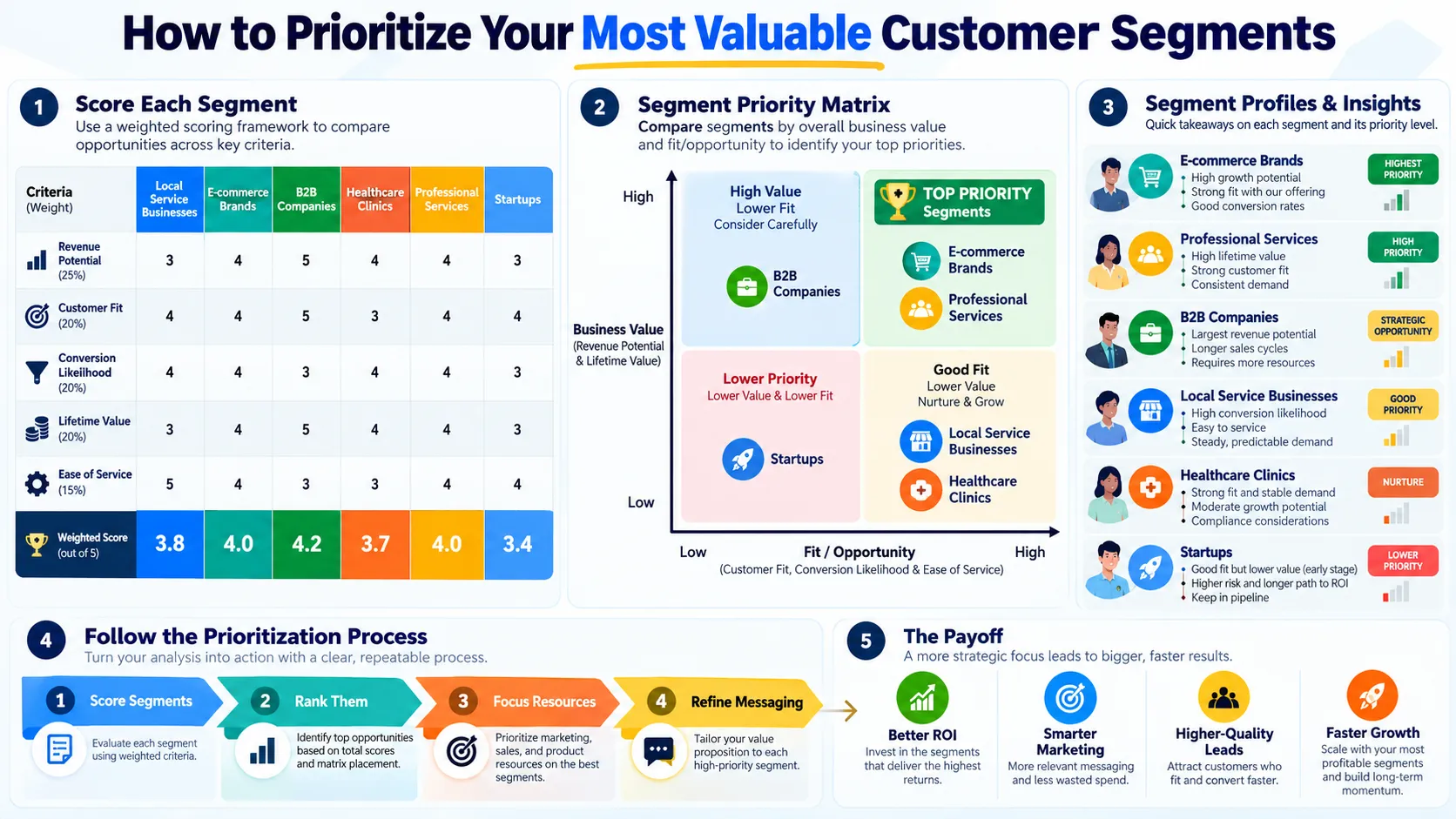
Research may reveal several promising audiences. The next decision is which one to prioritize first.
Consider a small agency that serves ecommerce businesses, professional services, startups, and local retailers. Each segment may need marketing support, but each can differ in budget, competition, buying urgency, sales complexity, and service fit.
A simple scoring model can help make the decision more transparent. Rate each potential segment from 1 to 5 on factors such as problem severity, willingness to pay, accessibility, competitive opportunity, and delivery fit.
Assign higher importance to the factors most relevant to your business. A company with limited capacity might place more weight on delivery fit and customer profitability than on market size alone.
Illustrative Segment-Prioritization Example
The following example uses hypothetical scores to demonstrate the method. It does not represent measured market data.
| Segment | Illustrative assessment |
|---|---|
| Established professional-service firms | Strong fit when the business needs qualified leads, has a realistic service budget, and can be reached through search and professional content |
| Early-stage startups | Potentially attractive when demand is clear, but budgets and purchasing readiness may vary substantially |
| Local retail businesses | Suitable when the offer addresses local discovery, customer acquisition, or ecommerce needs and the agency can deliver within budget |
A real scoring sheet should assign numerical scores and weights based on your actual criteria. Do not choose a segment simply because it appears attractive in theory.
Consider the value of a typical customer, the effort needed to acquire them, the cost of delivery, and the likelihood of repeat business.
The best initial audience is often the group where your offer is most relevant, your proof is strongest, and your team can deliver reliable results.
How to Create a Useful Buyer Persona
A buyer persona translates audience research into a concise profile that helps teams write relevant messages and plan customer experiences.
It should summarize meaningful evidence rather than invent a detailed fictional biography.
Include the Information That Changes Marketing Decisions
For a B2B buyer persona, describe the person’s role, business context, goals, problems, buying authority, objections, preferred evidence, and decision process.
For a consumer persona, describe the purchase context, needs, priorities, budget considerations, relevant habits, and factors that influence trust.
Keep the profile concise enough that employees can use it when creating campaigns, qualifying leads, or planning content.
Separate Facts From Assumptions
Label information according to its evidence. Customer interviews and purchase records may provide direct evidence, while a theory about why a particular audience prefers a certain channel may remain an assumption.
This distinction matters because unsupported assumptions can quietly become the foundation of an entire marketing strategy.
If the team believes customers prefer social media but cannot identify evidence, test that belief with a small campaign or customer interviews before investing heavily in the channel.
Connect the Persona to a Business Action
A useful persona should influence something concrete. It might change the headline on a service page, the examples used in an article, the audience selected for an advertisement, or the questions asked during a sales call.
If a persona does not change a decision, it may contain unnecessary detail.
How to Understand Customer Needs Through Research
Customer needs often become clearer when businesses investigate the full context behind a purchase rather than asking only whether someone likes a product.
Ask About Real Experiences
Ask customers to describe the last time they encountered the problem your product or service solves.
Explore what triggered the search, which alternatives they considered, what they found difficult, and what ultimately influenced the decision.
Specific past experiences generally provide more useful evidence than hypothetical questions such as, “Would you buy this?”
People may express interest in a product without being willing to pay for it. Past behavior, current urgency, budget, and actual purchasing decisions provide important context.
Analyze the Customer Journey
Map the process from recognizing a problem to evaluating solutions, contacting a provider, making a purchase, and using the service.
Identify where customers become confused or lose confidence.
A website visitor might understand the service but struggle to compare packages. A qualified lead might hesitate because the business does not explain its process or expected deliverables. These observations can reveal opportunities to improve messaging and the customer experience.
For related guidance on connecting audience insights with campaigns, explore GrowthAxis Solutions’ Digital Marketing services, which include audience research, content planning, paid campaigns, and measurement.
Identify Purchase Barriers
Common barriers include unclear pricing, limited trust, confusing technical language, uncertainty about results, insufficient proof, and concerns about implementation effort.
The correct response depends on the barrier. More advertising will not necessarily solve a trust problem, and a discount may not solve a confusing offer.
Use customer feedback to identify the actual obstacle, then test an appropriate change.
How Target Audience Research Improves SEO and Content Marketing
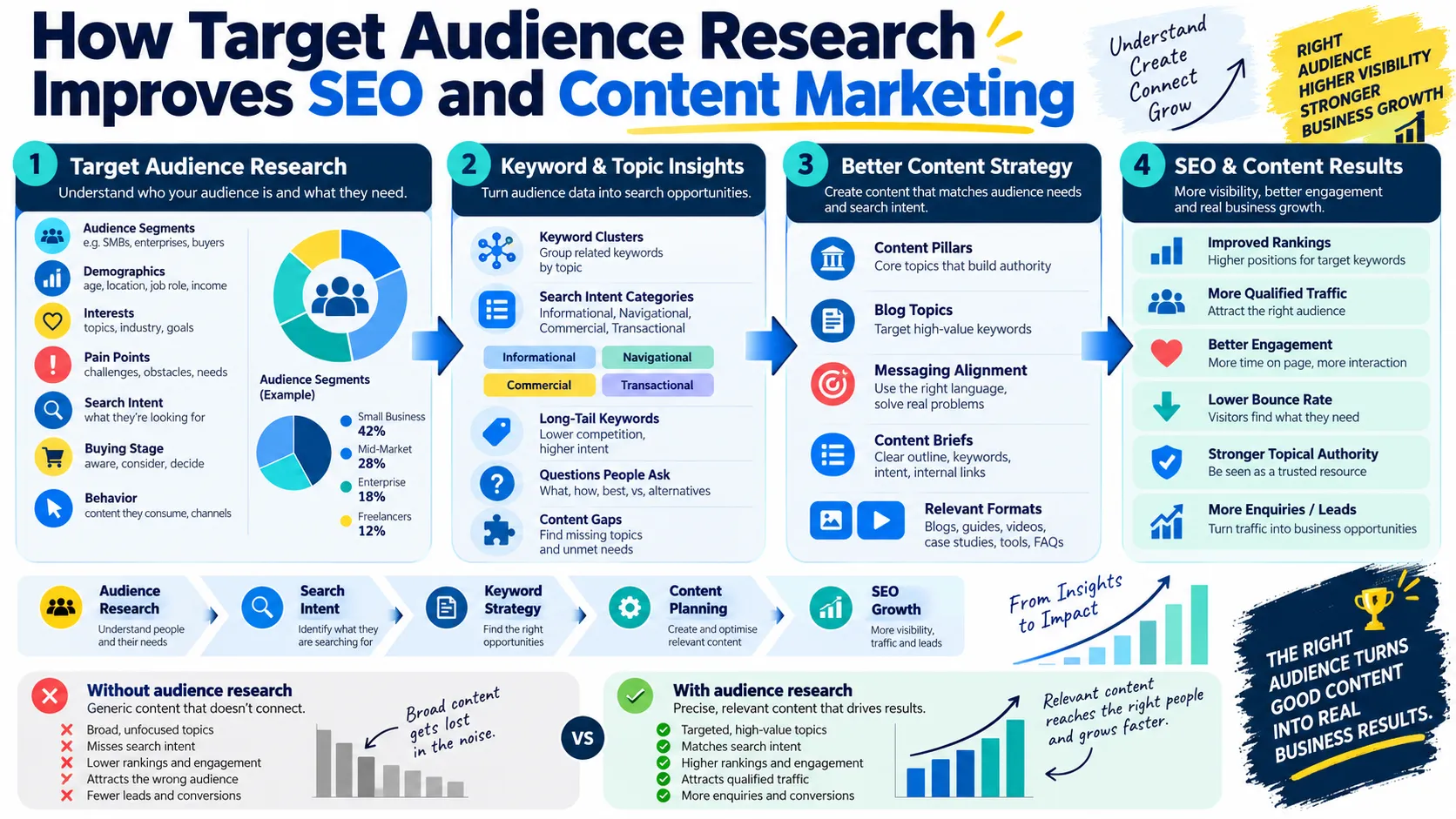
Audience research helps businesses create content around real questions and commercial needs rather than publishing topics solely because they contain popular keywords.
Search queries can reveal different stages of the buying journey. A person searching for a definition may need an educational explanation, while someone comparing agencies may need service criteria, examples, and pricing guidance.
Your content should match that intent.
Build Content Around Customer Questions
Start by collecting questions from sales calls, customer emails, support conversations, keyword research, and search performance data.
Group similar questions into themes, then identify which should be addressed by a broad pillar article and which deserve a focused supporting article.
For example, a digital marketing agency might build educational content around market research, customer segmentation, lead generation, and channel selection. Each article should answer a distinct question and link to relevant resources when those links help the reader.
GrowthAxis Solutions’ SEO Content Strategy for Search and AI Visibility guide explains how to connect search intent, useful content, and internal linking.
Use Audience Language Naturally
The terms customers use to describe a problem can inform article titles, headings, page copy, and calls to action.
However, do not force every phrase into the same page. Select one clear primary topic and use related terms where they genuinely improve the explanation.
The objective is to answer the question well, not to repeat a keyword as often as possible.
Connect Educational Content to Relevant Services
A reader who learns how to define an audience may eventually need help implementing a marketing strategy, launching campaigns, or improving a website.
Contextual internal links create a natural route between educational resources and relevant service pages.
For example, a reader exploring audience research may benefit from learning about Social Media Marketing if social channels suit their customers. A business considering paid audience testing may also explore Google Ads and PPC when search advertising aligns with its goals.
These links should support the reader’s next decision rather than interrupt the article with unrelated promotions.
How to Use Audience Insights in Paid Advertising
Paid advertising can help test audience and message assumptions, but results depend on more than audience settings alone.
An advertisement’s offer, creative, landing page, budget, tracking, competition, and follow-up process can all influence performance.
Start With One Testable Hypothesis
Instead of launching a broad campaign and hoping for results, identify a specific question.
For example, you might test whether established service businesses respond more strongly to a message about increasing qualified enquiries than to one about improving website design.
Keep the offer and other important conditions reasonably consistent while testing the message. This makes the results easier to interpret.
Measure Lead Quality, Not Just Clicks
Clicks show that people interacted with an advertisement. They do not prove that those people are likely to buy.
Review the proportion of leads that meet your qualification criteria, attend consultations, request proposals, and become customers.
If a campaign generates inexpensive leads that rarely progress, the audience or message may be attracting people who are interested but unsuitable.
GrowthAxis Solutions’ Meta Ads service and Google Ads and PPC service provide relevant options for businesses that need campaign execution and optimization. The right service depends on where the audience searches, how it makes decisions, and the business’s conversion readiness.
Common Mistakes to Avoid
Audience research can become misleading when businesses confuse assumptions with evidence or define groups that cannot be reached profitably.
- Targeting everyone: A broad audience makes it harder to develop a clear message or prioritize marketing spending.
- Relying only on demographics: Age, location, or company size rarely explains the complete buying motivation. Combine relevant characteristics with needs and behavior.
- Copying competitors: Competitor research helps identify market conventions, but it cannot prove that another business’s audience or positioning is right for you.
- Creating fictional personas: Detailed personas based on unsupported assumptions can mislead the entire marketing team.
- Ignoring profitability: A segment can generate many enquiries while producing poor margins or demanding more delivery effort than the business can support.
- Using too little evidence: A single customer conversation can reveal a useful question, but it should not automatically determine the entire strategy.
- Confusing engagement with buying intent: Likes, views, and clicks may indicate attention without demonstrating purchase readiness.
- Collecting unnecessary personal data: Research should focus on information that supports legitimate business decisions and respect applicable privacy requirements.
- Never revisiting the audience: Customer needs, competitors, products, and buying behavior can change. Review important assumptions when performance or market conditions shift.
How to Measure Whether Your Target Audience Is Correct
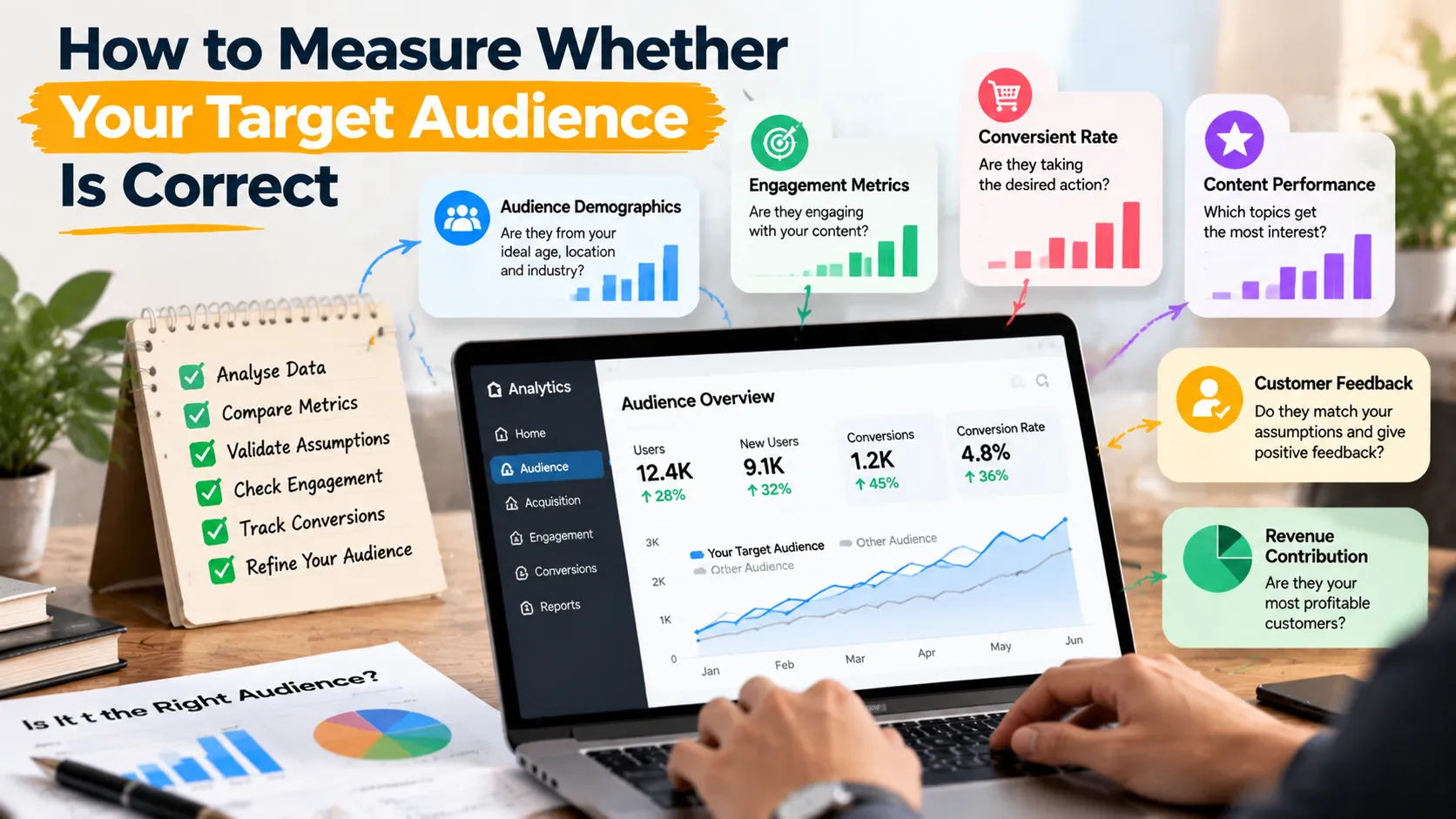
You cannot determine audience quality from a profile document alone. You need evidence from actual marketing and sales activity.
Track Relevant Performance Indicators
Start by measuring how well your marketing reaches the intended audience and how effectively that audience progresses toward a business outcome.
Useful measures may include qualified enquiry rate, conversion rate, cost per qualified lead, sales acceptance rate, customer acquisition cost, repeat purchases, and customer retention.
Supporting indicators such as relevant website visits, search impressions, and engagement can help explain the results, but they should not replace business outcomes.
Establish a Baseline
Record performance before changing the audience or launching a new campaign. Then compare results over a suitable period while accounting for factors such as seasonality, pricing, creative changes, and campaign spending.
Avoid declaring a segment successful based on a small number of enquiries. Look for consistent evidence and consider whether the customers are commercially valuable.
Refine the Audience Based on Evidence
If the audience engages but does not convert, investigate whether the offer, price, trust signals, landing page, or follow-up process creates friction.
If qualified leads convert but the market is too small, consider adjacent segments with similar needs. If the audience is large but lead quality is poor, narrow the qualification criteria or change the message.
The purpose of measurement is to improve decisions, not to defend an original assumption.
A Practical 30-Day Target Audience Research Plan
A small business can use a four-week process to move from assumptions toward a clearer audience definition.
Week 1: Collect Existing Evidence
Review sales records, enquiry forms, customer reviews, website analytics, search queries, and competitor information.
Document the questions you need to answer. Prioritize the uncertainties most likely to affect your offer, pricing, channel selection, or ability to reach profitable customers.
Week 2: Conduct Direct Research
Speak with a manageable group of existing customers and suitable prospects. Use consistent questions to understand their needs, alternatives, decision criteria, and concerns.
The number of interviews should depend on your available resources and how consistently new conversations reveal useful insights. A small exploratory sample can reveal patterns, but it should not be treated as statistically representative of an entire market.
Week 3: Define and Prioritize Segments
Create a short ideal customer profile for the most promising segments. Evaluate problem relevance, purchasing ability, reachability, competition, and delivery fit.
Select one priority audience for an initial marketing test and document why you chose it.
Week 4: Test and Review
Launch a focused experiment, such as a landing page, targeted campaign, or educational content piece.
Track relevant responses and assess their quality. Record what the results support, what remains uncertain, and what you will test next.
This process does not produce a permanently fixed audience. It creates a practical starting point that can improve as the business gathers more evidence.
Expert Tips for Small Business Owners
The strongest audience strategies combine customer understanding with commercial discipline.
First, prioritize customers who receive meaningful value from your offer and whom your business can serve reliably. Market size alone does not determine whether a segment is suitable.
Second, preserve the distinction between evidence and assumptions. Mark uncertain conclusions and design tests that can confirm or challenge them.
Third, use customer research across the organization. Sales teams, support staff, designers, and marketers may each notice different parts of the buying journey. Combining these observations can produce a more complete picture.
Fourth, connect audience research with the business’s wider strategy. Your target customer should influence the offer, website, content, advertising, service delivery, and performance metrics.
Finally, keep the process manageable. A small business does not need perfect information before acting. It needs enough evidence to make a reasonable decision, a way to measure the result, and the willingness to improve when new information appears.
Conclusion
Learning how to identify your target audience helps a small business focus its marketing on people who need its offer and can benefit from it. Start with customer research, define meaningful segments, test your assumptions, and measure qualified business outcomes. Explore GrowthAxis Solutions’ digital marketing services to discuss a practical strategy for reaching and converting the right customers.
Frequently Asked Questions
1. How do I identify my target audience for a small business?
Start by identifying the problem your business solves, reviewing existing customers, and researching potential buyers. Examine relevant demographics, motivations, behavior, purchasing ability, and buying barriers. Group similar customers into segments, prioritize the strongest opportunities, and validate your assumptions through interviews, analytics, or focused marketing tests.
2. What is the difference between a target market and a target audience?
A target market is the broader group of people or organizations likely to benefit from and purchase your offer. A target audience is the specific group you want to reach with a particular message or campaign. One target market can contain several audiences with different needs and buying motivations.
3. What is an ideal customer profile for a small business?
An ideal customer profile describes the type of customer or organization that best fits your offer and business model. It may include industry, company size, customer needs, budget, decision-making authority, urgency, and ability to benefit from your service. A useful profile helps prioritize profitable, suitable customers.
4. How can I research my target audience without a large budget?
Begin with customer interviews, short surveys, sales records, reviews, support questions, competitor research, and free analytics tools. Google Search Console can reveal search queries and website performance, while Google Trends can help compare interest across topics and locations. Choose research methods according to the specific question you need to answer.
5. What are demographics and psychographics in target audience research?
Demographics describe characteristics such as age, income, occupation, and location. Psychographics explore motivations, values, attitudes, interests, and priorities. Combining relevant demographic and psychographic information helps explain not only who potential customers are but also why they may choose a particular product or service.
6. How do I find my target market if my business has no customers yet?
Begin with the problem your product or service solves and identify people or organizations likely to experience it. Research competitors, industry conditions, existing alternatives, pricing, and market demand. Interview potential buyers and test a small offer or campaign before committing significant resources. Treat the initial audience definition as a hypothesis to validate.
7. How many target audiences should a small business have?
There is no universal number. A small business should focus on the segments it can serve effectively and reach through realistic marketing channels. One primary audience may be sufficient initially, while businesses with different products, services, or customer needs may require several distinct audiences and tailored messages.
8. How does target audience research improve digital marketing?
Audience research helps businesses select relevant channels, write clearer messages, develop useful content, improve landing pages, and qualify leads more effectively. It also helps teams measure whether marketing reaches suitable prospects rather than optimizing only for impressions, clicks, or engagement.
9. How often should I update my target audience profile?
Review the profile when customer behavior, market conditions, competition, product offerings, or business results change significantly. A regular performance review can reveal whether the audience remains commercially suitable. Avoid changing the profile after every small fluctuation; look for meaningful patterns and validate important decisions with evidence.
10. Can a digital marketing agency help identify my target audience?
Yes. A suitable agency can help research customer needs, analyze competitors, evaluate search intent, develop customer profiles, select marketing channels, and measure campaign quality. The most useful engagement connects research with clear business decisions and measurable outcomes rather than delivering a persona document without an implementation plan.