
Digital Marketing Strategy for Small Businesses: A Complete Growth Guide
Small businesses do not need to be everywhere online; they need a clear path from discovery to trust, action, and repeat business. A digital marketing strategy makes that path measurable.
A sustainable online presence starts with business goals, not a list of platforms. This guide shows how to define an audience, choose channels, build a conversion-ready website, use SEO and paid media responsibly, measure progress, and execute a practical 90-day plan without wasting limited time or budget.
What Is a Digital Marketing Strategy for Small Businesses?
A digital marketing strategy is a plan that uses online channels to reach business goals. Those goals might include creating leads boosting sales raising brand awareness launching a new service entering a new market or keeping current customers.
A digital marketing strategy is not a list of tactics. Publishing on Facebook running Google Ads sending emails and writing blog posts are tactics. A digital marketing strategy explains why those activities are used, who they aim to reach what action they want to trigger how much they will cost and how success will be measured.
For example a local accounting firm might want to generate consultation requests. Its digital marketing strategy could mix SEO, educational articles, a service landing page Google Search Ads, a downloadable tax checklist and follow-up emails. Each activity is part of the customer journey.
A strong digital marketing strategy usually connects five elements:
- A clearly defined business outcome
- A specific audience and customer problem
- A compelling offer and message
- A focused mix of digital channels
- A measurement and improvement system
The goal is not to use every available platform. The goal is to select the channels that best connect your offer with the people most likely to need it.
Why Small Businesses Need a Clear Digital Marketing Strategy

Small businesses often have less time, fewer employees, and smaller budgets than large brands. That makes prioritisation especially important. Without a clear digital marketing strategy, a business may publish irregularly, change direction every few weeks, spend on advertising without tracking conversions, or focus on followers instead of revenue.
A strategy creates discipline in several ways.
It connects marketing activity to business outcomes
A business should know whether its priority is calls, online purchases, consultation bookings, newsletter sign-ups, store visits, or brand awareness. Different goals require different campaigns and measurements.
It reduces wasted effort
A business does not need to create daily content for every platform. A focused plan may produce one useful article, several short social posts, one video, and a small paid campaign from the same core idea.
It improves customer trust
People often compare several providers before contacting one. Consistent branding, useful information, clear pricing guidance, reviews, case studies, and a professional website help reduce uncertainty.
It makes learning possible
When goals and tracking are defined, you can see which channel produces qualified enquiries and which activity only creates attention. The next campaign can then be based on evidence rather than assumption.
Google recommends creating helpful, reliable, people-first content that provides original value and satisfies a real audience. It also warns against producing large amounts of shallow content simply to attract search traffic.
Start With the Business Goal, Not the Platform
Many businesses begin with a platform question: “Should we use Facebook, Instagram, Google, or TikTok?” A better starting point is: “What business result must marketing create?”
Common small-business goals
- Generate qualified enquiries
- Increase online sales
- Build awareness in a new location
- Promote a new product or service
- Improve repeat purchases
- Reduce dependence on referrals
- Build an email or customer database
- Establish expertise in a niche
A useful goal should be specific and measurable. Instead of saying “get more visibility,” define an outcome such as:
- Increase qualified website enquiries
- Grow organic traffic to service pages
- Generate more calls from a target location
- Improve the conversion rate of a landing page
- Increase repeat purchases from existing customers
Then define a review period. A short-term review cycle allows a small business to learn without expecting every channel to produce immediate revenue.
Define the value proposition
Your value proposition answers one question:
Why should the right customer choose this business instead of another option?
A useful value proposition includes:
- The audience you serve
- The problem you solve
- The outcome you help create
- The reason your approach is credible or different
For Growth Axis Solution, a service-focused message could connect digital marketing, creative production, website development, and software into one growth system rather than presenting them as unrelated services.
Identify Your Target Audience and Customer Journey
A digital marketing strategy becomes stronger when it describes a real customer rather than a broad group such as “everyone who needs marketing.”
Start by defining:
- Industry or business type
- Location
- Company size
- Typical budget
- Main problem
- Buying urgency
- Decision-maker
- Preferred communication channel
- Objections and concerns
A small restaurant, a software startup, and a professional consultancy may all need marketing, but their messages, content formats, buying cycles, and conversion points will be different.
Build a practical customer profile
You do not need a fictional biography with unnecessary details. Focus on information that changes your marketing decisions:
- What does this customer want to achieve?
- What prevents them from achieving it?
- What alternatives are they considering?
- What questions do they ask before buying?
- What evidence would make them trust a provider?
- What action can they realistically take today?
Map the customer journey
Customers may move through four broad stages:
| Stage | Customer question | Useful content |
|---|---|---|
| Discovery | What problem am I facing? | Educational articles, short videos, social posts |
| Evaluation | Which solution is right for me? | Comparisons, checklists, case studies |
| Decision | Why should I choose this provider? | Service pages, testimonials, pricing guidance |
| Retention | How can I get more value? | Onboarding, support content, email follow-up |
Your digital marketing strategy should provide an appropriate answer at each stage. A business that only publishes promotional posts may miss people who are still researching the problem.
Choose a Focused Digital Channel Mix
A practical channel mix should reflect your audience, goals, resources, and buying process.
Search engine optimization
SEO helps people discover your website when they search for problems, services, products, or solutions. It is especially useful for businesses that can answer specific questions or serve clear locations.
SEO work may include:
- Keyword and search-intent research
- Technical website improvements
- Service-page optimisation
- Helpful blog content
- Internal linking
- Local search optimisation
- Digital PR and legitimate authority building
Content marketing
Content marketing turns expertise into useful resources. It can include articles, guides, templates, videos, case studies, newsletters, and social content.
A content marketing agency may help a business research customer questions, develop a topic map, create content briefs, and distribute each piece across several channels.
Social media marketing
Social media is useful for attention, community, education, proof, and direct conversation. It is not a replacement for a website or a complete sales system.
A social media marketing agency can support content planning, creative production, community management, paid campaigns, and performance reporting.
Paid search and paid social
Paid media can create faster visibility, but it requires accurate tracking and a clear conversion path. Search advertising captures existing demand, while social advertising can create or stimulate demand through visual and audience-based targeting.
Email and customer relationship marketing
Email helps a business follow up with leads, educate prospects, announce offers, and encourage repeat purchases. It also gives the business a direct communication channel that is less dependent on changing platform algorithms.
A simple channel selection framework
| Business situation | Recommended starting focus |
|---|---|
| Local service business | Local SEO, Google Business Profile, service pages, reviews |
| New online store | Product pages, social content, paid testing, email capture |
| B2B consultancy | SEO, LinkedIn content, case studies, lead magnets |
| Startup with limited budget | Website foundation, one organic channel, focused experimentation |
| High-value service | Search visibility, proof, consultation landing page, remarketing |
A business should start with a manageable combination rather than launching every channel at once.
Build Content Around Customer Questions
A strong digital marketing strategy requires a content system.
First choose one Pillar topic.
Then create supporting Cluster Content that answers the questions your customers ask.
For example:
Pillar: Digital Marketing Strategy for Small Businesses
Clusters:
- How to Create a 90-Day Digital Marketing Plan
- How Much Should a Small Business Spend on Marketing?
- SEO vs Google Ads
- Lead Generation for Small Businesses
- Digital Marketing KPIs
- Local SEO for Small Businesses
- Social Media Marketing Strategy
- Landing Page Optimisation
The Pillar page gives the broad framework. Each Cluster page answers one specific question in greater detail. The pages should link to one another naturally, using descriptive anchor text.
A useful content brief should include:
- Primary keyword
- Search intent
- Audience
- Main question
- Supporting terms
- H2 and H3 structure
- Internal links
- External references
- Image or video requirements
- Service-related CTA
Do not write several pages that answer the same search intent. If two proposed articles would provide the same answer, combine them or make their purposes clearly different.
SEO and AI Search Visibility

SEO continues to play a role in a digital marketing strategy but just putting keywords in the right spots is not enough. A web page needs to be easy to crawl clear to understand, helpful to users and reliable to trust.
Google says that its AI features follow the basic SEO rules as regular search. There are no extra steps or hidden files required to show up in AI Overviews or AI Mode. Important information should still be, in text backed up with images or videos linked through internal connections and displayed with a great page experience.
Practical SEO priorities
- Match the page to the search intent
- Use one clear primary topic for each URL
- Write a descriptive title and H1
- Use natural related terms and entities
- Answer the main question early
- Organise the page with useful H2 and H3 headings
- Link to relevant service and Cluster pages
- Add original examples, processes, or analysis
- Optimise images without keyword stuffing
- Review performance in Search Console
An AI SEO optimization approach should not mean writing robotic content for machines. It should mean making the information clear enough for both people and search systems to understand.
Use location intelligently
Growth Axis Solution is aimed at the USA, UK, Australia, Canada, Bangladesh and other markets. Therefore do not list every country name on every page. First make a page that’s useful worldwide. Then build a country‑specific page when you can give real local details, such, as market background what customers expect, price points, rules or what services are available.
Google’s Search Essentials and SEO Starter Guide provide the technical and content foundations for discoverability.
Use Google Trends and keyword data correctly
Google Trends can help compare interest by location and time. Google Keyword Planner can provide keyword ideas, average monthly searches, trend information, and location-based historical data. Its advertising Competition score is not an organic SEO difficulty score.
Use Semrush to evaluate:
- Keyword Difficulty
- Search intent
- SERP competition
- Competitor gaps
- Related keywords
- Potential traffic
Use Paid Media as a Controlled Experiment
Paid advertising should not begin with the largest possible budget. Start with a measurable hypothesis.
For example:
- Which audience is most likely to enquire?
- Which service offer creates the strongest response?
- Which landing page converts better?
- Which message attracts qualified traffic?
- Which location produces the best lead quality?
A paid media agency may manage campaign structure, audience targeting, bidding, creative testing, and conversion tracking. A performance marketing agency should focus on measurable outcomes rather than simply increasing impressions or clicks.
Paid campaign fundamentals
Before launching a campaign, prepare:
- One clear offer
- One focused audience
- One relevant landing page
- One primary conversion action
- Accurate conversion tracking
- A realistic testing period
- A plan for handling new leads
Do not send every advertisement to the homepage. A visitor who clicks an ad about SEO should land on a page that directly explains SEO services, outcomes, process, proof, and next steps.
Google Ads and social advertising serve different purposes
Search ads reach people who are actively looking for something. Social advertising can reach people based on interests, behaviour, demographics, or similarity to existing customers.
Neither channel is automatically better. The right choice depends on whether your business needs to capture existing demand, create awareness, generate demand, or retarget people who already interacted with the brand.
Make the Website the Conversion Foundation
A digital marketing strategy often fails because the website does not support the traffic it receives.
Your website should clearly communicate:
- What the business does
- Who it helps
- What problem it solves
- Why it is credible
- What the visitor should do next
A useful service page normally includes:
- Clear headline
- Specific audience and problem
- Explanation of the service
- Process or deliverables
- Relevant proof
- Frequently asked questions
- Strong but natural CTA
- Easy contact method
For Growth Axis Solution, you can connect this article to the Digital Marketing Services, SEO Services, Google Ads Services, Content Marketing Services, and Social Media Marketing Services pages.
You can also connect strategy-related content to Web Development Services when discussing website performance, landing pages, forms, or conversion design.
A Practical 90-Day Implementation Plan
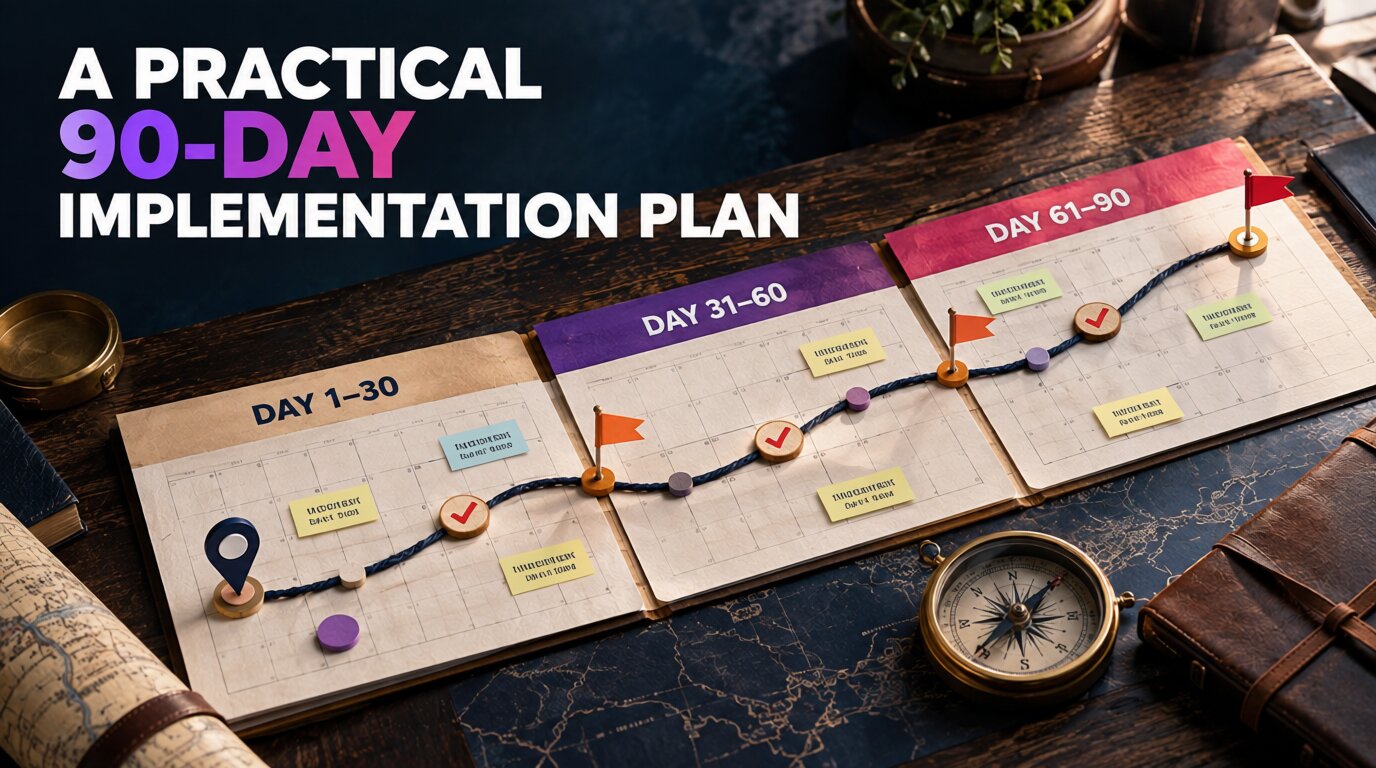
A strategy becomes useful when it can be executed. The following framework gives a small business a practical starting point.
Days 1–30: Build the foundation
During the first month:
- Define one primary business goal
- Identify the highest-value audience
- Clarify the value proposition
- Review competitors
- Audit the website
- Set up analytics and conversion tracking
- Select one or two priority channels
- Create the first content map
- Improve key service pages
- Claim or update relevant business profiles
Do not attempt to solve every marketing problem at once. Focus on the foundations that affect every future campaign.
Days 31–60: Publish and test
During the second month:
- Publish the main Pillar Content
- Publish supporting Cluster Content
- Create social posts from the same topics
- Launch a small paid test if tracking is ready
- Improve calls to action
- Test landing page messages
- Collect customer questions and objections
- Create one useful downloadable resource
- Begin a simple email follow-up sequence
At this stage, the goal is learning. A campaign that produces weak results can still be valuable if it reveals a problem with the audience, message, offer, landing page, or tracking.
Days 61–90: Improve and scale
During the third month:
- Review search impressions and clicks
- Identify high-performing pages
- Improve pages with impressions but low click-through rates
- Review lead quality, not only lead quantity
- Move budget toward better-performing audiences
- Refresh weak content
- Add internal links between related articles
- Publish a case study or practical example
- Document what should be repeated
Search Console can help monitor queries, impressions, clicks, and pages that are beginning to gain visibility. You can use the Google Search Console Performance Report as part of the review process.
How to Set a Sensible Marketing Budget
There is no universal budget that works for every business. A useful budget depends on customer value, margin, sales cycle, location, competition, existing brand awareness, and internal capacity.
Instead of asking only, “How much should we spend?” ask:
- What is one new customer worth?
- What is the acceptable cost per lead?
- How many qualified leads can the sales team handle?
- Which activity requires time rather than cash?
- What amount can be tested without creating financial pressure?
- When will the campaign be reviewed?
Create separate budget categories for:
- Strategy and research
- Website and conversion improvements
- Content and creative production
- SEO
- Paid media
- Software and analytics
- Testing and contingency
A broad digital marketing services list may look impressive, but a focused plan is usually easier to measure. Choose the work that supports the next business milestone.
Measure the Right Performance Indicators
A digital marketing strategy should be evaluated through business outcomes and supporting indicators.
Awareness metrics
- Relevant impressions
- Branded search interest
- Reach within the target audience
- Video completion or engagement
- New users from relevant markets
Consideration metrics
- Engaged sessions
- Service-page views
- Content downloads
- Returning visitors
- Email sign-ups
- Time spent on useful pages
Conversion metrics
- Qualified enquiries
- Calls
- Booked consultations
- Purchases
- Conversion rate
- Cost per qualified lead
- Customer acquisition cost
Retention metrics
- Repeat purchases
- Renewal rate
- Email engagement
- Customer referrals
- Support requests
- Customer lifetime value
Avoid celebrating traffic that does not support a business goal. A smaller number of relevant visitors can be more valuable than a large volume of unqualified traffic.
Common Mistakes to Avoid

Trying to reach everyone
A broad message is often less persuasive than a specific message for a defined customer group.
Publishing without a content system
Random articles may create activity but not topical authority. Use a Pillar and Cluster structure.
Chasing every trend
A topic should fit your audience and service. Google’s people-first guidance warns against publishing about subjects simply because they appear trendy when they do not serve the intended audience.
Using AI without editorial review
AI can support research, outlines, and drafts, but automatically producing many pages without additional value can create quality and spam risks. Review facts, add experience, verify sources, and improve the practical usefulness of every page.
Measuring vanity metrics
Followers, impressions, and likes can be useful signals, but they should not replace lead quality, sales, retention, or profit analysis.
Sending all traffic to one page
Different audiences and offers require different landing experiences. Match the page to the promise made in the content or advertisement.
Ignoring the customer experience after conversion
A lead-generation campaign is incomplete if nobody responds quickly, records the enquiry, or follows up consistently.
Pro Tips for a More Effective Strategy
Turn one idea into multiple assets
A strong Pillar article can become:
- A LinkedIn post
- A short video
- A carousel
- A newsletter
- A checklist
- A sales conversation
- A webinar outline
- A frequently asked question
This creates consistency without copying the same text everywhere.
Build a proof library
Collect:
- Customer questions
- Before-and-after examples
- Campaign lessons
- Screenshots
- Testimonials
- Process photographs
- Results that can be verified
- Common objections
Real evidence makes content more trustworthy than generic claims.
Use a testing log
For each campaign, record:
- Hypothesis
- Audience
- Offer
- Creative
- Landing page
- Budget
- Conversion event
- Result
- Decision
This prevents repeated mistakes and improves future campaigns.
Select an agency based on the problem
A business may need different expertise at different stages. A digital marketing business may provide strategy, but you should ask whether it can also explain measurement, content quality, website conversion, and follow-up.
Ask potential partners:
- What business outcome will you prioritise?
- How will you define a qualified lead?
- What will be measured?
- Which work will happen first?
- How often will reporting occur?
- What assumptions are being made?
- How will you protect access to accounts and data?
Growth Axis Solution can present its combined digital marketing solutions through strategy, SEO, content, creative, website development, paid media, and software support. The strongest positioning is not “we do everything”; it is “we connect the parts that help the business grow.”
Conclusion
A successful digital marketing strategy gives a small business focus, consistency, and a way to learn from every campaign. Start with one business goal, understand one valuable audience, choose a manageable channel mix, build useful content, improve the website, and measure qualified outcomes. Growth Axis Solution can help turn that plan into practical digital marketing solutions for businesses in the USA, UK, Australia, Canada, Bangladesh, and other markets. Contact Growth Axis Solution to discuss your next growth project.
Frequently Asked Questions
1. What is the best digital marketing strategy for a small business?
The best approach depends on the business model, audience, location, budget, and buying process. Most small businesses should begin with a clear website, a specific value proposition, search visibility, one suitable social channel, reliable conversion tracking, and a consistent follow-up process. The right strategy is the one that connects marketing activity to a measurable business outcome.
2. How much does a digital marketing strategy cost?
The cost depends on the work required, the competitiveness of the market, the number of channels, the amount of content, website improvements, creative production, and advertising budget. A small business can begin with a focused foundation and expand as it learns. Strategy, production, media spending, and software costs should be planned separately.
3. Should a small business invest in SEO or Google Ads first?
SEO is useful for long-term visibility and trust, while Google Ads can create immediate exposure for relevant searches. A business with urgent lead needs may test paid search while building its SEO foundation. The decision should consider competition, budget, conversion readiness, and how quickly the business needs results.
4. How long does digital marketing take to produce results?
The timing varies by channel, competition, website quality, budget, offer, and execution. Paid campaigns can generate early data, while SEO and content marketing often require more time to build visibility and authority. A responsible plan should define early learning milestones rather than promise a guaranteed ranking or revenue result.
5. How many social media platforms should a small business use?
Start with the platforms where the target audience is most likely to pay attention and take action. One or two well-managed channels are usually better than several neglected profiles. The decision should also consider the business’s content strengths, such as video, education, visual design, community discussion, or professional insight.
6. What should a small business publish on its blog?
Publish content that answers real customer questions, explains decisions, compares options, demonstrates expertise, and helps prospects move toward an informed action. A Pillar and Cluster structure can organise broad guides and focused articles. Content should be original, accurate, useful, and connected to relevant services.
7. Is AI-generated content good for SEO?
AI can help with research, outlining, editing, and content workflows. It should not replace fact-checking, experience, expert review, or original analysis. Pages created primarily through automation without meaningful value may create quality and policy risks. Human review is essential before publication.
8. What is the role of a business website in digital marketing?
The website is the central place where visitors learn about the business, evaluate trust, understand services, and take action. Social media and advertising can attract attention, but the website should provide the complete explanation, proof, conversion path, contact options, and measurement points.
9. How can a small business measure marketing success?
Measure metrics that reflect the business goal. These may include qualified leads, sales, conversion rate, cost per lead, customer acquisition cost, repeat purchases, and revenue. Supporting indicators such as impressions and traffic help explain performance, but they should not replace business outcome analysis.
10. When should a business hire a digital marketing agency?
An agency can be useful when the business lacks internal expertise, has inconsistent marketing activity, cannot measure campaign performance, needs a stronger website, wants to enter a new market, or has traffic without enough enquiries. Choose a partner that explains priorities, measurement, responsibilities, and realistic expectations clearly.