
Local SEO for Small Businesses: Complete Guide
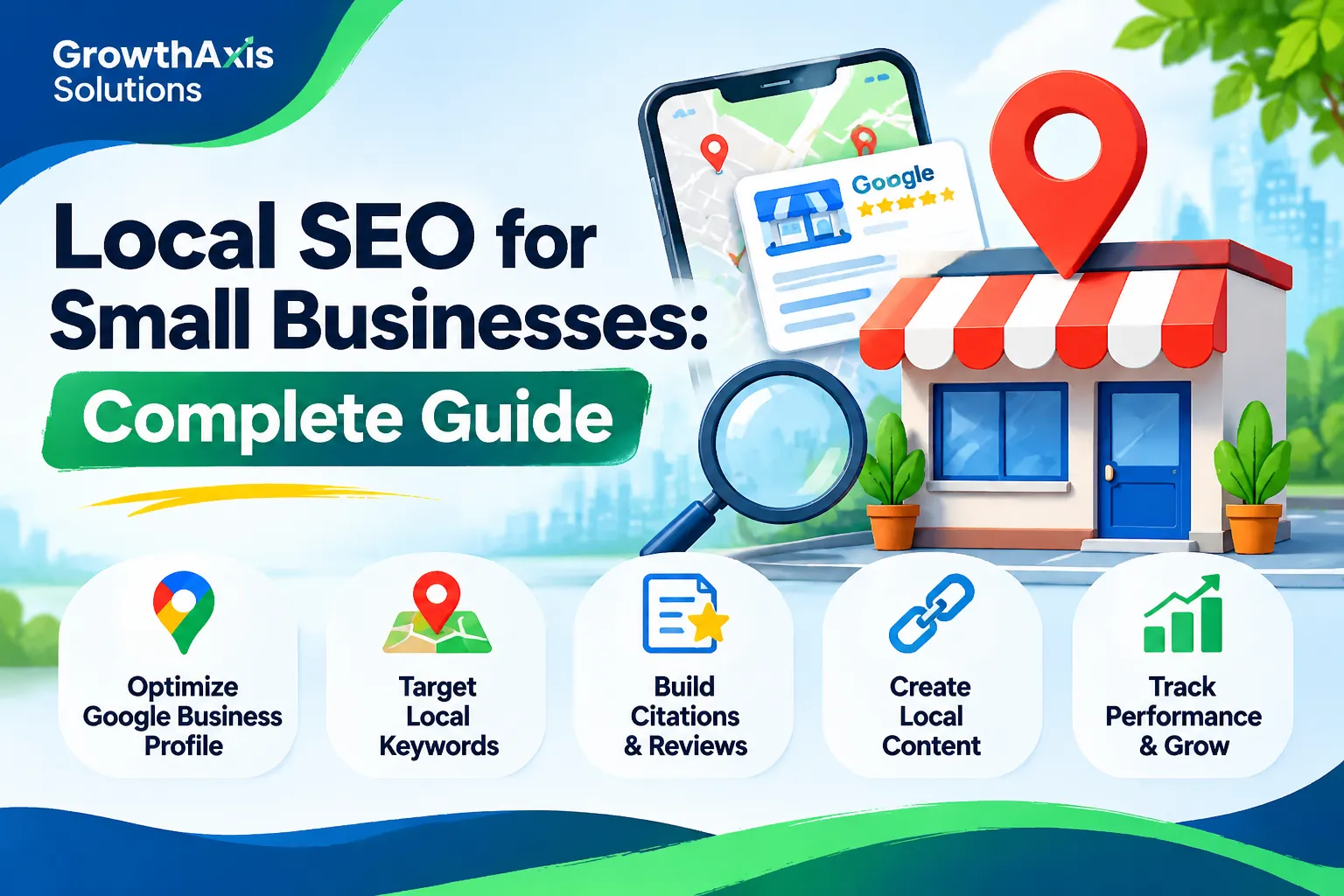
Want more customers from your local area? Local SEO for small businesses helps people discover your services, compare local providers, and contact your business when they need you.
This guide explains how small businesses can improve local search visibility, optimize Google Business Profile, attract genuine reviews, build local authority, and turn search traffic into customers. You will also learn practical strategies, advertising options, measurement methods, and common mistakes that can limit local growth.
What Is Local SEO and Why Does It Matter for Small Businesses?
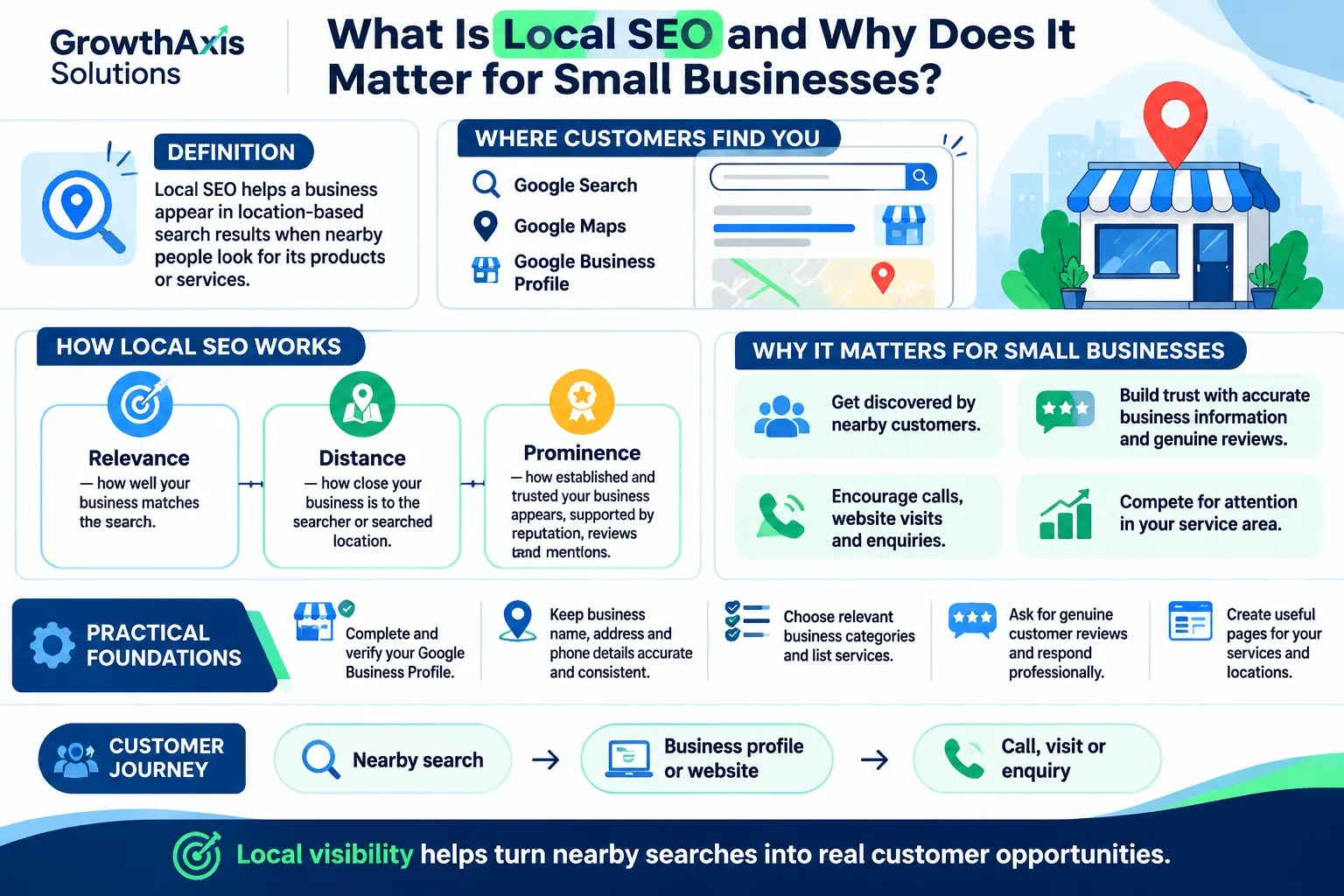
Local SEO is the process of improving a business’s visibility in location-based search results. It helps nearby customers discover relevant businesses when they search for products or services in a particular city, neighborhood, or service area.
For example, someone searching for an electrician in Dallas may see Google Maps listings, local businesses, service pages, reviews, and other relevant results.
A business with accurate information, relevant services, useful website content, and a trustworthy online reputation has a better opportunity to reach those customers.
Unlike traditional SEO, which can target audiences across an entire country or internationally, local optimization focuses on geographic relevance and customer proximity.
However, local SEO is not limited to Google Maps. It includes your website, business directories, customer reviews, location-specific content, local backlinks, and other online platforms where potential customers discover businesses.
How Does Local SEO Work?
Google explains that local search results mainly depend on three factors: relevance, distance, and prominence.
| Factor | Meaning | Practical Example |
|---|---|---|
| Relevance | How closely a business matches the search | An electrician’s profile should accurately describe electrical services |
| Distance | How far the business is from the searcher or relevant location | A nearby plumber may be more relevant than one several miles away |
| Prominence | How well-known and established the business appears | Reviews, links, and broader business recognition can contribute |
Source: Google’s official local ranking guidance.
These factors work together. A business cannot guarantee first-place rankings by adding more keywords or purchasing backlinks. Google determines which results best match a searcher’s needs.
Why Small Businesses Need Local Search Visibility
Small businesses often compete with established companies that have larger advertising budgets and stronger brand recognition.
Local search gives smaller companies another way to reach customers who already need their services.
Consider a small plumbing company in Manchester. Instead of competing for a broad national keyword such as plumbing services, it can develop useful service pages, maintain an accurate Business Profile, and build recognition among customers in its actual service area.
Local search visibility can help businesses:
- Reach people actively searching for nearby services.
- Increase relevant website visits and phone enquiries.
- Build trust through genuine customer feedback.
- Explain services, prices, opening hours, and service areas.
- Compete with larger businesses through geographic relevance.
- Develop a more predictable source of customer enquiries.
The important distinction is between website traffic and business results. A thousand visitors who live outside your service area may have less commercial value than twenty visitors who are ready to request a quotation.
How to Build a Local SEO Strategy for Small Businesses
An effective local strategy starts with understanding your customers, services, competitors, and geographic coverage.
Before changing website content or publishing new location pages, identify what customers actually need and how they search for those services.
Step 1: Understand Your Local Customers
Start by identifying the people most likely to purchase from your business.
Ask:
- Which locations generate the most valuable customers?
- What services do customers request most frequently?
- What problems encourage people to contact your business?
- Which questions do customers ask before making a purchase?
- What makes customers choose your business over competitors?
For example, a residential cleaning company may attract customers searching for deep cleaning, move-out cleaning, recurring house cleaning, or emergency cleaning.
These searches represent different needs. Each may require a different landing page or content section.
Step 2: Research Local Search Keywords
Keyword research helps you understand how customers describe their problems and services.
Start with your main services, then add geographic modifiers and question-based variations.
| Keyword Type | Example | Search Intent |
|---|---|---|
| Service keyword | Emergency plumber | Immediate service need |
| Location keyword | Plumber in Austin | Local commercial |
| Question keyword | How much does plumbing repair cost? | Informational |
| Comparison keyword | Local plumber vs national plumbing company | Commercial investigation |
| Near-me keyword | Emergency plumber near me | High local intent |
Use Google Keyword Planner, Google Search Console, Google autocomplete, and competitor research to identify relevant opportunities.
Do not select keywords based on search volume alone. A keyword with lower search volume may produce more qualified leads if it describes a service that your business provides.
For further guidance, Google’s SEO Starter Guide explains how to create content that helps search engines understand your pages.
Step 3: Map Keywords to Relevant Pages
Assign each important search topic to the most suitable page.
For example:
| Search Topic | Recommended Page |
|---|---|
| Local plumbing services | Main plumbing service page |
| Emergency plumbing repair | Emergency plumbing landing page |
| Plumbing costs | Educational blog article |
| Plumbing services in Austin | Austin location page, if genuinely served |
| How to prevent pipe leaks | Informational blog article |
This structure prevents several pages from competing for the same search intent.
It also creates a logical path from informational content to service pages.
Step 4: Analyze Local Competitors
Search for your main services and locations using Google Search and Maps.
Review businesses that consistently appear for relevant searches.
Look at:
- Their primary and additional business categories.
- Services listed on their profiles.
- Website page structure.
- Customer review patterns.
- Local backlinks and business mentions.
- Content covering customer questions.
- Location coverage.
- Contact and booking options.
Do not copy competitor content. Identify what customers still need to know and create a more useful resource.
How to Optimize Google Business Profile for Better Local Visibility
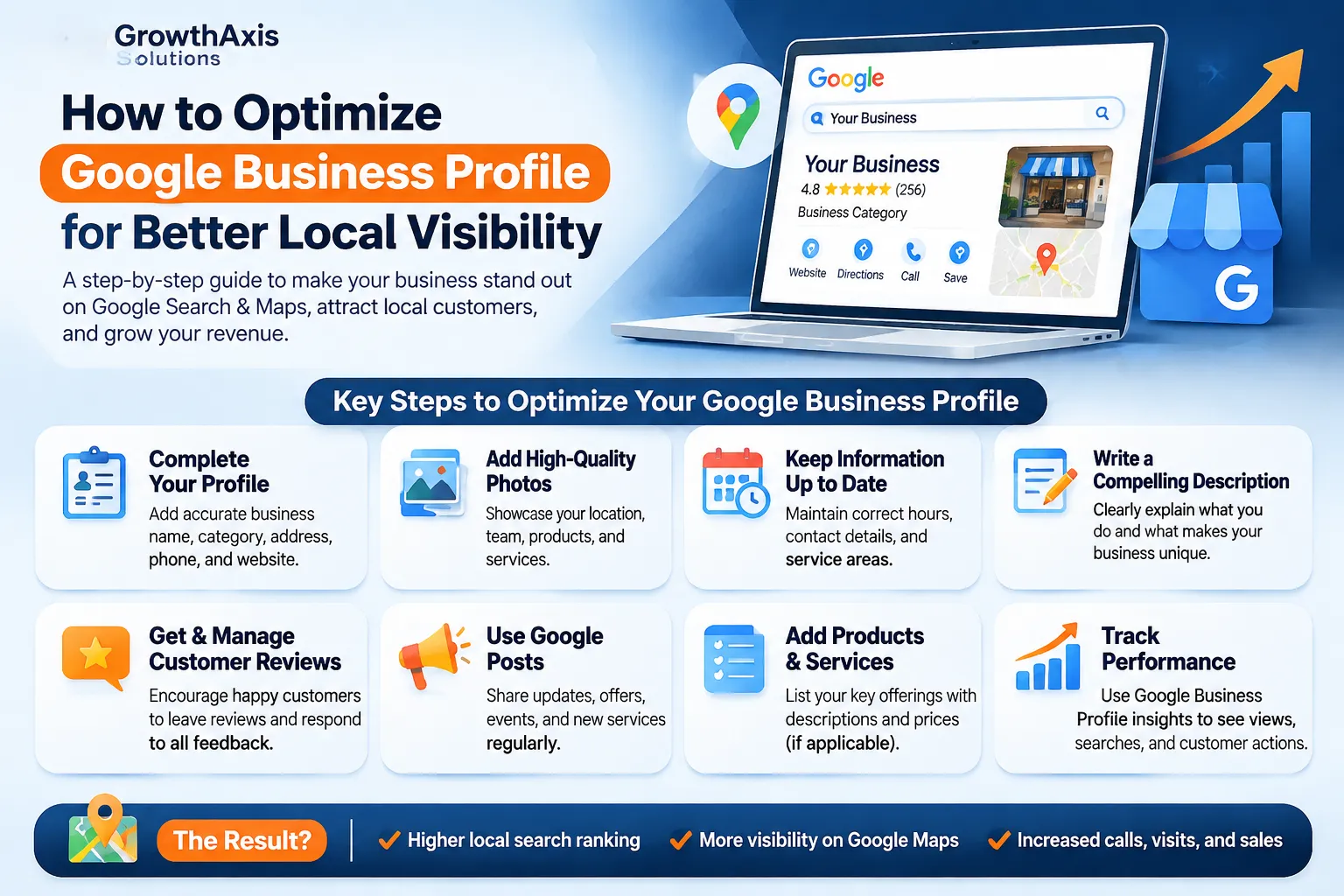
Google Business Profile is one of the most important assets for eligible businesses with a physical location or qualifying service-area operation.
It allows businesses to manage information that may appear across Google Search and Maps.
An incomplete profile can leave customers without important information about your services, operating hours, location, and contact details.
Essential Google Business Profile Optimization Tasks
Focus on the following improvements:
- Business name: Use your real-world business name without adding unnecessary keywords.
- Primary category: Select the category that best describes your main business activity.
- Additional categories: Add relevant categories only when they accurately describe your services.
- Business description: Explain what you offer, who you help, and which areas you serve.
- Address: Provide an accurate address when eligible to display one.
- Service areas: Identify the areas where your business genuinely operates.
- Opening hours: Keep regular and special hours accurate.
- Phone number: Use a working business contact number.
- Website: Link to the most relevant website landing page.
- Services: Add accurate service descriptions.
- Photos: Upload genuine images of your premises, team, products, and completed work.
Google provides detailed instructions through its Business Profile Help Center.
How to Choose the Right Business Category
Your primary category should represent the main service or business type.
For example:
A company that primarily provides residential electrical repairs should select an appropriate electrician category rather than a broader category that does not describe its core activity.
Additional categories should reflect genuine secondary services.
Adding unrelated categories can confuse customers and weaken the accuracy of your business information.
How Often Should You Update Your Business Profile?
Update your profile whenever important business information changes.
You should also review it regularly to check for incorrect details, customer questions, service changes, and new photographs.
Google Business Profile posts can communicate offers, events, announcements, and updates. However, publishing frequent posts should not be treated as a guaranteed ranking technique.
The main purpose is to give customers accurate and useful information.
How to Optimize Your Website for Local Search
Your website should explain what your business does, where you operate, and how customers can use your services.
A well-organized website also helps search engines understand the relationship between your services, locations, and business identity.
Create Dedicated Service Pages
Each major service should have a dedicated page when the service has a distinct customer need and enough useful information to justify its own page.
For example, an HVAC company might create separate pages for:
- Air conditioning installation.
- Heating system repair.
- HVAC maintenance.
- Emergency HVAC services.
Each page should explain the service, its benefits, common problems, service process, and relevant customer questions.
Avoid creating multiple nearly identical pages that only replace the city name. Such pages provide little additional value.
Create Useful Location Pages
Location pages help explain where your business operates.
A useful location page should include:
- The specific geographic area served.
- Services available in that location.
- Local customer needs and relevant information.
- Genuine project examples, where available.
- Relevant photographs.
- Clear contact and enquiry options.
For example, a roofing company serving several communities may create separate pages when each location has meaningful service information and distinct customer needs.
Do not claim a physical office in a city where your business has no genuine presence.
Optimize Titles, Headings, and Content
Your page title should describe the page clearly.
Example:
Title: Emergency Plumber in Austin | 24-Hour Plumbing Repair
H1: Emergency Plumbing Services in Austin
H2: Common Plumbing Emergencies We Handle
H2: When Should You Call an Emergency Plumber?
H2: Our Plumbing Repair Process
H2: Frequently Asked Questions
Use location terms naturally when they help clarify the service. Avoid repeating the same city and keyword in every heading.
Improve Mobile Website Experience
Many local customers search while travelling, shopping, or dealing with an immediate service problem.
Your website should make it easy to:
- Find your telephone number.
- Request a quotation.
- View opening hours.
- Understand available services.
- Read important information without excessive scrolling.
- Submit a contact form on a mobile device.
Check mobile usability and Core Web Vitals through Google PageSpeed Insights.
A mobile-friendly website can improve the customer experience, although passing a particular performance score does not guarantee higher rankings.
How to Build Local Authority Through Reviews and Citations
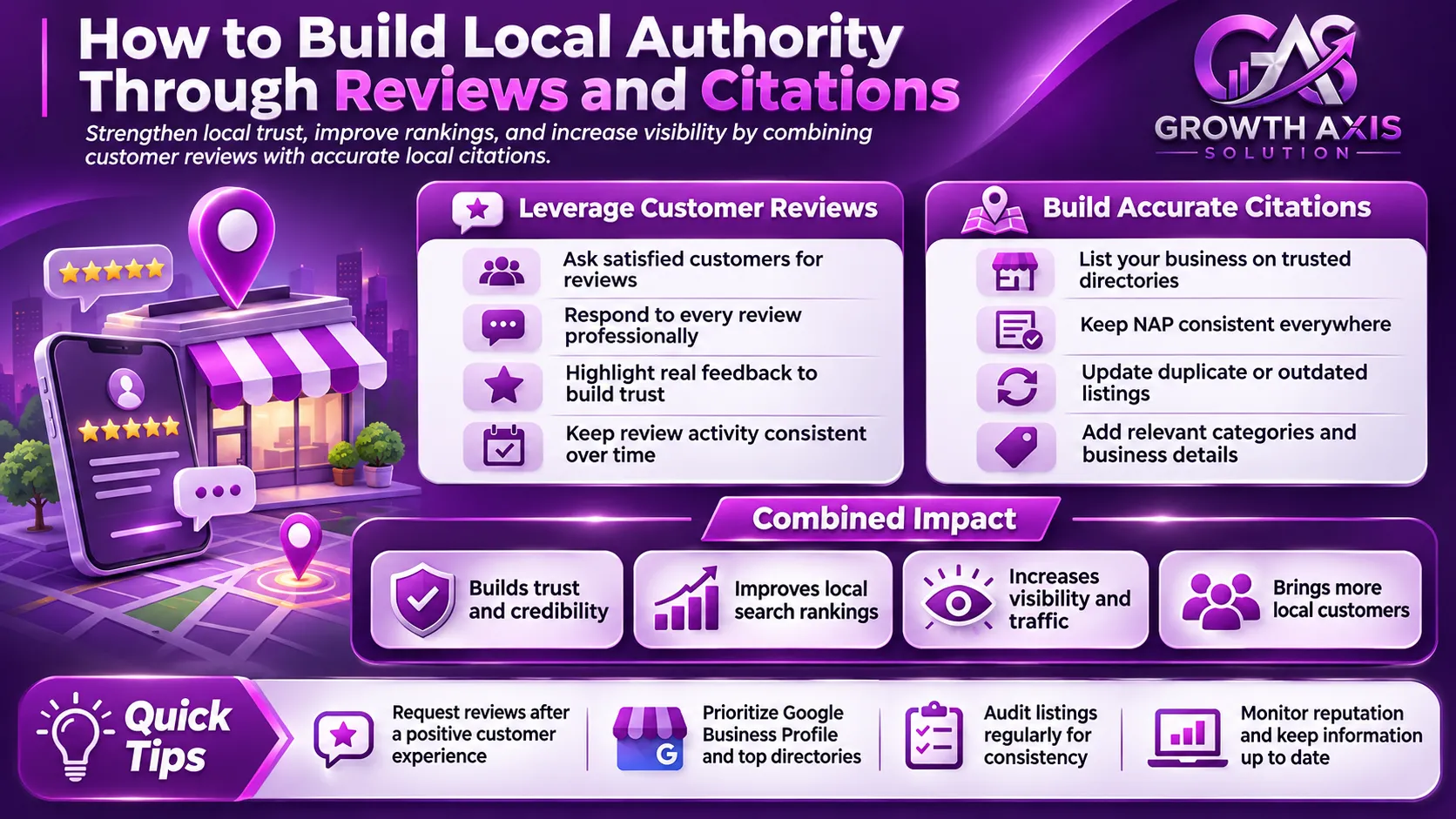
Customers often compare several businesses before contacting one. Reviews and consistent business information can help them understand which company deserves consideration.
Build a Genuine Customer Review Strategy
Ask customers for honest feedback after completing a service or transaction.
You can request reviews through:
- Follow-up emails.
- SMS messages.
- Receipts.
- QR codes.
- Customer service conversations.
- Post-purchase communication.
Make the process simple. Customers should be free to share positive or negative experiences.
Respond to reviews professionally.
A useful response should acknowledge the customer’s experience, address specific concerns where appropriate, and offer a practical way to resolve an issue.
Never purchase reviews, create fake customer accounts, or offer rewards in exchange for positive ratings.
Google’s contribution and review policies explain prohibited review practices.
Maintain Consistent NAP Information
NAP means Name, Address, and Phone Number.
These details should be accurate and consistent across your website, Business Profile, and relevant directories.
For example, if your business operates under the name ABC Plumbing Services, avoid using several unrelated business names across directory listings.
Check the following platforms where relevant:
- Google Business Profile.
- Apple Business Connect.
- Bing Places.
- Yelp.
- Facebook.
- Industry-specific directories.
- Local business associations.
Not every directory deserves your attention. Prioritize trusted platforms that customers actually use in your market.
Build Relevant Local Backlinks
Local backlinks are links from relevant websites that help people discover your business.
Potential opportunities include:
- Local newspapers.
- Business associations.
- Community organizations.
- Industry publications.
- Local event websites.
- Relevant business partners.
- Genuine sponsorship and community projects.
For example, a local landscaping company could sponsor a community gardening event. If the event organizer publishes a relevant page mentioning the company and linking to its website, the mention can provide referral traffic and support online visibility.
Avoid buying large quantities of unrelated backlinks. Link relevance and editorial quality matter more than raw link counts.
Local SEO vs Paid Advertising: Which Is Better for Small Businesses?
Local SEO and paid advertising serve different marketing purposes.
Local SEO focuses on earning organic visibility over time. Paid advertising provides access to advertising placements through a campaign budget.
A small business should select its marketing mix according to its budget, sales cycle, competition, and immediate growth requirements.
| Comparison | Local SEO | Google Ads | Facebook Ads |
|---|---|---|---|
| Main purpose | Organic local discovery | Capture search demand | Reach selected audiences |
| Traffic cost | No charge per organic click | Pay for advertising clicks or other actions | Pay for campaign delivery |
| Speed | Usually takes time | Can start quickly after approval | Can start quickly after approval |
| Customer intent | Varies by search | Often strong for service searches | Depends on audience and creative |
| Long-term value | Can build lasting visibility | Requires ongoing budget | Requires ongoing budget |
| Best use | Sustainable local discovery | Immediate search demand | Awareness and lead generation |
When Should a Business Use Local SEO?
Local SEO is useful when a business wants to build visibility for recurring customer searches.
It works well for:
- Restaurants.
- Home service companies.
- Healthcare practices.
- Retail stores.
- Legal practices.
- Beauty and wellness businesses.
- Local professional services.
When Should a Business Use Paid Advertising?
Paid advertising can help when a business needs faster exposure, wants to test a new service, or needs to generate enquiries during a specific campaign period.
For example, a newly opened dental practice may use Google Ads to reach people searching for emergency dental appointments while building its organic local visibility.
Can Local SEO and Advertising Work Together?
Yes. Combining organic search and advertising can help businesses reach customers at different stages of their buying journey.
A company can use Google Ads to test which services generate qualified enquiries, then use those insights to improve its service pages and local content.
It can also use facebook ads for local businesses to promote community events, seasonal offers, and selected services.
How to Use Digital Marketing to Generate More Local Leads
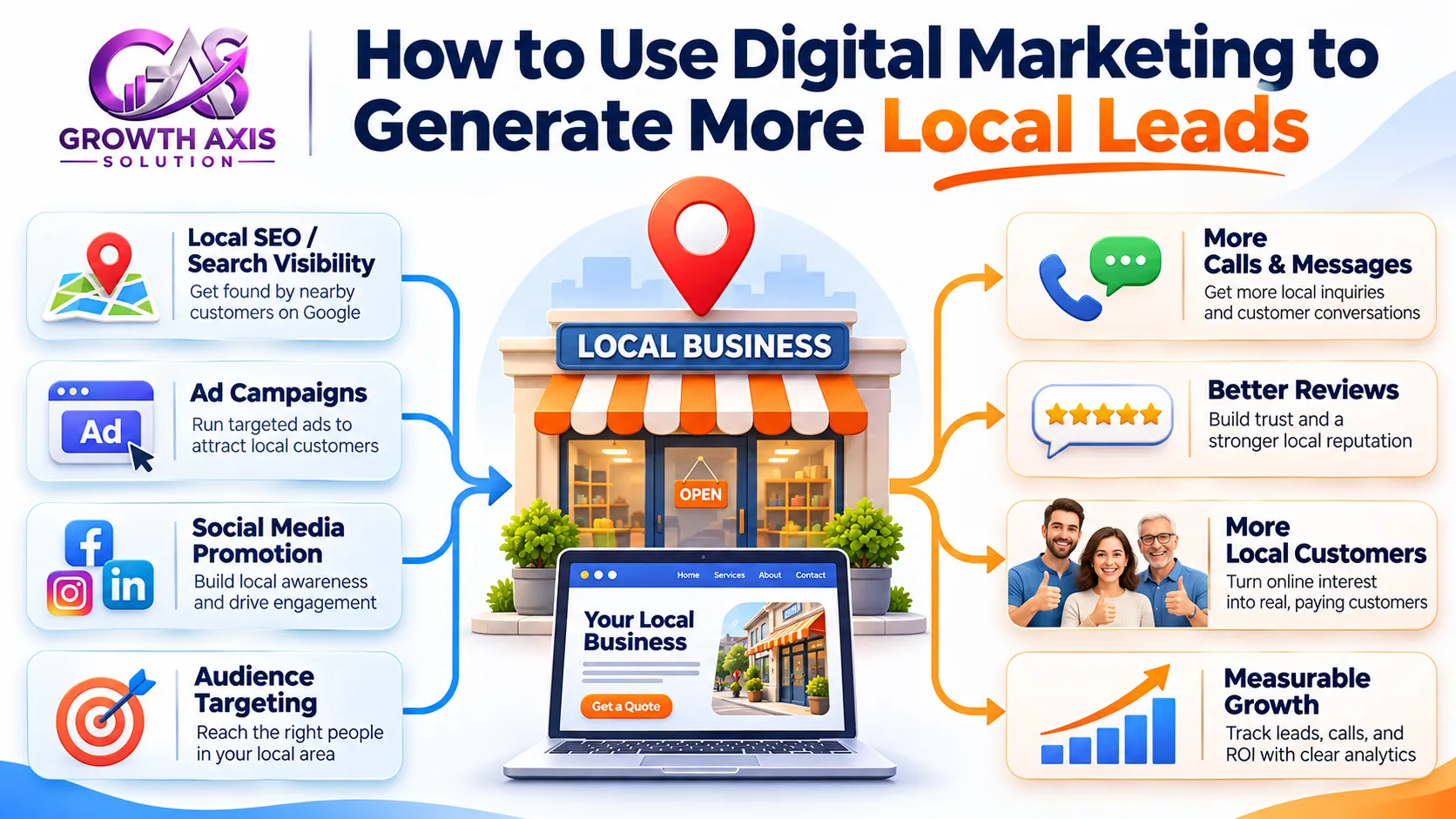
Local visibility is useful only when it helps people take meaningful action.
A strong strategy connects search discovery with an easy customer journey.
Improve Your Lead Generation Process
Start by identifying the action you want customers to take.
Depending on your business, this may include:
- Calling your business.
- Requesting a quotation.
- Booking an appointment.
- Visiting your premises.
- Completing a contact form.
- Purchasing a product.
Your landing pages should explain the next step clearly.
For example, a local roofing company should provide information about roofing services, service locations, project examples, and how customers can request an inspection.
This creates a more useful experience than sending every visitor to a generic homepage.
Use Social Media to Support Local Discovery
Social media can help customers discover your business and understand the services you provide.
facebook advertising for local businesses can support local campaigns by reaching relevant audiences within selected geographic areas.
Useful content includes:
- Before-and-after project photographs.
- Customer education videos.
- Product demonstrations.
- Local event announcements.
- Seasonal promotions.
- Frequently asked customer questions.
influencer marketing for small business can also support awareness when you work with creators who have a genuine audience in your service area.
For example, a local restaurant could collaborate with a food creator who regularly produces content about restaurants in the same city.
Choose creators based on audience relevance, content quality, and genuine engagement rather than follower count alone.
Develop a Practical Lead Generation Strategy
Businesses that want to generate leads for local business should connect their website, search presence, social media, and enquiry process.
A practical approach includes:
- Identify your most profitable services.
- Create dedicated landing pages.
- Optimize your Google Business Profile.
- Publish useful educational content.
- Build a genuine review strategy.
- Use paid advertising where appropriate.
- Track calls, forms, and booked appointments.
- Improve the process using actual customer data.
An effective lead generation for small business strategy focuses on lead quality rather than simply increasing enquiry volume.
How to Measure Local SEO Performance
You need reliable data to understand whether your work is producing business results.
Do not evaluate success only by checking whether your website appears first for one keyword.
Local search results can change according to the searcher’s location, device, query, and competition.
Important Local SEO Metrics
| Metric | What It Measures | Where to Check |
|---|---|---|
| Google Business Profile interactions | Customer activity on your profile | Business Profile Performance |
| Organic clicks | Visits from organic Google results | Google Search Console |
| Organic impressions | How often pages appear in Google Search | Google Search Console |
| Local keyword positions | Visibility for selected geographic searches | Local rank tracking tools |
| Phone enquiries | Calls generated through your marketing | Call tracking and CRM |
| Form submissions | Website enquiries | GA4 and CRM |
| Conversion rate | Percentage of visitors who take an intended action | Google Analytics 4 |
| Lead quality | Whether enquiries match your target customers | CRM and sales records |
Use Google Search Console to identify queries and pages receiving impressions and clicks.
Use Google Analytics 4 to understand website engagement and track meaningful conversions.
For phone leads, consider call tracking. Use appropriate consent and privacy practices, especially when serving customers in the UK, EU, or other regulated markets.
Build a 90-Day Local SEO Action Plan
Small businesses can organize their initial optimization work into three stages.
| Period | Main Activities | Expected Deliverables |
|---|---|---|
| Days 1–30 | Audit, keyword research, profile optimization, technical checks | Baseline report and optimized business information |
| Days 31–60 | Service pages, location content, review process, citation cleanup | Improved website structure and local relevance |
| Days 61–90 | Local outreach, content improvements, conversion tracking | Performance analysis and next-step priorities |
These periods represent a working plan, not a ranking guarantee. Actual results depend on competition, implementation quality, business history, and market conditions.
Common Local SEO Mistakes Small Businesses Should Avoid
Many businesses spend time on activities that produce little value because they focus on shortcuts instead of customer needs.
Watch out for these problems:
- Keyword stuffing: Repeating city names and service keywords unnaturally makes content difficult to read.
- Fake reviews: Purchased or fabricated reviews can damage trust and violate platform policies.
- Duplicate location pages: Publishing near-identical pages for multiple cities adds little value.
- Incorrect business information: Conflicting telephone numbers, addresses, or opening hours can confuse customers.
- Unrelated backlinks: Links from irrelevant websites provide little value and may introduce risk.
- Ignoring customer feedback: Unanswered complaints can discourage potential customers.
- Neglecting mobile users: Difficult navigation and inaccessible contact details can reduce enquiries.
- Tracking rankings alone: A ranking improvement does not automatically mean more customers.
- Unnecessary paid directories: Paying for listings without checking their relevance or audience can waste money.
- Overpromising results: No agency can guarantee a specific Google position or a fixed number of leads.
The better approach is to prioritize accurate information, helpful content, genuine reputation signals, and measurable business outcomes.
Pro Tips for Improving Local Search Visibility
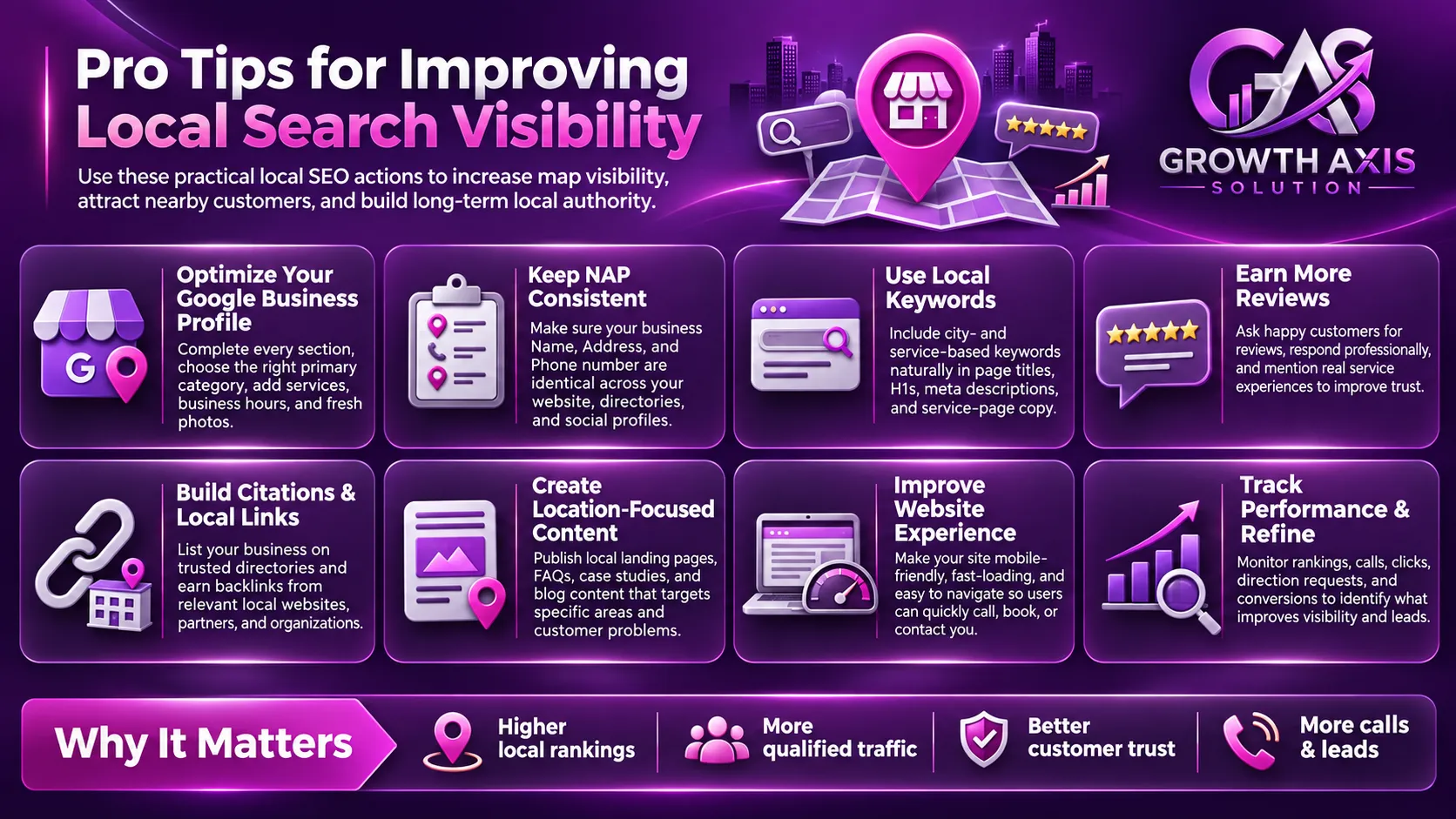
A few additional practices can make your strategy more useful and easier to manage.
1. Create Content Around Real Customer Questions
Look at customer emails, calls, sales conversations, and frequently asked questions.
If customers regularly ask about service costs, preparation requirements, or repair timelines, create pages that answer those questions.
For example, a roofing company could publish a guide explaining what affects roof replacement costs.
This gives customers useful information before they request a quotation.
2. Use Original Photographs and Project Examples
Original images can help customers understand the quality and nature of your work.
A home renovation company could publish photographs showing completed kitchens, bathrooms, and flooring projects.
Include accurate descriptions and relevant context. Avoid presenting stock photographs as genuine customer projects.
3. Improve Your Internal Linking Structure
Connect educational blog articles to relevant service pages.
For example, an article explaining common website indexing problems can link to your Technical SEO services page when discussing professional technical support.
Similarly, an article explaining how customers discover brands through AI-powered search can link to your AI Search Optimization services page.
For local search support, readers can explore GrowthAxis Solutions’ Local SEO services.
Use descriptive anchor text that explains the destination. Avoid forcing service links into unrelated paragraphs.
4. Understand the Difference Between Traditional Search and AI Search
Customers increasingly use different platforms to research businesses.
A business should maintain clear information about its identity, services, expertise, and locations across relevant online sources.
You can improve information clarity through:
- Accurate business descriptions.
- Dedicated service pages.
- Clear company information.
- Consistent business details.
- Useful FAQs.
- Credible third-party mentions.
- Relevant reviews.
These practices can help search systems and people understand your business. However, no specific content format guarantees inclusion in AI-generated recommendations.
For more information, see Google’s structured data documentation for local businesses.
How Much Does Local SEO Cost for Small Businesses?
The cost depends on the business’s location, competition, number of services, website condition, and amount of work required.
A single-location business with an established website may need a smaller optimization project than a company serving multiple cities with several service categories.
Common cost components include:
- Initial SEO audit.
- Google Business Profile optimization.
- Local keyword research.
- Website content improvements.
- Dedicated service and location pages.
- Citation management.
- Review management.
- Local link acquisition.
- Performance reporting.
Some businesses handle basic profile management internally. Others hire an agency for technical work, content development, and ongoing optimization.
When comparing providers, ask for a clear scope of work. Check which activities are included, how performance will be measured, who implements the changes, and whether the proposed budget includes ongoing maintenance.
GrowthAxis Solutions provides Local SEO services with starting packages listed on its service page. The appropriate scope should depend on the business’s actual requirements.
How to Choose a Local SEO Agency for Your Business
Hiring an agency can help when you lack the time or technical knowledge to manage your local search strategy.
However, not every provider follows the same process.
Before choosing an agency, ask:
- How will you audit my existing online presence?
- How do you research local competitors?
- Which website pages will you optimize?
- How will you manage Google Business Profile?
- What is your approach to customer reviews?
- How do you acquire relevant local backlinks?
- Which performance metrics will you report?
- Who will implement technical changes?
- How will you identify and address problems?
A reliable provider should explain its strategy in understandable language and connect its recommendations to business objectives.
Be cautious of providers promising guaranteed first-page rankings, hundreds of backlinks within days, or instant results.
How GrowthAxis Solutions Can Support Small Businesses
GrowthAxis Solutions offers digital marketing services for businesses looking to improve online visibility, attract potential customers, and develop their digital presence.
Its Local SEO service covers areas such as:
- Google Business Profile strategy.
- Local keyword research.
- Location page recommendations.
- Citation and NAP consistency review.
- Review and local content guidance.
Businesses that need additional support can also explore its Technical SEO services and AI Search Optimization services.
The starting point should be an assessment of your website, current search visibility, competition, target locations, and business objectives.
Explore Local SEO Services at GrowthAxis Solutions
Conclusion
Local SEO for small businesses helps customers discover relevant services, assess business credibility, and make informed purchasing decisions. Focus on accurate business information, useful website content, genuine reviews, and relevant local authority. Measure enquiries alongside search visibility. If you want to improve your local search strategy, contact GrowthAxis Solutions to discuss an approach suited to your business goals.
Frequently Asked Questions
1. What is local SEO for small businesses?
Local SEO is the process of improving a business’s visibility in location-based search results, including Google Search and Google Maps. It helps customers find nearby products and services.
A small business can improve local visibility by maintaining an accurate Google Business Profile, publishing relevant service pages, collecting genuine customer reviews, and building consistent business information across trusted websites.
2. How can a small business rank higher on Google Maps?
Start by verifying and completing your eligible Google Business Profile.
Choose the most relevant business category, provide accurate contact details, add your services, maintain correct operating hours, and upload genuine photographs.
Encourage customers to leave honest reviews and respond professionally to their feedback.
Your website should also support your business profile with relevant service information, accurate location details, and a useful mobile experience.
Google considers relevance, distance, and prominence when determining local results. No optimization technique guarantees a specific Maps position.
3. How long does local SEO take to produce results?
Local SEO does not have a fixed timeline.
Some improvements, such as correcting business information or fixing technical problems, may have an observable effect sooner. More competitive markets may require sustained content improvements, reputation development, and local authority building.
A business should establish a baseline and monitor progress over several months rather than expect immediate first-page rankings.
4. Is Google Business Profile free for small businesses?
Yes. Eligible businesses can create and manage a Google Business Profile without paying Google a registration or monthly listing fee.
Businesses can use it to display important information, communicate with customers, add photographs, manage reviews, and understand profile performance.
Additional costs may apply if you hire an agency or use third-party management tools.
5. What are the most important local SEO ranking factors?
Google identifies relevance, distance, and prominence as the main factors behind local search results.
Businesses should provide complete and accurate information, select relevant categories, maintain a trustworthy reputation, and develop a useful website.
Other aspects, including local backlinks, dedicated service pages, geographic relevance, and internal linking, can support organic local visibility.
The importance of individual signals varies between Google Maps and traditional organic results.
6. Do small businesses need a separate website page for every location?
Not necessarily.
Create a separate location page when the business genuinely serves that area and can provide useful, location-specific information.
A good page should explain available services, local coverage, relevant customer needs, and how people can contact the business.
Avoid publishing dozens of nearly identical pages that differ only by city names. Each page should offer a clear benefit to its intended audience.
7. How do customer reviews help local businesses?
Customer reviews help potential buyers understand other people’s experiences with a business.
They can provide information about service quality, communication, pricing, reliability, and customer support.
Reviews also contribute to Google’s understanding of business prominence in local results.
Encourage honest feedback, respond to customers, and address genuine complaints. Never purchase reviews or offer rewards for positive ratings.
8. Can Facebook Ads improve local SEO?
Facebook Ads do not directly improve organic Google rankings.
However, facebook advertising for local businesses can support broader local marketing by increasing brand awareness, promoting services, and generating enquiries.
For example, a local fitness studio could promote a free introductory session to people within its service area.
You can combine paid social campaigns with local search optimization to reach customers through multiple channels.
9. How much should a small business spend on local SEO?
There is no universal budget.
The cost depends on competition, website condition, target locations, number of services, and the amount of ongoing work required.
Start by identifying your most valuable services and locations. Then prioritize work that addresses genuine problems, such as an incomplete Business Profile, missing service pages, technical issues, or weak local authority.
Compare agency proposals based on deliverables and measurable outcomes rather than price alone.
10. Can a business improve local search visibility without hiring an SEO agency?
Yes. Business owners can manage many basic optimization tasks themselves.
Start with Google Business Profile, accurate contact details, customer reviews, relevant service pages, and useful local content.
Google Search Console and Google Analytics 4 can help you monitor website performance.
However, technical problems, competitive keyword research, complex website structures, and link acquisition may require specialist support.
If you need help, GrowthAxis Solutions can assess your current position and recommend suitable Local SEO improvements.
Further Reading and Authoritative References
- Google Business Profile: Improve Your Local Ranking
- Google Search Central: SEO Starter Guide
- Google Search Central: Local Business Structured Data
- Google Business Profile Help
- BrightLocal: Local Consumer Review Survey 2025
- Whitespark: Local Search Ranking Factors 2026
- Semrush: Local SEO Guide
- Semrush: Local SEO Strategies for Small Businesses