
How to Create a 90-Day Digital Marketing Plan
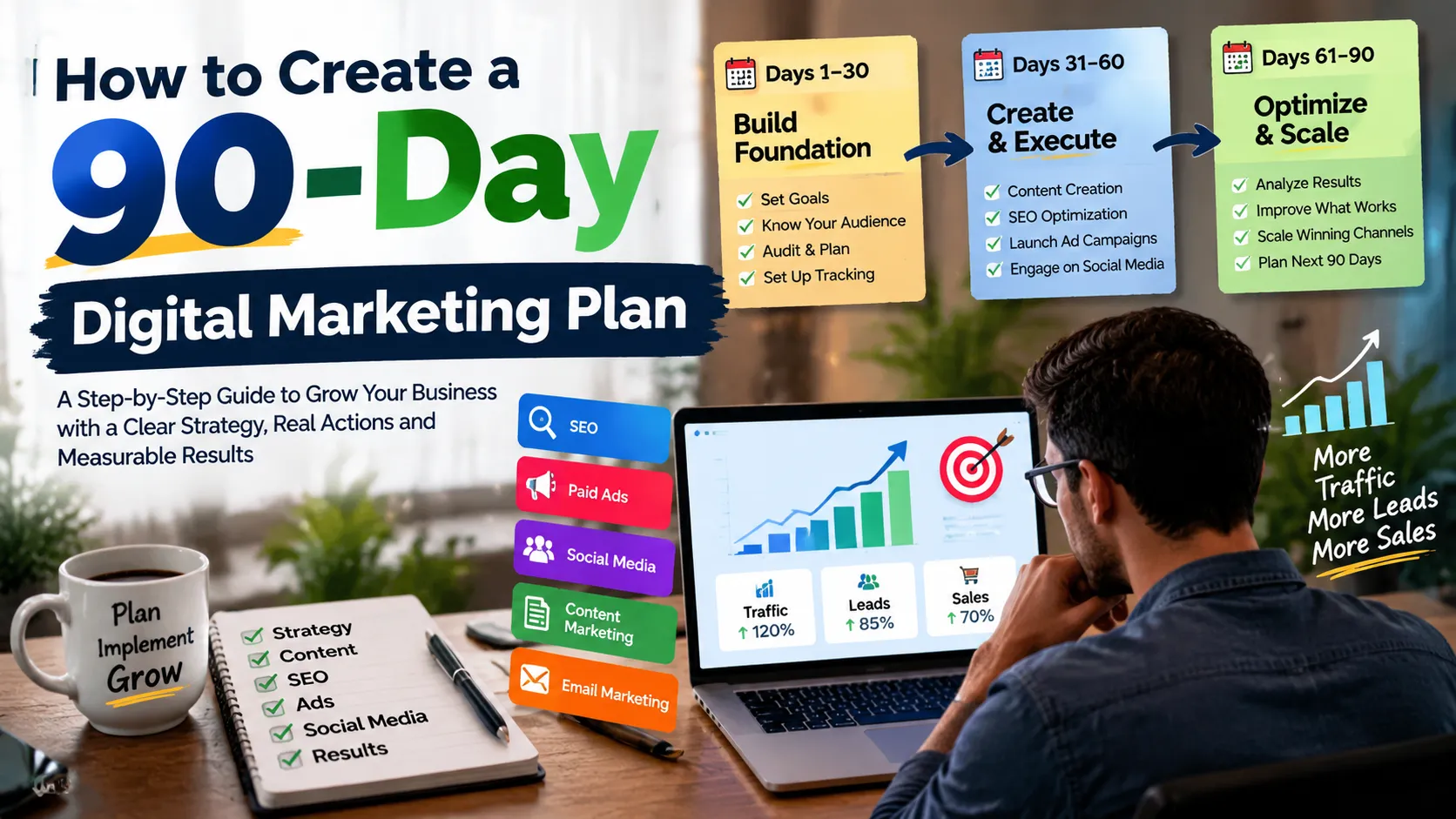
A 90-day digital marketing plan helps small businesses turn scattered marketing activities into a focused strategy with clear priorities, measurable goals, and practical steps toward sustainable growth.
A successful marketing strategy requires more than posting on social media or running advertisements. This guide explains how to build a practical 90-day roadmap, establish measurable goals, select suitable channels, allocate your budget, and evaluate results. Follow the 30/60/90-day framework to improve execution and make evidence-based marketing decisions.
What Is a 90-Day Digital Marketing Plan?
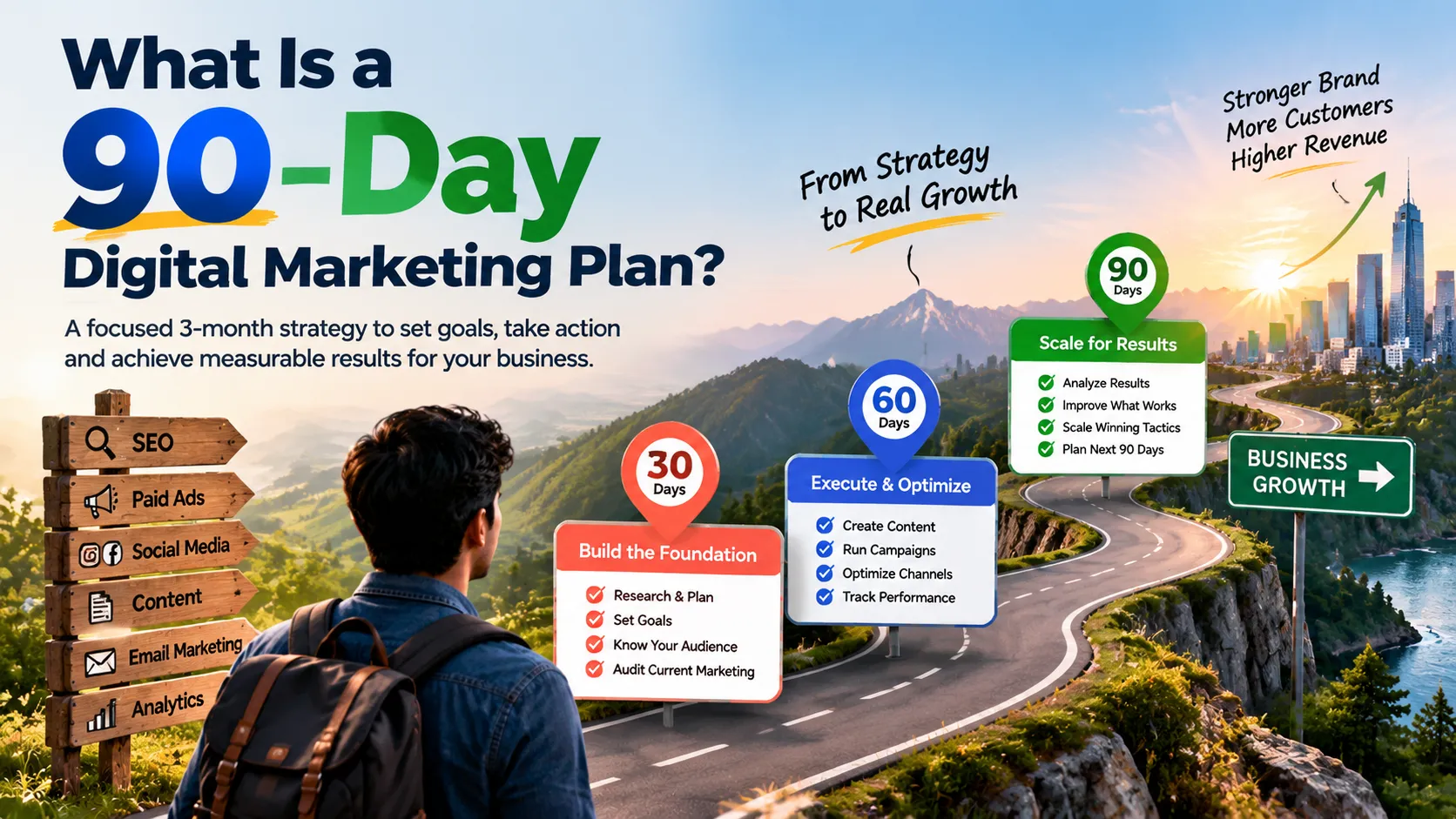
A 90-day digital marketing plan is a time-bound roadmap that organizes marketing activities, resources, deadlines, and performance indicators across three months.
Instead of trying every available marketing channel simultaneously, a business identifies its most important objective, determines which customers it wants to reach, chooses the most suitable marketing activities, and evaluates progress against measurable targets.
For example, a professional services company might want to generate more qualified consultation requests. Its plan could prioritize website improvements, search engine optimization, educational content, and a small paid search campaign.
The business would then establish deadlines for implementing these activities and define how it will measure qualified enquiries, conversion rates, and customer acquisition costs.
A 90-day period offers enough time to establish a baseline, implement meaningful improvements, and gather initial performance evidence. However, it does not guarantee a particular ranking, revenue increase, or number of customers. Results depend on the business, market, resources, competition, and channels involved.
A useful 90-day digital marketing plan therefore combines strategy, execution, measurement, and adjustment rather than treating the calendar as a guarantee of results.
Why Small Businesses Need a 90-Day Marketing Strategy
Small businesses frequently operate with limited budgets and small teams. A clear marketing roadmap helps them decide which activities deserve attention first and which can wait.
1. It connects marketing activities to business goals
Posting regularly, publishing articles, and increasing website traffic can all support growth. However, these activities matter most when they contribute to a meaningful business outcome.
A company seeking more qualified enquiries should prioritize actions that help relevant customers discover its services, understand its value, and contact the business.
A company focused on repeat purchases might instead prioritize customer retention, email communication, and post-purchase experiences.
Your objectives should determine your activities—not the other way around.
2. It creates accountability
A written plan assigns responsibility, establishes deadlines, and makes progress easier to review.
Without a schedule, teams may repeatedly discuss ideas without completing them. A 90-day roadmap turns priorities into deliverables and creates regular opportunities to identify delays or obstacles.
3. It helps control marketing spending
A defined budget helps businesses avoid investing in too many channels before they understand which ones are suitable.
The U.S. Small Business Administration’s marketing and sales guidance recommends documenting the target market, competitive advantage, sales approach, marketing goals, action plan, and budget.
A practical 90-day plan connects those elements to a clear sequence of work and a process for comparing marketing costs with business results.
4. It supports continuous improvement
Marketing performance changes as audiences, competitors, offers, and market conditions change.
A 90-day roadmap gives you a structured period for testing assumptions, reviewing results, and refining your approach. You can keep effective activities, improve underperforming ones, and stop spending on tactics that fail to support your objectives.
How to Create a 90-Day Digital Marketing Plan Step by Step
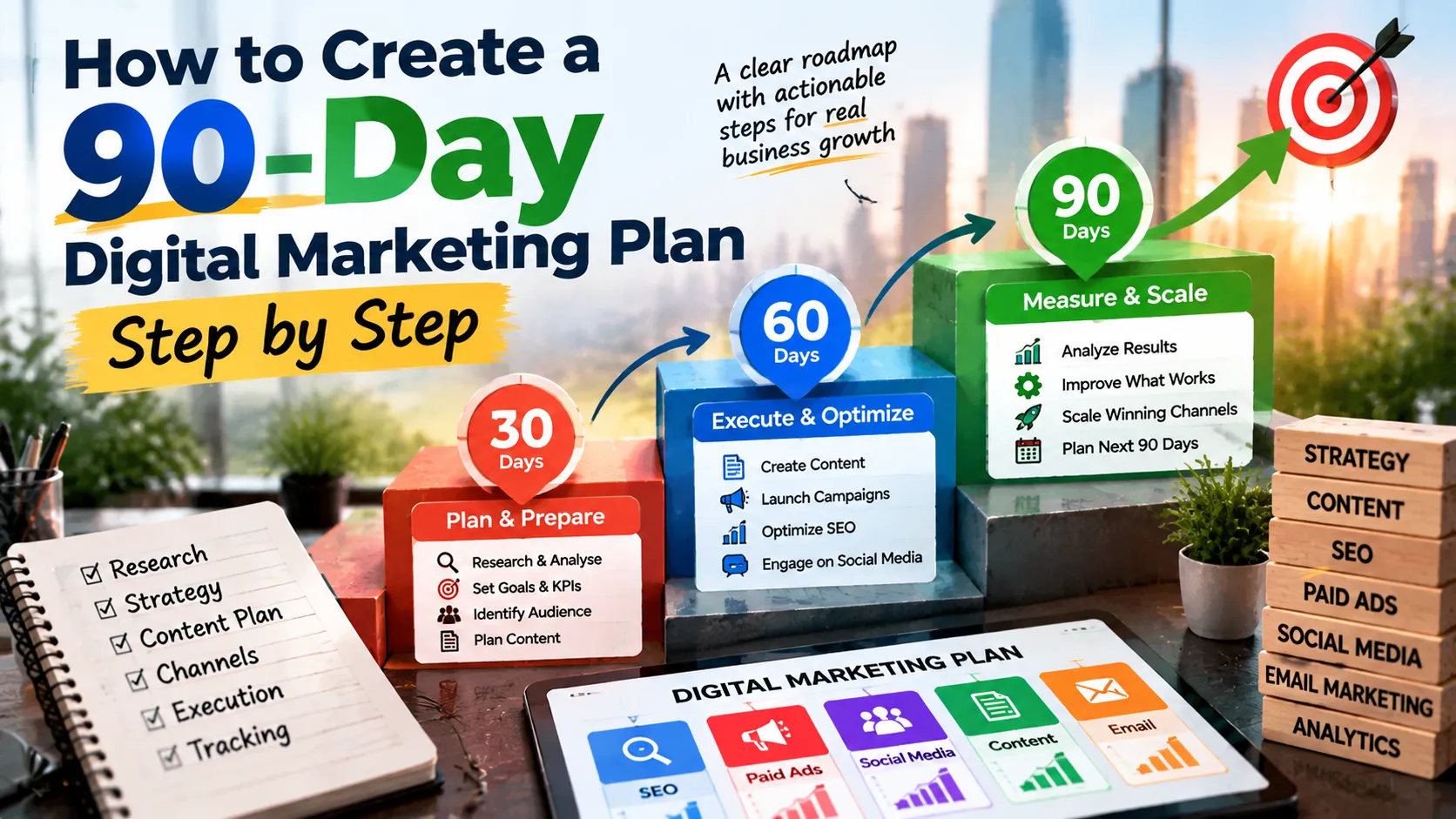
Before assigning activities to specific weeks, establish the business priorities that will guide your decisions.
Step 1: Audit Your Current Digital Marketing Performance
Begin by understanding your current position.
Review your website, search visibility, content library, social media profiles, advertising accounts, customer enquiries, and existing marketing processes.
The goal is to identify strengths, weaknesses, and opportunities—not to create an unnecessarily long list of technical problems.
For your website, examine whether visitors can understand your services, find relevant information, navigate easily, and complete the actions you want them to take.
For organic search, review indexed pages, relevant search queries, impressions, clicks, and important landing pages in Google Search Console.
For advertising, examine campaign spending, tracking configuration, lead quality, and the relationship between advertising costs and sales outcomes.
For social media, evaluate whether the content reaches the intended audience and contributes to meaningful interactions, website visits, or enquiries.
Google Analytics can help you understand traffic acquisition and important user actions. Its official key events documentation explains how businesses can measure actions that matter to their objectives.
Create a simple baseline report before changing your strategy. This gives you a reference point for evaluating progress during the next 90 days.
Step 2: Define Your Target Audience
Your marketing will be more effective when you understand the people or organizations most likely to benefit from your offer.
Identify the problems they experience, the alternatives they consider, their purchasing constraints, and the evidence they need before making a decision.
For a digital marketing agency, the audience might include established service businesses that need more qualified enquiries but lack an organized marketing process.
For an ecommerce company, the priority audience could consist of shoppers who already understand the product category and are comparing features, prices, and delivery options.
Avoid targeting everyone simply because your business can technically serve them.
A more focused audience makes it easier to choose relevant keywords, create useful content, write clear advertising messages, and select appropriate channels.
For additional guidance, use the Digital Marketing Strategy for Small Businesses guide from GrowthAxis Solutions to connect audience research with business objectives and channel selection.
Step 3: Set SMART Marketing Goals
A useful goal identifies what you want to accomplish, how you will measure it, whether it is realistic, and when you expect to evaluate progress.
SMART goals are specific, measurable, achievable, relevant, and time-bound.
For example, “Improve marketing” is too vague to guide a team.
A stronger goal would be: “Increase qualified consultation requests from the website by 15% compared with the previous 90-day period, provided that tracking and baseline data are reliable.”
This example establishes a measurable outcome and a comparison period. The 15% target is illustrative, not an industry benchmark or a promised result.
Choose targets based on your existing performance, budget, sales capacity, and business economics.
You might focus on qualified leads, completed purchases, repeat orders, email subscribers, or another action that directly supports your business objective.
Avoid setting too many primary goals. One principal business outcome and a few supporting indicators usually create clearer priorities than a long list of unrelated metrics.
Step 4: Select the Right Marketing Channels
Your business does not need to use every available platform. It needs to select the channels that connect its offer with the right customers.
Search engine optimization can support long-term organic discovery. Paid search can reach people actively looking for particular products or services. Social media can help businesses build familiarity, distribute content, and communicate with their audiences.
Email marketing can nurture interested prospects and support customer retention. Educational content can answer questions that arise before a purchase.
The best combination depends on customer behavior, commercial intent, competition, resources, and the quality of your website or sales process.
For example, a business with strong demand from searchers may benefit from improving its service pages and testing paid search. A new brand with limited awareness may need to explain its value proposition and establish a consistent creative identity before expanding its campaigns.
GrowthAxis Solutions offers Digital Marketing services covering audience research, social media, paid campaigns, and content marketing.
Step 5: Create a Content and Campaign Strategy
Once you know your audience and objectives, decide what you will communicate, where you will publish it, and what action you want readers or viewers to take.
Content should answer genuine customer questions and support a stage of the buying journey.
An educational article might explain a business problem. A comparison page could help readers evaluate alternatives. A service page should clarify the offer, explain its benefits, establish trust, and make the next step clear.
For SEO, map each important search intent to the most appropriate page. Avoid publishing several articles that target the same query without a clear reason.
For paid campaigns, align advertisements with their landing pages. If an advertisement promises a particular solution, the destination page should address that promise immediately.
GrowthAxis Solutions’ Content Marketing service can support topic research, content planning, and search-focused content development.
Google’s helpful, reliable, people-first content guidance also emphasizes creating useful, original content for people rather than producing pages primarily to manipulate rankings.
Step 6: Establish Your Budget and Resources
Your budget should reflect your objectives, current capabilities, and ability to deliver on the demand marketing creates.
Separate one-time implementation costs from recurring expenses.
One-time work may include website fixes, conversion tracking, creative development, landing-page creation, or initial account setup. Recurring expenses may include advertising spend, content production, software subscriptions, ongoing optimization, and agency support.
Also account for internal labor. A strategy can appear inexpensive when employee time is excluded, even though it requires substantial resources to execute.
Set a spending limit for each major activity and identify who will manage it. Reserve some capacity for unexpected technical issues or opportunities that emerge from early results.
Do not allocate the entire budget to advertising if the website cannot convert visitors or the business lacks a reliable follow-up process.
Likewise, avoid investing heavily in a long-term organic strategy while ignoring urgent problems that prevent visitors from contacting you.
Step 7: Build a Measurement Framework
Every important activity should have a corresponding measure of success.
If your goal is qualified enquiries, track completed enquiry forms, consultation bookings, lead qualification, and the progression of opportunities through your sales process.
If your goal is ecommerce sales, monitor purchases, revenue, average order value, and acquisition costs.
If your goal is organic visibility, monitor search impressions, clicks, relevant queries, landing-page performance, and conversions where tracking permits.
Distinguish leading indicators from business outcomes. Publishing useful content is an activity; attracting relevant visitors is an intermediate result; generating qualified customers is a business outcome.
A strong 90-day digital marketing plan measures each stage without assuming that improvement in one metric automatically guarantees improvement in another.
Step 8: Assign Responsibilities and Deadlines
Document who owns each task, what needs to be completed, and which dependencies must be resolved first.
For example, an advertising campaign may depend on a functioning landing page, approved creative assets, accurate conversion tracking, and a clear offer.
If those foundations remain incomplete, launching the campaign on the original date may waste resources.
Use a shared calendar or project tracker to make responsibilities visible. Review progress regularly and identify blockers before they delay other work.
The 30/60/90-Day Digital Marketing Framework
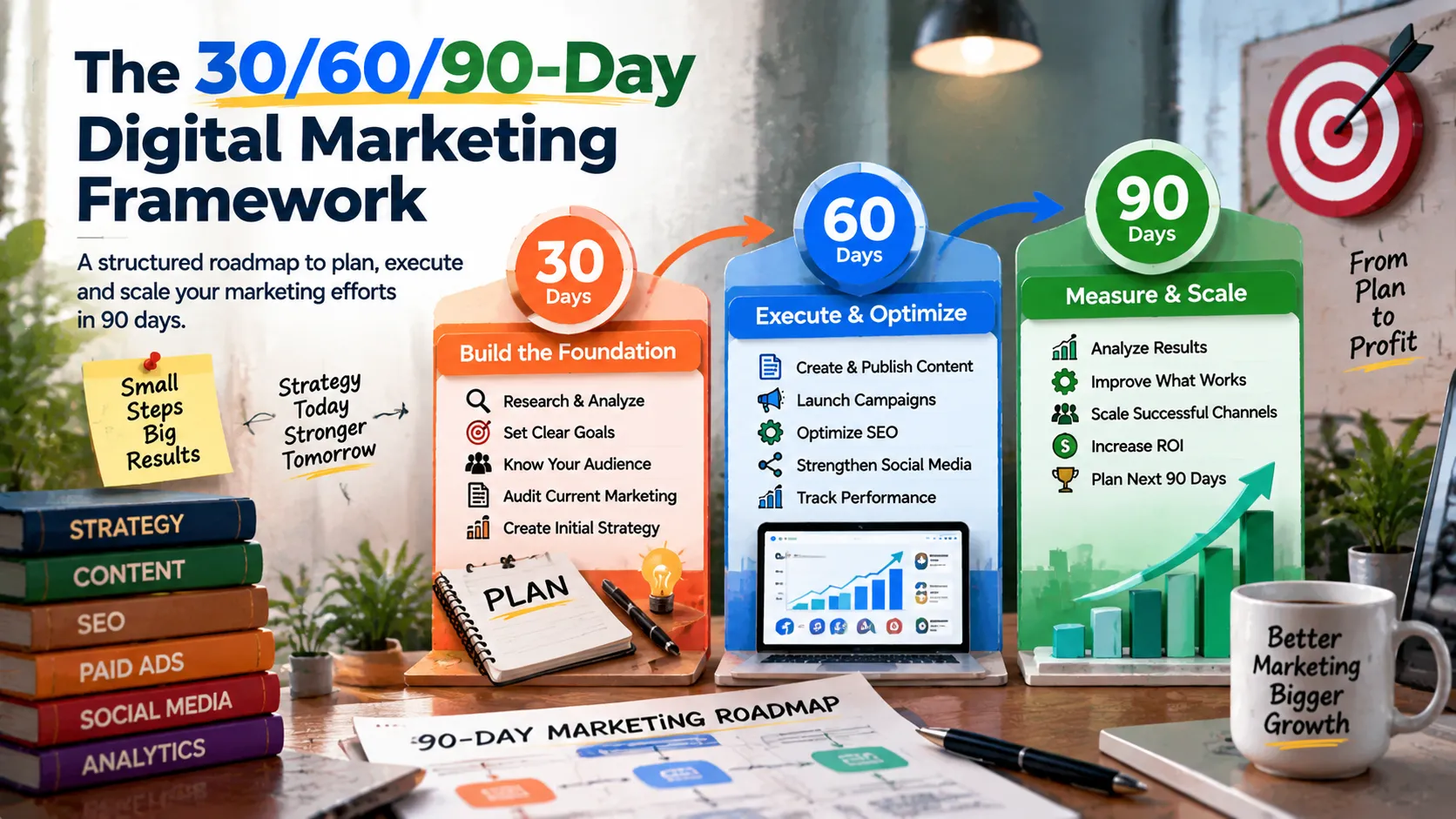
The most practical way to structure a 90-day digital marketing plan is to divide it into three phases: research and foundation, implementation and testing, and evaluation and optimization.
This resembles a 30 day 60 day 90 day plan, but the marketing version focuses on business outcomes rather than employee onboarding.
The phrase 30 60 90 day plan for new job generally refers to a new employee’s early priorities and milestones. The same time structure can organize marketing work, although the objectives and deliverables are different.
Days 1–30: Research, Audit, and Foundation
The first month establishes what the business needs to accomplish and prepares the systems required to execute its strategy.
Start with the digital marketing audit, customer research, competitor analysis, and goal-setting process.
Review the website’s important pages and determine whether they communicate the offer clearly. Identify technical problems, missing conversion events, confusing calls to action, and gaps in customer information.
Build a prioritized content calendar and select the channels that best match the target audience.
If your brand positioning is unclear, review the relationship between messaging, visual consistency, and customer expectations. Appropriate brand identity design and branding & graphic design can help establish a more consistent presentation across websites, advertisements, and social media.
Some businesses may benefit from specialist creative support. When evaluating a branding agency, assess its process, relevant portfolio, deliverables, and ability to work within your commercial objectives. A local company searching for a branding agency near me should also consider whether local collaboration is important or whether a remote partner would meet its needs.
The month-one deliverable should be a documented strategy, a realistic budget, a prioritized task list, and a measurement baseline.
Days 31–60: Implement, Publish, and Test
The second month turns the strategy into actual marketing activity.
Implement the highest-priority website improvements, publish planned content, establish campaign tracking, and launch selected campaigns when the underlying systems are ready.
For SEO, focus on relevant pages, useful content, search intent, internal linking, and technical issues that materially affect discoverability or user experience.
For paid advertising, start with a controlled test rather than assuming the first campaign will produce optimal results.
For social media, establish a sustainable publishing schedule and test content formats that suit the audience.
Review early results, but avoid making major decisions based on a handful of clicks or enquiries. Some activities produce useful signals quickly, while SEO and content efforts may need substantially longer to show their full impact.
By day 60, the business should have completed meaningful implementation, started collecting performance data, and identified the strongest early opportunities.
Days 61–90: Optimize, Evaluate, and Plan the Next Quarter
The final month focuses on learning from the evidence.
Compare current results with the baseline established during the first month. Determine which activities are attracting suitable customers, which pages are converting, and which channels consume resources without producing sufficient value.
Improve underperforming landing pages, refine advertising messages, address recurring objections, and update content where the evidence supports a change.
Do not automatically abandon a channel because it has not produced immediate revenue. Consider its purpose, the length of the buying cycle, the quality of the available data, and whether implementation problems affected performance.
At the same time, do not continue funding an activity indefinitely without a credible rationale.
At day 90, document completed work, performance against goals, remaining limitations, lessons learned, and priorities for the next quarter.
The 90-Day Plan at a Glance
Use this 30 60 90 day plan as a practical execution checklist.
- Days 1–30 — Diagnose: Audit performance, research customers, review competitors, establish goals, allocate resources, and prepare tracking.
- Days 31–60 — Execute: Improve priority pages, publish relevant content, launch suitable campaigns, and gather initial performance evidence.
- Days 61–90 — Optimize: Compare results with the baseline, improve weak points, document lessons, and build the next quarterly roadmap.
The phases are guidelines rather than rigid rules. If tracking is broken, fix it before judging campaign performance. If the website needs significant development, adjust the campaign schedule to match the actual implementation timeline.
| Phase | Main deliverables and success criteria |
|---|---|
| Days 1–30 | Documented goals, audience research, baseline metrics, prioritized roadmap, budget, and measurement setup |
| Days 31–60 | Implemented improvements, published content, launched tests, and initial evidence about audience response |
| Days 61–90 | Performance review, documented lessons, optimization priorities, and a revised next-quarter plan |
Which KPIs Should Your 90-Day Marketing Plan Track?
Your KPIs should reflect the goal you selected, not simply the metrics available in your analytics dashboard.
For example, a business seeking qualified leads should not treat social media impressions as its main measure of success. Impressions can provide useful context, but they do not reveal whether the campaign generates viable customers.
| KPI | What it tells you and when to use it |
|---|---|
| Qualified leads | Measures enquiries that meet your customer criteria and helps assess lead quality |
| Conversion rate | Shows the proportion of relevant visitors or prospects who complete a defined action |
| Customer acquisition cost | Estimates the cost of acquiring a customer, based on a clearly defined cost and attribution method |
| Return on advertising spend | Compares attributable advertising revenue with advertising spend; it does not automatically account for all business costs |
| Organic search clicks | Shows how often people click through from search results to your website |
| Cost per qualified lead | Helps evaluate paid acquisition efficiency while accounting for lead suitability |
| Revenue and sales pipeline | Connects marketing activity to commercial outcomes, subject to sales-cycle length and attribution limitations |
Choose a small set of primary indicators and a few supporting measures. Too many KPIs can make it difficult to identify which changes actually matter.
Track Conversions Correctly
Google Analytics lets businesses mark important interactions as key events. Depending on your business, these might include completed enquiry forms, successful purchases, or consultation bookings.
Review the official Google Analytics key events documentation when setting up measurement.
Test your tracking before launching campaigns. Confirm that events fire correctly, exclude duplicate submissions where appropriate, and distinguish genuine business outcomes from low-value interactions.
A form submission is not always a qualified lead, and a qualified lead is not always a sale. Connect website data with sales records wherever practical.
How to Allocate Your Marketing Budget Over 90 Days
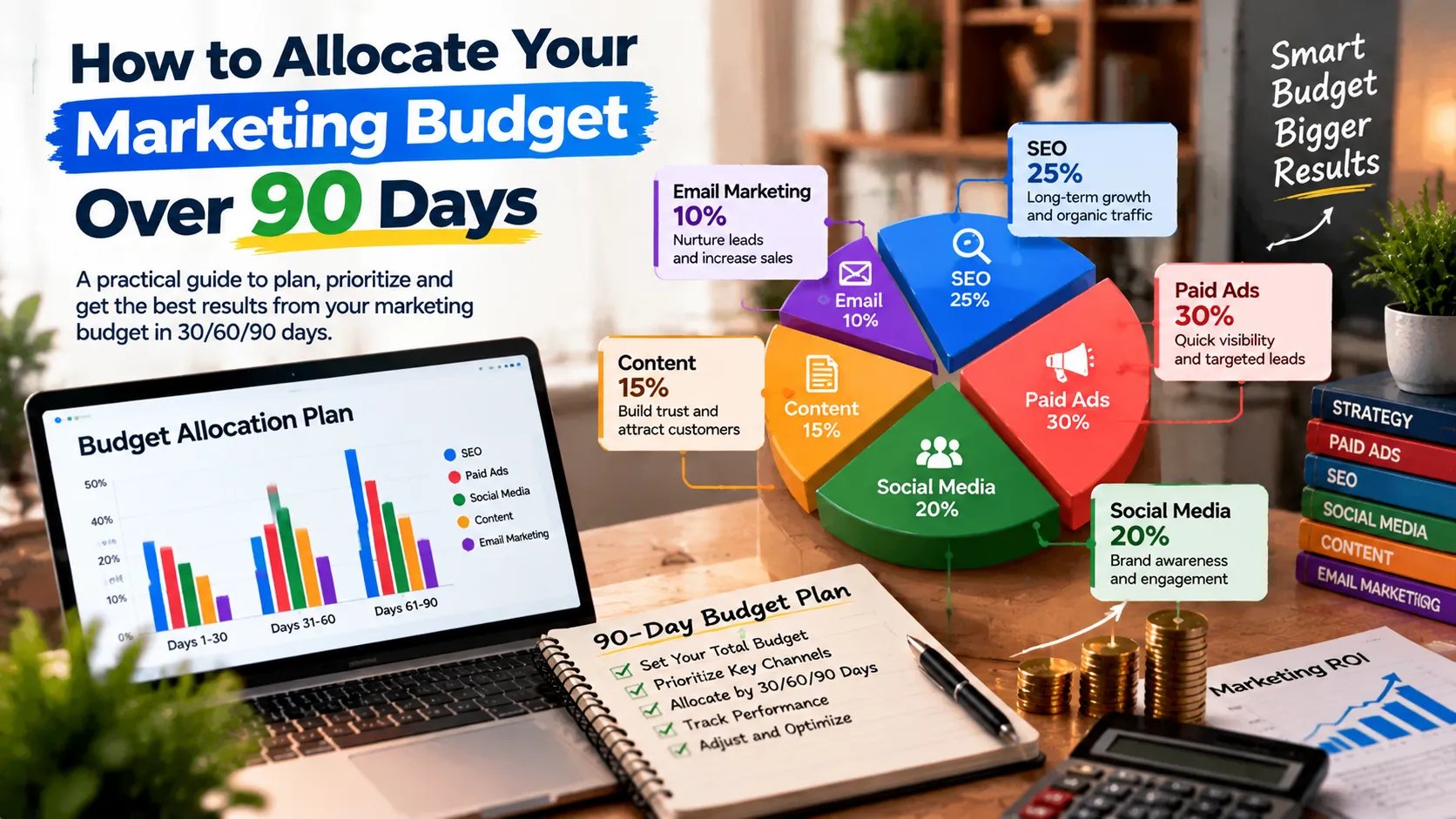
There is no universal budget allocation that works for every business. The appropriate mix depends on current performance, competition, available resources, margins, and the time required to generate results.
A new business might prioritize essential website work, customer research, and initial demand testing. An established business with reliable conversion tracking might allocate more resources to the channels already producing profitable customers.
Before assigning amounts, estimate the total available budget for the quarter. Include media spend, production, software, agency fees, and internal implementation costs where relevant.
Next, separate essential foundation work from experiments. Website usability, reliable tracking, and clear messaging may be prerequisites for successful campaigns.
Allocate an appropriate amount to the highest-priority activities and keep the remaining capacity flexible enough to respond to evidence. Review spending at planned checkpoints instead of waiting until the end of the quarter.
For example, a company might begin with a small paid-search test while improving its service pages and building organic content. If the advertising generates qualified enquiries at an acceptable cost, it can consider expanding the campaign. If the leads are unsuitable, it should investigate targeting, intent, pricing, and landing-page relevance before increasing spend.
How to Integrate SEO, Content Marketing, Paid Ads, and Branding
A strong marketing plan coordinates channels around the same audience and business objective.
Search Engine Optimization
SEO helps potential customers discover relevant pages through organic search.
During the first 90 days, focus on the opportunities most likely to improve the site’s search foundation and usefulness. These may include keyword and intent research, title and heading improvements, internal linking, technical fixes, and content that answers real customer questions.
Organic visibility can take longer than 90 days to develop. Use the first quarter to establish a sound foundation and measure progress rather than promising immediate rankings.
GrowthAxis Solutions provides SEO & AI Search services covering technical foundations, keyword research, on-page improvements, and search-focused content.
Content Marketing
Content can help customers understand a problem, evaluate alternatives, and decide whether a service suits their needs.
Plan content around specific search intents instead of publishing articles simply to increase volume. Connect educational resources to relevant service pages and previously published articles when the links genuinely help the reader.
Paid Advertising
Paid campaigns can help businesses test offers and reach relevant audiences while organic visibility develops.
Start with clear objectives, reliable tracking, relevant landing pages, and a controlled budget. Evaluate the quality of the resulting leads, not just clicks or impressions.
GrowthAxis Solutions’ Google Ads & PPC service supports campaign structure, search-intent research, conversion tracking, and performance optimization.
Branding and Creative Consistency
Branding supports recognition and trust by making the business easier to understand and distinguish from competitors.
Review whether your logo, visual assets, website, advertising, and social content communicate a consistent message. Branding and brand identity should reinforce the same positioning rather than presenting disconnected versions of the business.
Creative changes alone will not solve every marketing problem, but consistent visual communication can support a clearer customer experience when combined with a relevant offer and useful information.
Common Mistakes to Avoid
A 90-day marketing roadmap is only useful when it reflects the business’s actual constraints and commercial objectives.
- Trying every channel at once: Too many simultaneous initiatives can spread a small team’s resources thin and make results difficult to interpret.
- Setting vague goals: Objectives such as “get more traffic” need a baseline, a measurable target, and a deadline to guide decisions.
- Ignoring tracking: Without reliable measurement, the team may misinterpret performance or attribute results to the wrong activity.
- Expecting instant SEO results: Technical fixes may be completed quickly, but organic visibility and business impact often require sustained work.
- Publishing content without a purpose: Every article or campaign should serve a real audience need and have a clear role in the customer journey.
- Increasing advertising spend too early: Validate tracking, landing-page quality, and lead suitability before scaling.
- Measuring vanity metrics alone: Reach, impressions, and likes provide context but should not replace measures tied to business outcomes.
- Failing to assign ownership: A plan without accountable owners and realistic deadlines can remain a document instead of becoming actual work.
- Ignoring the sales process: Marketing cannot compensate indefinitely for slow follow-up, confusing proposals, or an offer that does not match customer needs.
- Treating day 90 as the finish line: The final review should create the next cycle of priorities rather than end the process of learning and improvement.
Expert Tips for Better Results
First, make your initial plan smaller than your team’s theoretical capacity. It is better to complete a focused set of high-value activities than to leave numerous initiatives unfinished.
Second, separate implementation milestones from performance targets. You can control whether you publish an article or repair a landing page, but you cannot guarantee how search engines, competitors, or customers will respond.
Third, preserve a record of significant decisions. Note why you selected a channel, what you expected to happen, and what the data eventually showed. This prevents teams from repeatedly testing the same ideas without learning from previous attempts.
Fourth, review performance at regular intervals but avoid changing everything after every short-term fluctuation. Use sufficient evidence to distinguish a real pattern from random variation.
Finally, keep the plan connected to your wider business strategy. Marketing should support the customers you can serve, the value you can deliver, and the financial outcomes your business needs.
Conclusion
A well-structured 90-day digital marketing plan gives small businesses a practical way to prioritize work, reach relevant customers, manage spending, and measure results. Start with research, implement the highest-value activities, and refine your approach using reliable evidence. Contact GrowthAxis Solutions to explore a tailored digital marketing strategy for your business goals.
Frequently Asked Questions
1. What is a 90-day digital marketing plan?
A 90-day digital marketing plan is a quarterly roadmap that defines marketing objectives, target audiences, channel priorities, budgets, deadlines, and KPIs. It helps businesses organize execution, measure progress, and make informed adjustments based on performance.
2. How do I create a 90-day digital marketing plan for a small business?
Start by auditing your current performance, defining your target audience, and setting measurable goals. Select suitable channels, allocate resources, create a 30/60/90-day roadmap, and establish reliable tracking. Review progress regularly and use the final assessment to prioritize the next quarter.
3. What should I do in the first 30 days of a marketing plan?
Focus on research, auditing, goal-setting, and foundational improvements. Establish baseline metrics, examine competitors, understand customer needs, prioritize website issues, and prepare tracking. These activities help ensure that later campaigns have clear objectives and reliable measurement.
4. What should happen during days 31–60?
Use the second month to implement the strategy. Publish planned content, improve priority pages, launch suitable campaigns, and begin gathering performance data. Check whether tracking works correctly and whether early responses match your intended audience.
5. What should happen during days 61–90?
Evaluate results against the original baseline and targets. Review lead quality, conversion performance, campaign costs, and completed deliverables. Improve underperforming activities, document lessons, and prepare a revised marketing roadmap for the following quarter.
6. How much does a 90-day digital marketing plan cost?
Costs vary according to the business’s goals, competition, website condition, staffing, advertising budget, and required services. A company may execute basic activities internally, while a more complex plan may require specialist support. Estimate all relevant expenses and prioritize activities according to their expected business value.
7. Which digital marketing channels should a small business prioritize?
Choose channels based on how your customers discover, evaluate, and purchase products or services. SEO can support organic discovery, paid search can reach high-intent prospects, social media can build awareness, and email can support nurturing and retention. Start with the channels most closely aligned with your goals and resources.
8. How do I measure the success of a 90-day marketing plan?
Measure outcomes relevant to your primary goal, such as qualified leads, sales, conversion rate, acquisition cost, or revenue. Use supporting metrics to understand performance and verify that tracking is accurate. Compare results with your baseline while considering seasonality, attribution limitations, and the length of the buying cycle.
9. Can SEO produce results within 90 days?
Some SEO improvements, such as fixing important technical issues or improving page relevance, can be implemented within 90 days. However, rankings, traffic, and commercial results vary according to competition, the website’s starting condition, content quality, and other factors. Treat the first quarter as a period for implementation and evidence gathering rather than a ranking guarantee.
10. Should I hire a digital marketing agency to create my 90-day plan?
An agency can help with research, strategy, implementation, creative work, tracking, and optimization when your team lacks the time or expertise. Before hiring one, clarify the business objective, deliverables, budget, responsibilities, and reporting process. Choose a partner that connects its activities to measurable business outcomes rather than promising guaranteed rankings or sales.