
How Much Should a Small Business Spend on Digital Marketing? A Small Business Digital Marketing Budget Guide

A practical small business digital marketing budget turns limited funds into measurable growth by prioritizing the right channels, realistic targets, and evidence—not guesswork.
A successful marketing budget connects business goals, customer acquisition costs, and channel performance. This guide explains recommended spending ranges, budget calculations, channel allocations, advertising costs, SEO, email marketing, and measurement strategies. You will learn how to build a realistic plan, avoid common financial mistakes, and invest confidently as your business grows.
The Short Answer: How Much Should a Small Business Spend on Digital Marketing?
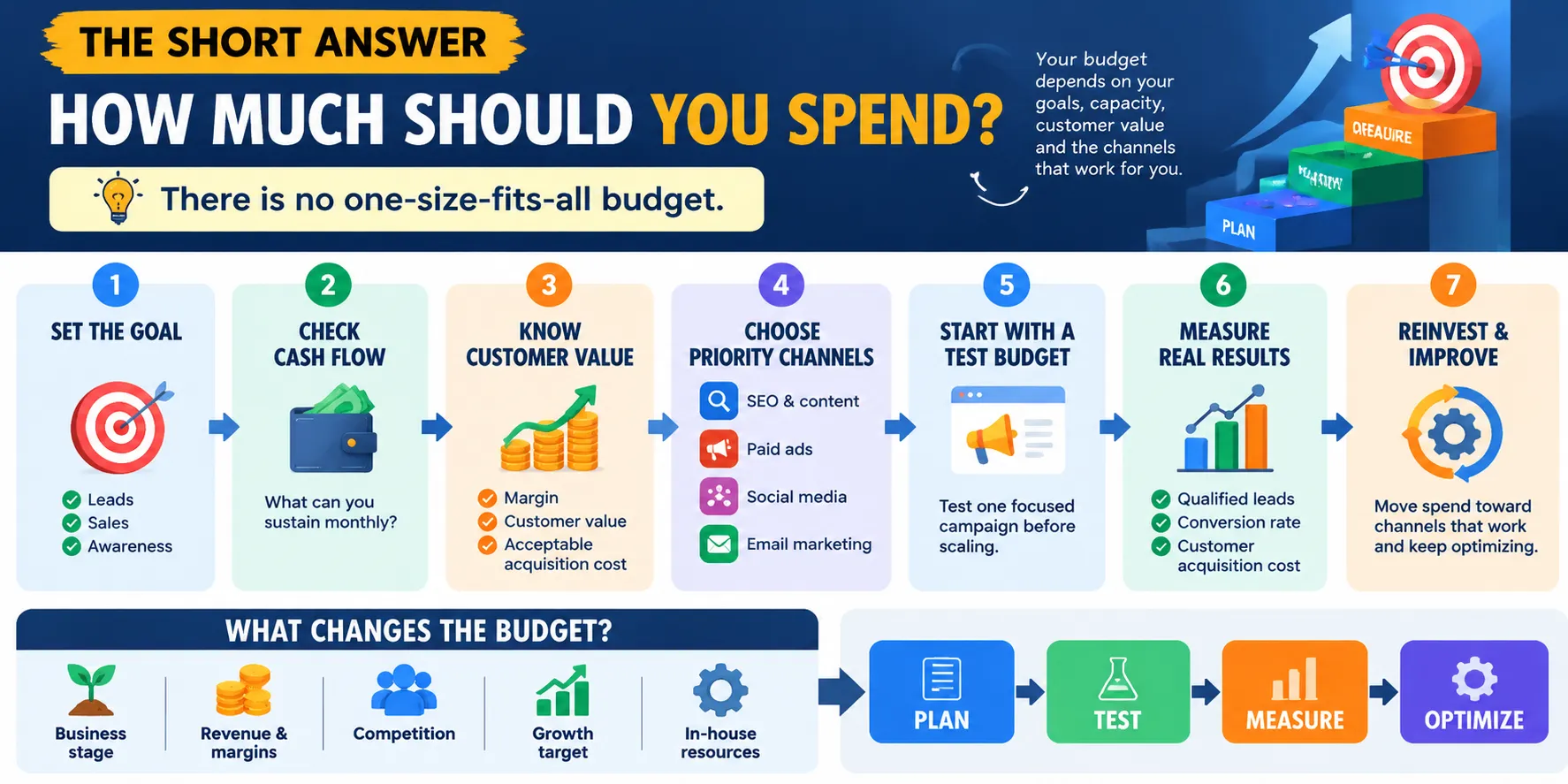
Most small businesses can use 5%–10% of annual revenue as an initial planning benchmark for their overall marketing investment. Businesses pursuing aggressive growth may need a larger allocation, while established businesses with strong referrals and repeat purchases may operate effectively with less.
However, there is an important distinction: a marketing budget is not the same as an advertising budget, and neither automatically equals a digital marketing budget.
Your overall marketing budget may cover staff, creative production, website improvements, software, public relations, events, advertising, and agency fees. Your digital marketing budget covers the portion assigned to online channels and the infrastructure required to operate them.
For example, a company earning $500,000 annually might allocate 8% of revenue to marketing. That creates an annual marketing budget of $40,000, or approximately $3,333 per month. If the company directs 70% of that allocation toward digital activities, its digital marketing budget would be $28,000 annually, or approximately $2,333 per month.
These figures illustrate a planning method, not a universal recommendation. Your ideal allocation depends on your profit margins, industry, location, growth objectives, sales cycle, and current marketing performance.
The goal is not to spend a predetermined amount simply because another company does. It is to invest enough to reach the right customers while maintaining healthy cash flow and generating profitable growth.
What Is a Small Business Digital Marketing Budget?
A small business digital marketing budget is a financial plan that specifies how much money a business will invest in online customer acquisition, brand visibility, conversion, and retention over a defined period.
It should identify the activities receiving funding, the expected outcomes, the costs associated with implementation, and the metrics used to evaluate performance.
Rather than treating marketing as a collection of unrelated expenses, a budget connects spending decisions to a measurable business objective.
What Does a Digital Marketing Budget Include?
A complete plan may include the following expenses:
- Paid advertising: Google Ads, paid social campaigns, remarketing, and sponsored placements.
- Search engine optimization: Technical SEO, keyword research, content optimization, local search visibility, and link acquisition.
- Content production: Blog articles, landing pages, videos, graphics, photography, and downloadable resources.
- Social media marketing: Content planning, publishing, community management, and paid promotion.
- Email marketing: Email platforms, list management, automation, campaign design, and performance reporting.
- Website development: Landing pages, website maintenance, conversion improvements, and technical fixes.
- Analytics and technology: Analytics software, customer relationship management systems, reporting tools, and automation platforms.
- Professional services: Agency retainers, consultants, freelancers, and specialist implementation.
- Internal labor: Employee time spent planning, creating, managing, and evaluating campaigns.
A frequent budgeting mistake occurs when a business counts only the money paid directly to advertising platforms. This approach ignores the resources needed to create campaigns, maintain landing pages, follow up with leads, and measure results.
Suppose you allocate $1,500 to advertising but have no functioning conversion tracking, weak landing pages, and no reliable follow-up process. Your advertising may generate clicks without producing enough qualified enquiries or sales.
A realistic small business digital marketing budget therefore accounts for the complete customer journey, not just the initial advertisement.
Marketing Budget vs. Advertising Budget vs. Digital Marketing Budget
| Budget type | What it covers | Example |
|---|---|---|
| Total marketing budget | All planned marketing activities | Advertising, SEO, creative work, staff, events, and research |
| Digital marketing budget | Online channels and supporting infrastructure | SEO, email, website optimization, and digital advertising |
| Advertising budget | Paid media placements | Google Ads, paid social, and sponsored content |
| Agency or service fees | External professional execution | Campaign management, SEO consulting, and content production |
| Marketing technology budget | Software and measurement infrastructure | CRM, email platforms, analytics, and automation tools |
These categories can overlap depending on your accounting method. For example, paid advertising belongs to digital marketing when it runs online, while agency fees may support several different channels.
Choose a consistent accounting structure so that you do not count the same expense twice.
What Percentage of Revenue Should a Small Business Spend on Marketing?
There is no single percentage that suits every business. Nevertheless, revenue-based benchmarks provide a useful starting point when you lack sufficient historical performance data.
The U.S. Small Business Administration’s guidance on marketing budgets emphasizes that businesses differ in their needs and should evaluate results instead of following one universal spending rule.
The following ranges are practical planning scenarios rather than official industry averages.
| Business situation | Illustrative marketing allocation | Primary objective |
|---|---|---|
| Established business with reliable referrals | 3%–5% of revenue | Maintain visibility and improve retention |
| Stable small business seeking measured growth | 5%–8% of revenue | Increase qualified enquiries and sales |
| Business entering a competitive market | 8%–12% of revenue | Build awareness and acquire new customers |
| Startup establishing initial demand | 10%–15% or more, if financially viable | Validate demand and develop acquisition channels |
A business should not adopt the highest range automatically. A company with narrow margins, limited cash reserves, or unpredictable revenue may need a more conservative plan.
Similarly, a new business may need to invest more heavily in foundational work, such as positioning, website development, customer research, and initial awareness campaigns.
What Do Recent Marketing Budget Reports Tell Us?
Recent industry research offers useful context, although the findings do not all measure the same thing.
1. Small business advertising investment
Intuit SMB MediaLabs published its 2025 Small Business Advertising Trends Report, based on responses from 1,006 business owners and marketing leaders.
The report estimated an average small business advertising budget of $78,000 for 2025. It also found that surveyed businesses allocated an average of 37% of their marketing budgets to advertising, while 92% planned to maintain or increase advertising spending.
These figures require context. The $78,000 estimate is an average, not a median or a minimum effective budget. It also concerns advertising rather than every component of marketing. A small number of larger spenders can influence an average substantially.
The practical lesson is that advertising represents a significant investment for many businesses, but your own budget should reflect your actual economics.
2. Marketing spending as a share of revenue
Gartner’s 2025 CMO Spend Survey reported marketing budgets equivalent to 7.7% of company revenue.
However, the survey covered 402 CMOs and marketing leaders, with most participants representing companies generating more than $1 billion in annual revenue. It should not be interpreted as a direct benchmark for small businesses.
3. The importance of digital channels
Gartner’s 2025 research on marketing channel spending reported that digital channels accounted for 61.1% of total marketing spending among surveyed organizations.
Again, this finding describes a broader corporate sample rather than small businesses alone. It demonstrates the importance of digital channels without proving that every small business should copy the same allocation.
Taken together, these reports support a disciplined approach: use industry data to establish context, then calculate your own requirements using revenue, margins, customer acquisition costs, and growth targets.
How to Calculate Your Small Business Digital Marketing Budget
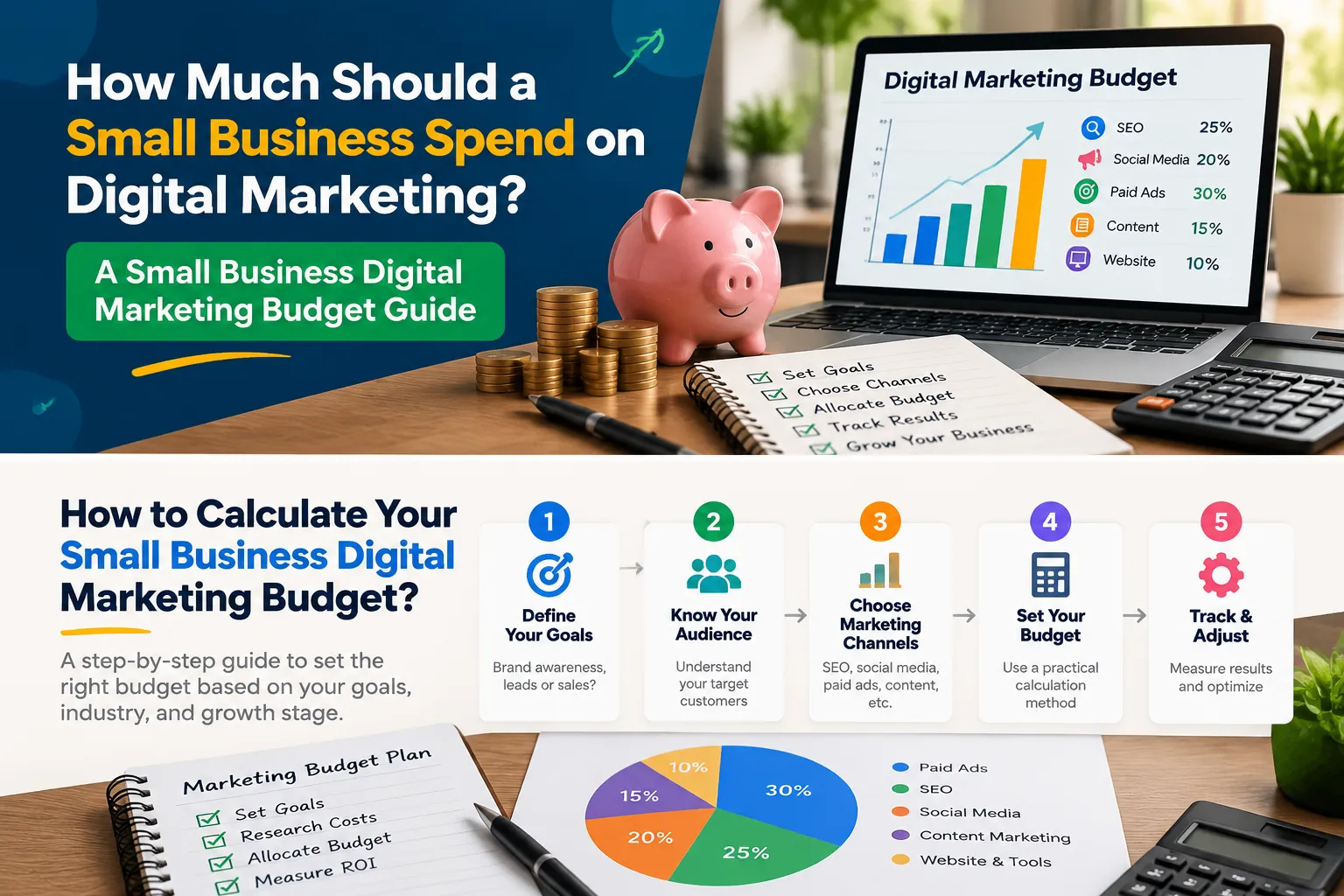
A reliable budget should begin with your business objectives and financial capacity. A percentage-of-revenue model helps establish a starting point, but customer economics should determine whether that amount is sufficient.
Use the following process.
Step 1: Calculate Your Annual Revenue
Start with actual revenue from the previous 12 months, then estimate the next 12 months using realistic assumptions.
For an established business, use historical sales data and account for seasonality. For a startup, use projected revenue scenarios instead of treating uncertain forecasts as guaranteed income.
For example, suppose your business generates $600,000 annually.
If you select an initial marketing allocation of 6%, your calculation becomes:
Annual marketing budget = $600,000 × 0.06 = $36,000
Monthly marketing budget = $36,000 ÷ 12 = $3,000
This provides a baseline for planning. You can subsequently decide how much of the total should support digital channels.
Step 2: Separate Essential Costs From Growth Investments
Before funding new campaigns, identify the costs required to maintain your existing marketing operation.
These may include website hosting, essential software subscriptions, existing agency commitments, domain renewals, and ongoing customer communications.
Next, identify discretionary growth investments, such as new campaigns, additional content, expanded SEO work, or testing a new advertising platform.
This distinction helps you understand how much money you can allocate without disrupting essential business operations.
Step 3: Work Backward From Your Sales Goal
A particularly useful method starts with the revenue you want marketing to generate.
Suppose your business wants to acquire 20 additional customers per month.
Your average first sale is worth $500, and your gross margin is 40%.
The gross profit from each first sale is:
$500 × 40% = $200
If you spend $100 to acquire each customer, your first-purchase contribution after acquisition cost is $100 before other operating expenses.
At 20 new customers per month, the business would spend $2,000 on customer acquisition.
However, this target is financially sensible only if the acquisition cost leaves enough contribution to cover fulfillment, overhead, refunds, and other expenses.
This is why a small business digital marketing budget should reflect profitability rather than traffic targets alone.
Step 4: Calculate Your Allowable Customer Acquisition Cost
Customer acquisition cost (CAC) measures the average cost of acquiring a new customer.
The formula is:
CAC = Total acquisition costs ÷ Number of new customers acquired
Suppose you spend $3,000 on a campaign and related acquisition activities, generating 30 new customers.
Your CAC is $100.
Next, compare that cost with your customer economics. A customer who generates $150 in contribution may justify a different acquisition investment from one who generates $1,000 in contribution over a longer relationship.
For subscription businesses, lifetime value (LTV) can provide additional insight. However, use realistic retention assumptions rather than optimistic lifetime revenue estimates.
A useful principle is to establish an allowable CAC based on contribution margin, expected retention, cash flow, and the time required to recover the acquisition cost.
Step 5: Allocate Funds According to Business Priorities
Once you know your available budget, divide it among activities that support your objectives.
A business seeking immediate enquiries may allocate more to paid search. A business with a long sales cycle may prioritize useful content, SEO, email nurturing, and conversion-focused landing pages.
Your small business digital marketing budget should also account for the time required to obtain meaningful results. Paid advertising can produce traffic quickly, while organic search typically requires sustained work.
Do not fund every channel equally. Give each activity a defined purpose and a measurable outcome.
Step 6: Reserve Money for Testing and Improvement
Avoid allocating every dollar to planned campaigns.
Reserve a modest portion for experimentation, unexpected costs, and performance improvements. The appropriate amount depends on your financial position, but even a small reserve can help you test new messaging or address underperforming landing pages.
A reserve also prevents you from making rushed spending decisions when an opportunity appears.
How Much Should You Budget at Different Revenue Levels?
The table below illustrates how revenue-based allocations translate into annual and monthly amounts.
| Annual revenue | 5% allocation | 8% allocation | 10% allocation |
|---|---|---|---|
| $100,000 | $5,000/year | $8,000/year | $10,000/year |
| $250,000 | $12,500/year | $20,000/year | $25,000/year |
| $500,000 | $25,000/year | $40,000/year | $50,000/year |
| $750,000 | $37,500/year | $60,000/year | $75,000/year |
| $1,000,000 | $50,000/year | $80,000/year | $100,000/year |
These amounts represent total marketing allocations, not automatic digital-only spending or paid advertising limits.
Example: A Business Generating $250,000 Annually
At an 8% marketing allocation, the business has $20,000 per year, or approximately $1,667 per month.
If it dedicates 70% to digital marketing, the digital allocation becomes $14,000 annually, or approximately $1,167 per month.
That amount might support a focused mix of local SEO, essential website improvements, email communications, and limited paid advertising, particularly if the owner handles some work internally.
Example: A Business Generating $500,000 Annually
At an 8% marketing allocation, the business has $40,000 per year, or approximately $3,333 per month.
With 70% allocated to digital channels, it has $28,000 annually, or approximately $2,333 monthly, for digital activities.
Depending on its business model, it might invest in paid search, SEO, content production, conversion improvements, and customer retention.
Example: A Business Generating $1 Million Annually
At an 8% allocation, the business has $80,000 annually, or approximately $6,667 monthly.
If 70% supports digital marketing, that creates a digital allocation of $56,000 per year, or approximately $4,667 monthly.
At this level, the business may have more flexibility to support multiple channels, improve analytics, hire specialists, and conduct structured experiments.
These examples are planning illustrations, not predictions of results. Your margin, industry, geographic market, and internal capabilities may justify a different allocation.
How Should You Split a Digital Marketing Budget?
A strong budget balances customer acquisition, long-term visibility, conversion, and retention.
The right distribution depends on your current stage. The following model provides an illustrative starting point for a service-based business that wants a balanced acquisition system.
| Activity | Illustrative share | Purpose |
|---|---|---|
| Paid advertising | 30% | Generate targeted traffic and near-term enquiries |
| SEO and content | 25% | Build organic visibility and answer customer questions |
| Website and conversion optimization | 15% | Convert more visitors into qualified leads |
| Email and customer retention | 10% | Nurture leads and encourage repeat business |
| Social media and creative | 10% | Build awareness, engagement, and campaign assets |
| Analytics, tools, and experimentation | 10% | Measure results and identify improvements |
| Total | 100% |
This model treats each category as a distinct allocation for planning purposes. If an agency fee or employee cost supports several channels, assign it consistently to avoid double counting.
A business with an established organic search presence might reduce its SEO allocation temporarily and invest more in paid acquisition. An ecommerce business may need more advertising and product creative, while a local professional service may prioritize search visibility and lead conversion.
Review the split quarterly. Your budget should evolve as evidence accumulates.
Choosing the Right Marketing Channels for Your Budget

The most effective channel is not necessarily the cheapest. It is the one that reaches your intended audience, communicates a relevant offer, and generates results at an acceptable cost.
1. Search Engine Optimization for Sustainable Growth
SEO helps potential customers discover your business when they search for relevant products, services, and information.
Unlike paid advertising, organic search does not charge you for each click. However, SEO still requires investment in research, content, technical improvements, internal linking, and ongoing maintenance.
For businesses with limited resources, local seo for small businesses can be especially valuable when customers search for services in a particular city or region.
A practical SEO budget may cover:
- Technical audits and website performance improvements.
- Search intent and keyword research.
- Service-page optimization.
- Helpful articles that answer relevant customer questions.
- Internal links between related content and service pages.
- Google Business Profile management where applicable.
- Local citations, genuine reviews, and relevant authority building.
- Search performance monitoring.
For example, a plumbing company could publish useful guidance about common plumbing problems while optimizing service pages for the locations it serves. A consultancy might create detailed resources answering questions prospects ask before requesting a proposal.
Both businesses should focus on relevance and usefulness rather than publishing large volumes of shallow content.
Google’s guidance on helpful, reliable, people-first content explains why original value, accuracy, and audience satisfaction matter.
If SEO is central to your growth strategy, connect your investment with a broader digital marketing strategy for small businesses so that search traffic supports specific business outcomes.
2. Google Ads for Immediate Demand
Paid search allows a business to appear when potential customers search for relevant products or services. It can be useful when you need more immediate visibility while developing organic channels.
However, advertising costs vary substantially by keyword, location, competition, campaign settings, and landing-page quality.
A business targeting a highly competitive legal or financial service may face very different click costs from a business selling a niche local service.
When planning google ads for small business, begin by identifying the value of a qualified enquiry and the maximum acquisition cost your business can sustain.
Consider the following:
- Which search terms indicate strong buying intent?
- What is the expected cost per click?
- What proportion of clicks may turn into enquiries?
- What proportion of enquiries become customers?
- What contribution does each new customer generate?
- How much can you afford to spend while collecting enough data to learn?
For example, assume a campaign attracts 100 clicks at an average cost of $3 per click.
The media cost is $300.
If 5% of visitors submit a valid enquiry, the campaign produces five leads, giving it a cost per lead of $60.
If one of those leads becomes a customer, the acquisition cost is $300 before campaign-management fees and other expenses.
That result may be profitable for a high-value service and unprofitable for a low-margin product. The business must evaluate the economics rather than judging success by clicks alone.
For google advertising for small business, Google’s official average daily budget guidance explains how daily budgets work and how monthly spending limits are calculated for most campaigns.
Google also offers a campaign budget planning tool to help advertisers explore spending estimates.
Start with a defined test budget, verify conversion tracking, and evaluate qualified leads and sales before increasing investment.
3. Social Media Marketing and Paid Social Campaigns
Social media can help businesses demonstrate expertise, show products, answer questions, and build relationships with potential customers.
The best platform depends on your audience. A business selling visually distinctive consumer products may benefit from Instagram or TikTok, while a B2B consultancy may prioritize LinkedIn and educational content.
For businesses in social media-driven markets, consistency matters, but posting frequently is not a complete strategy.
Plan content around customer needs and commercial objectives.
For example:
- Educational posts can answer common questions.
- Demonstrations can show how a product works.
- Customer stories can provide credible evidence of value.
- Short videos can explain complex services.
- Paid campaigns can promote a relevant offer to a defined audience.
- Retargeting can reconnect with eligible visitors where consent and platform policies allow it.
Organic social media often requires more staff time than cash expenditure. Paid social adds media costs and may also require creative production, testing, and campaign management.
Measure meaningful outcomes such as qualified enquiries, purchases, booked consultations, and assisted conversions. Followers and likes can provide context, but they do not automatically demonstrate financial performance.
4. Email Marketing for Customer Retention
Email marketing can support customer retention, repeat purchases, lead nurturing, and direct communication with people who have chosen to hear from your business.
It is particularly useful when customers need time or additional information before making a decision.
A business could use email to deliver a welcome sequence, explain a product, share helpful resources, remind customers about renewals, or introduce complementary services.
A practical email marketing for small business plan should begin with a clearly defined audience and a useful reason to communicate.
The budget may include:
- Email platform subscriptions.
- List cleaning and segmentation.
- Campaign copywriting and design.
- Automated customer journeys.
- Signup forms and landing pages.
- Deliverability monitoring and reporting.
- Consent management and compliance.
When comparing email marketing platforms for small business, evaluate more than the starting subscription price. Consider contact limits, sending volume, automation capabilities, integrations, segmentation, reporting, and the cost of upgrading as your audience grows.
The cheapest platform may not be the most economical option if it lacks the functionality your business needs.
If you prefer professional support, compare email marketing services for small business according to the scope of work, reporting quality, automation experience, and the business outcomes they can support.
When evaluating email marketing services small business providers, clarify whether the quoted fee includes strategy, writing, design, platform costs, implementation, and performance reporting. These components can be priced separately.
You can explore GrowthAxis Solutions’ email marketing service to see how email strategy, campaigns, automation, and conversion optimization can fit into a broader marketing plan.
Always follow applicable privacy and email marketing laws. In the United States, the Federal Trade Commission’s CAN-SPAM compliance guide explains key requirements for commercial email.
5. Local Business Advertising
Businesses that serve a specific geographic area can often improve efficiency by concentrating their marketing on the locations where they can realistically acquire and serve customers.
Local business advertising may include paid search campaigns, location-focused social campaigns, sponsored local placements, and promotions connected to particular services or offers.
The objective is not to reach everyone in a city. It is to reach people who are likely to need your service and can realistically become customers.
For example, a local dentist may prioritize searches related to appointments and specific treatments within its service area. A cleaning company may focus on relevant neighborhoods rather than advertising across an entire region it cannot efficiently serve.
Before launching local business ads, define:
- Your service area and travel limitations.
- The services or products you want to promote.
- The likely value of each new customer.
- The hours and capacity available to handle enquiries.
- The conversion action you want customers to take.
- The tracking method for calls, forms, and bookings.
A smaller geographic audience can reduce irrelevant exposure, but it does not guarantee cheaper clicks or better conversion rates. Test locations and evaluate results before expanding.
6. Website Development and Conversion Optimization
Marketing generates little value when the destination fails to help visitors take the next step.
Your website should explain what you offer, who you serve, why customers should trust you, and how they can contact you or purchase.
A conversion-focused website budget may include:
- Landing-page development.
- Mobile usability improvements.
- Faster loading and technical maintenance.
- Clearer service descriptions.
- Better calls to action.
- Contact forms and booking systems.
- Trust signals, case studies, and authentic testimonials.
- Conversion tracking and user testing.
Suppose a website receives 2,000 relevant visitors each month and converts 2% into enquiries. That produces 40 enquiries.
If targeted improvements raise the conversion rate to 3%, the same traffic produces 60 enquiries.
That is 20 additional enquiries without increasing the advertising or traffic-acquisition budget.
The example is illustrative, not a guaranteed outcome. It demonstrates why a business should evaluate the website as part of its acquisition system.
Allocate sufficient funds to the destination before assuming that more traffic will solve every growth problem.
7. Content Marketing and Customer Education
Content marketing helps potential customers understand their problems, compare solutions, and evaluate your business before making a purchase.
Useful formats include educational articles, comparison guides, tutorials, checklists, case studies, videos, and answers to common customer questions.
A strong content investment should address topics that connect audience needs with your actual products or services.
For example, a marketing agency could publish a practical guide to choosing an advertising budget, then link readers to relevant campaign-management services. A software company could explain a workflow problem and demonstrate how its product addresses it.
Avoid investing in articles solely because a keyword has attractive search volume. A topic should fit your audience, your expertise, and your broader business objectives.
Google’s people-first content guidance emphasizes originality and usefulness rather than simply summarizing information that already exists elsewhere.
Three Illustrative Monthly Budget Plans
The following examples show how a small business digital marketing budget might support different levels of activity. They are planning scenarios, not verified market-price averages or guarantees of results.
| Monthly allocation | Lean: $500 | Focused: $1,500 | Growth: $3,000 |
|---|---|---|---|
| Paid advertising | $100 | $450 | $1,000 |
| SEO and content | $150 | $375 | $750 |
| Website improvements | $75 | $225 | $450 |
| Email and retention | $50 | $150 | $300 |
| Social media and creative | $75 | $150 | $300 |
| Analytics and testing | $50 | $150 | $200 |
| Total | $500 | $1,500 | $3,000 |
These allocations assume the business can access the necessary skills and tools within each category. In practice, the budget may not cover a full-service agency, extensive content production, or significant website development at every level.
The Lean Budget: $500 per Month
A lean budget works best when the business has a narrow audience, a clear offer, and the capacity to complete some work internally.
Focus on one primary acquisition channel and a small number of supporting activities. A local service provider might improve its website, maintain its business profile, publish useful content, and run a tightly targeted advertising test.
Avoid dividing $500 across numerous platforms without enough money or time to manage them effectively.
The Focused Budget: $1,500 per Month
A focused budget can support more consistent execution.
For example, a service business could invest in a specific search campaign, improve its highest-value service pages, publish useful content, and follow up with enquiries through a basic CRM or email system.
The priority is to establish a repeatable process and identify which activities generate qualified opportunities.
The Growth Budget: $3,000 per Month
A larger allocation provides more room for campaign testing, specialist support, content production, and website improvements.
A business with validated demand might use this budget to strengthen its best-performing acquisition channel while developing a second channel to reduce dependence on one source of leads.
However, increasing the budget before validating the offer, tracking, and conversion process can simply increase waste.
The best allocation is the one that reflects your current constraints and the next measurable improvement your business needs.
How to Build a Small Business Digital Marketing Budget in 90 Days
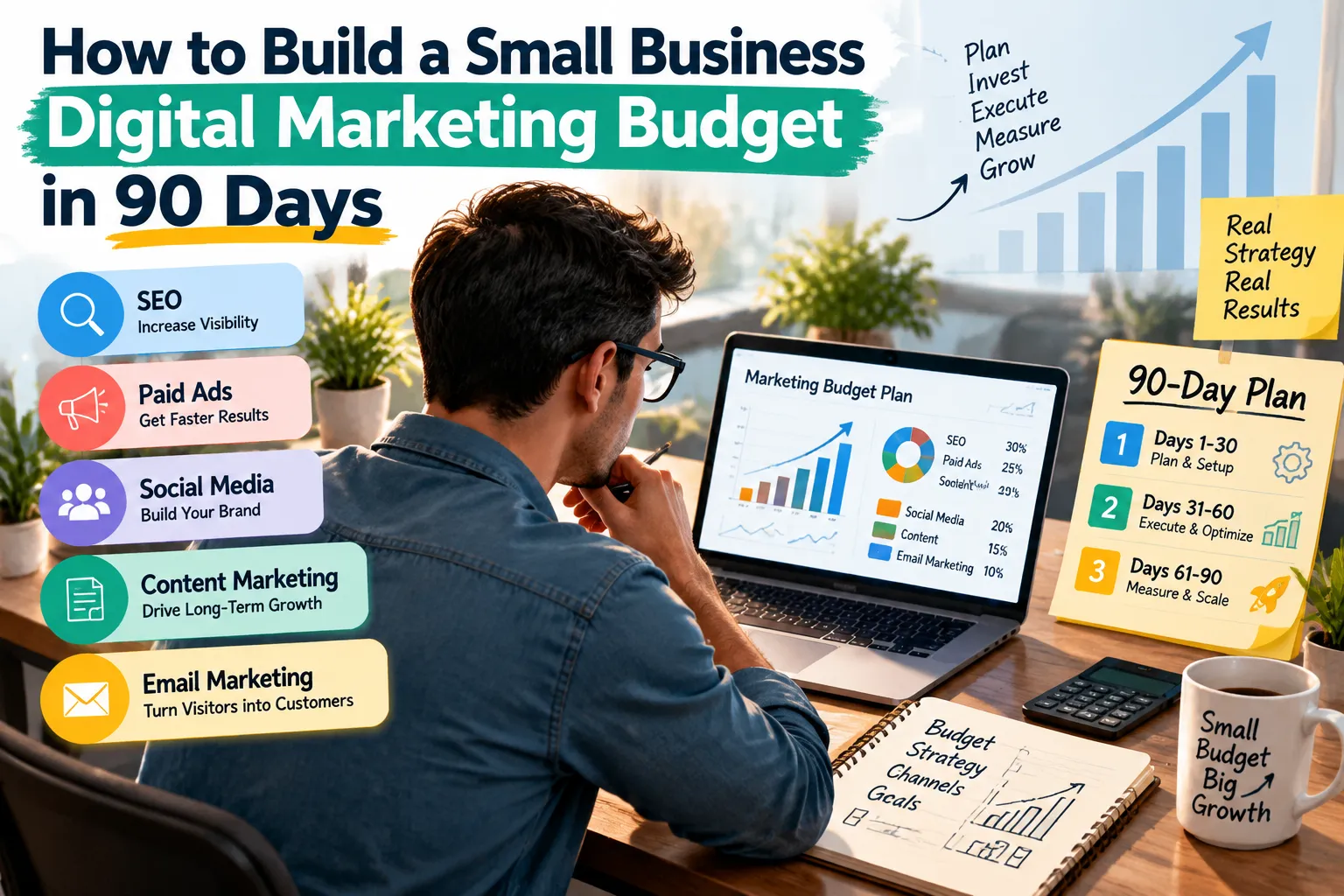
A 90-day plan creates enough structure to organize spending, collect useful evidence, and make informed adjustments without assuming that every channel will produce immediate results.
Days 1–30: Establish the Foundation
Start by understanding your current position.
- Review revenue, margins, average order value, and repeat purchases.
- Identify your most valuable customer segments.
- Review your website, landing pages, and conversion process.
- Check your existing analytics and lead-tracking systems.
- Review current advertising, SEO, email, and social media performance.
- Establish a realistic monthly spending limit.
- Identify one primary business objective for the next quarter.
Your objective should be specific. For example, you might aim to generate 15 additional qualified enquiries per month, improve repeat purchases, or increase sales from a particular service.
Record your baseline performance before implementing changes. Otherwise, you may struggle to determine whether the investment produced meaningful improvement.
Days 31–60: Launch Focused Activities
Choose a manageable group of activities based on your research.
For a local business, this could include improving its service pages, strengthening local search visibility, and testing a targeted paid search campaign.
For a B2B company, it might involve publishing a useful industry guide, improving lead capture, and creating a follow-up email sequence.
For an ecommerce company, the priorities may include product-page improvements, paid acquisition tests, email automation, and abandoned-cart recovery where appropriate.
Assign each activity an owner, deadline, budget, and success metric.
Do not change several major variables simultaneously unless you have a clear testing design. A focused process makes it easier to understand why performance changes.
Days 61–90: Evaluate and Reallocate
At the end of the initial period, review the results.
Ask the following questions:
- Which channels generated qualified leads or purchases?
- What did each lead or customer cost?
- Did customers generate enough contribution to justify acquisition costs?
- Which landing pages or offers performed best?
- Did the business respond to enquiries quickly?
- Which activities produced useful results but need more time?
- Which costs produced little evidence of value?
- What should change in the next quarter?
Do not automatically eliminate a long-term channel because it generated little immediate revenue. SEO, brand awareness, and customer education may need more time to demonstrate their contribution.
Likewise, do not continue funding a paid campaign indefinitely simply because it produces clicks.
A structured review helps your small business digital marketing budget evolve according to evidence rather than habit.
How to Measure Marketing ROI and Control Spending
A budget becomes useful when the business can connect expenditure to outcomes.
The appropriate metrics depend on the business model, but every organization should distinguish between attention, qualified demand, and financial results.
Cost Per Lead
Cost per lead measures the average cost of generating a lead.
Cost per lead = Marketing expenditure ÷ Number of leads generated
If you spend $1,200 and generate 30 leads, the cost per lead is $40.
However, not all leads have equal value. A campaign producing 30 poorly qualified enquiries may perform worse than one producing 15 enquiries from customers who are ready to buy.
Track lead quality alongside volume.
Customer Acquisition Cost
CAC measures the cost of acquiring customers.
CAC = Acquisition costs ÷ New customers acquired
Define which costs your calculation includes. A media-only CAC differs from a fully loaded CAC that includes campaign management, creative production, and relevant labor.
For financial planning, a fully loaded measure often provides a more realistic view of profitability.
Return on Ad Spend
Return on ad spend (ROAS) measures revenue attributed to advertising relative to advertising expenditure.
ROAS = Attributed advertising revenue ÷ Advertising expenditure
If an advertising campaign spends $1,000 and generates $4,000 in attributed revenue, its ROAS is 4:1.
This does not mean the business earned $3,000 in profit. Product costs, fulfillment, refunds, agency fees, and other expenses still matter.
Use ROAS alongside contribution margin and customer acquisition cost.
Marketing Return on Investment
A simplified marketing ROI calculation is:
Marketing ROI = (Incremental profit attributable to marketing − Marketing cost) ÷ Marketing cost × 100
Suppose a campaign generates $5,000 in incremental contribution before marketing expenses and costs $2,000 to execute.
Its simplified ROI is:
($5,000 − $2,000) ÷ $2,000 × 100 = 150%
This calculation depends on correctly estimating incremental contribution. Attributing every sale that occurred during a campaign to that campaign can exaggerate its impact.
Where possible, compare performance with a baseline, use appropriate attribution methods, and consider other factors influencing sales.
Track the Full Customer Journey
A small business digital marketing budget should not be evaluated only through website visits or advertising clicks.
Track the progression from initial discovery to qualified lead, sale, and repeat purchase.
Useful metrics include:
- Qualified leads generated.
- Lead-to-customer conversion rate.
- Cost per acquisition.
- Average order value.
- Contribution margin.
- Customer retention and repeat purchase rate.
- Revenue by acquisition channel.
- Time required to recover acquisition costs.
- Website conversion rate.
- Email engagement and attributed conversions.
Google Analytics can help businesses understand website interactions and conversions. Start with the official Google Analytics documentation and configure measurements around the actions that matter to your business.
Common Mistakes to Avoid When Setting Your Marketing Budget

1. Copying Another Business’s Spending
A competitor may have different margins, customer lifetime value, geographic reach, staffing, and brand recognition.
Use competitor research to understand positioning and channel opportunities, not to copy an arbitrary spending figure.
2. Confusing Revenue With Profit
A business generating $1 million in revenue may have less available marketing cash than a smaller business with substantially higher margins.
Calculate your budget only after accounting for operating requirements, cash flow, and financial risk.
3. Spending Too Little to Test a Campaign Properly
A small advertising budget may be useful for testing a focused offer, but limited data can make performance difficult to interpret.
Estimate likely traffic, conversion rates, and the time needed to collect enough evidence before deciding whether a campaign has failed.
4. Funding Too Many Channels
Spreading limited resources across search ads, several social networks, multiple email campaigns, and extensive content production can weaken execution.
Choose fewer activities, manage them consistently, and expand only when you have a clear reason.
5. Ignoring Website Conversion Problems
Increasing traffic will not necessarily increase sales if your website communicates poorly, loads slowly, or makes it difficult to take action.
Review the entire customer journey before increasing acquisition spending.
6. Measuring Vanity Metrics Instead of Business Results
Impressions, followers, and clicks can provide useful diagnostic information, but they do not automatically demonstrate commercial value.
Connect channel performance to qualified leads, sales, contribution, and retention.
7. Treating SEO as a One-Time Expense
SEO requires ongoing research, technical maintenance, content improvement, and evaluation. A website may need less intensive work after establishing strong foundations, but competitors and customer needs continue to change.
8. Ignoring Existing Customers
Acquiring new customers is only one part of growth. Businesses may improve profitability by strengthening customer service, repeat purchases, renewals, and referrals.
Include appropriate retention activities in your planning rather than allocating every dollar to acquisition.
9. Failing to Separate Media Costs From Management Fees
A quoted campaign budget may include advertising spend, professional management, creative production, and software—or it may cover only some of these items.
Clarify the scope before approving a proposal so that you understand the complete financial commitment.
10. Changing the Budget Without a Review Process
Frequent changes make it harder to identify trends and evaluate performance. Establish regular review dates and change spending when evidence or business conditions justify a decision.
Expert Tips for Getting More Value From Your Budget
Prioritize Channels According to Customer Intent
Customers searching for a specific service may be closer to purchasing than people casually browsing social media.
Consider how much purchase intent each channel can capture, then compare its cost and likely conversion performance.
Improve Existing Assets Before Creating Everything From Scratch
Review your existing pages, articles, email lists, and campaigns. Updating a useful page, clarifying an offer, or fixing a conversion problem may create more value than launching another asset.
Use One Strong Piece of Content Across Multiple Channels
A comprehensive article can inform social posts, an email newsletter, a short video, or a sales resource.
Repurposing content helps small teams increase the usefulness of their research without requiring every format to be produced independently.
Build Measurement Into the Plan From the Beginning
Set up tracking before launching a campaign. Define conversions, record costs, and ensure that enquiries can be connected to their original source where practical.
Reliable measurement reduces the risk of continuing ineffective activities simply because they appear busy.
Increase Spending Gradually When Performance Supports It
When a campaign produces profitable customers, consider increasing investment in controlled increments. Monitor whether acquisition costs remain acceptable as spending grows.
A campaign that performs well at a small scale may encounter new audiences, higher costs, or operational limitations when expanded.
Keep Cash Flow and Seasonality in View
Some businesses experience predictable peaks and troughs in demand. A seasonal retailer may invest more before its busiest period, while a B2B consultancy may need to account for long purchasing cycles.
Plan for these variations instead of dividing annual spending into identical monthly amounts when demand does not support that approach.
Connect Strategy, Execution, and Measurement
Marketing works best when channel selection, website experience, content, creative, and reporting support the same objective.
Explore GrowthAxis Solutions’ digital marketing services for a view of how research, paid campaigns, social media, content, and optimization can work together. You can also review the company’s marketing and SEO service areas when evaluating which capabilities your business needs.
Conclusion
A small business digital marketing budget should reflect your revenue, margins, growth objectives, and customer acquisition economics—not an arbitrary industry average. Start with a realistic allocation, prioritize channels that address genuine customer needs, and measure the results consistently. As your business grows, refine the plan using evidence. Contact GrowthAxis Solutions to explore a digital marketing strategy aligned with your goals and resources.
Frequently Asked Questions
1. How much should a small business spend on digital marketing each month?
A small business can begin by estimating its annual marketing allocation, dividing it by 12, and determining what portion should support digital channels. A starting benchmark of 5%–10% of revenue for overall marketing can help with planning, but margins, competition, and growth goals should determine the final amount. The appropriate small business digital marketing budget may be lower or higher depending on the circumstances.
2. Is $500 per month enough for digital marketing?
Yes, $500 per month can support a focused marketing effort, particularly when the business handles some work internally. It may fund a limited advertising test, basic email marketing, content improvements, or local search activities. It is unlikely to cover every channel and extensive professional support simultaneously. Select one primary objective, track results carefully, and expand when the evidence justifies additional spending.
3. What percentage of revenue should go toward digital marketing?
There is no universally correct percentage. Some businesses use 5%–10% of revenue as a starting point for their overall marketing budget, while growth-focused businesses may require a larger allocation. The percentage directed specifically toward digital channels depends on the business model and the role of offline marketing. Use revenue-based benchmarks alongside customer acquisition cost, contribution margin, cash flow, and actual campaign performance.
4. How much should a small business spend on Google Ads?
The amount depends on keyword competition, geographic targeting, conversion rates, customer value, and the business’s financial capacity. Rather than selecting a budget solely by comparing competitors, estimate the number of clicks you can afford and the cost of acquiring a customer. Start with a defined test, confirm conversion tracking, and evaluate qualified enquiries and sales. Google’s budget-planning resources can help you explore suitable spending levels.
5. Is SEO or paid advertising better for a small business?
SEO and paid advertising serve different purposes. Paid advertising can provide immediate visibility for relevant searches, while SEO can build organic visibility over time. Advertising requires ongoing media expenditure, whereas SEO requires investment in research, technical improvements, content, and maintenance. Many businesses benefit from combining them, but the right balance depends on urgency, competition, available resources, and customer acquisition economics.
6. How much should a small business allocate to social media marketing?
Your allocation should reflect audience behavior, content requirements, and measurable business goals. Organic social media may require more employee time than direct spending, while paid campaigns add advertising and creative costs. Begin with the platforms most relevant to your audience rather than attempting to maintain a presence everywhere. Measure qualified enquiries, purchases, and meaningful engagement instead of relying exclusively on follower counts.
7. Are email marketing platforms for small businesses expensive?
Not necessarily. Many providers offer entry-level plans, but pricing varies according to contact volume, sending limits, automation, integrations, and advanced features. Compare the total cost of ownership rather than the advertised starting price. A suitable platform should support your current communication needs without forcing unnecessary upgrades. Your email marketing budget should also account for content creation, list management, deliverability, and compliance where applicable.
8. How long does it take to see results from a digital marketing budget?
The timeline depends on the channel, offer, competition, and starting position. Paid campaigns may generate initial traffic or enquiries soon after launch, although profitable performance is not guaranteed. SEO and content marketing generally require sustained work before their full value becomes apparent. Website improvements and email automation may produce earlier gains when they address existing conversion or retention problems. Evaluate short-term indicators alongside longer-term business outcomes.
9. Should a small business hire a digital marketing agency or manage marketing internally?
The decision depends on your skills, time, budget, and the complexity of your marketing requirements. Internal execution may suit businesses with capable staff and straightforward needs. An agency or specialist can provide expertise, implementation capacity, and structured reporting when those resources are missing internally. Compare proposals based on scope, accountability, expected outcomes, and total costs rather than choosing solely by price. Make sure you retain access to your advertising accounts, analytics, website, and customer data.
10. How can a small business know whether its digital marketing budget is working?
Track the relationship between marketing expenditure, qualified leads, new customers, contribution margin, and retention. Calculate cost per lead and customer acquisition cost, then evaluate whether the resulting customers generate sufficient value. Use website analytics and campaign reporting to identify where prospects drop out of the customer journey. Review performance regularly and adjust allocations based on evidence. A successful small business digital marketing budget supports profitable growth rather than merely generating more clicks or impressions.