Digital Marketing Funnel: From Awareness to Conversion
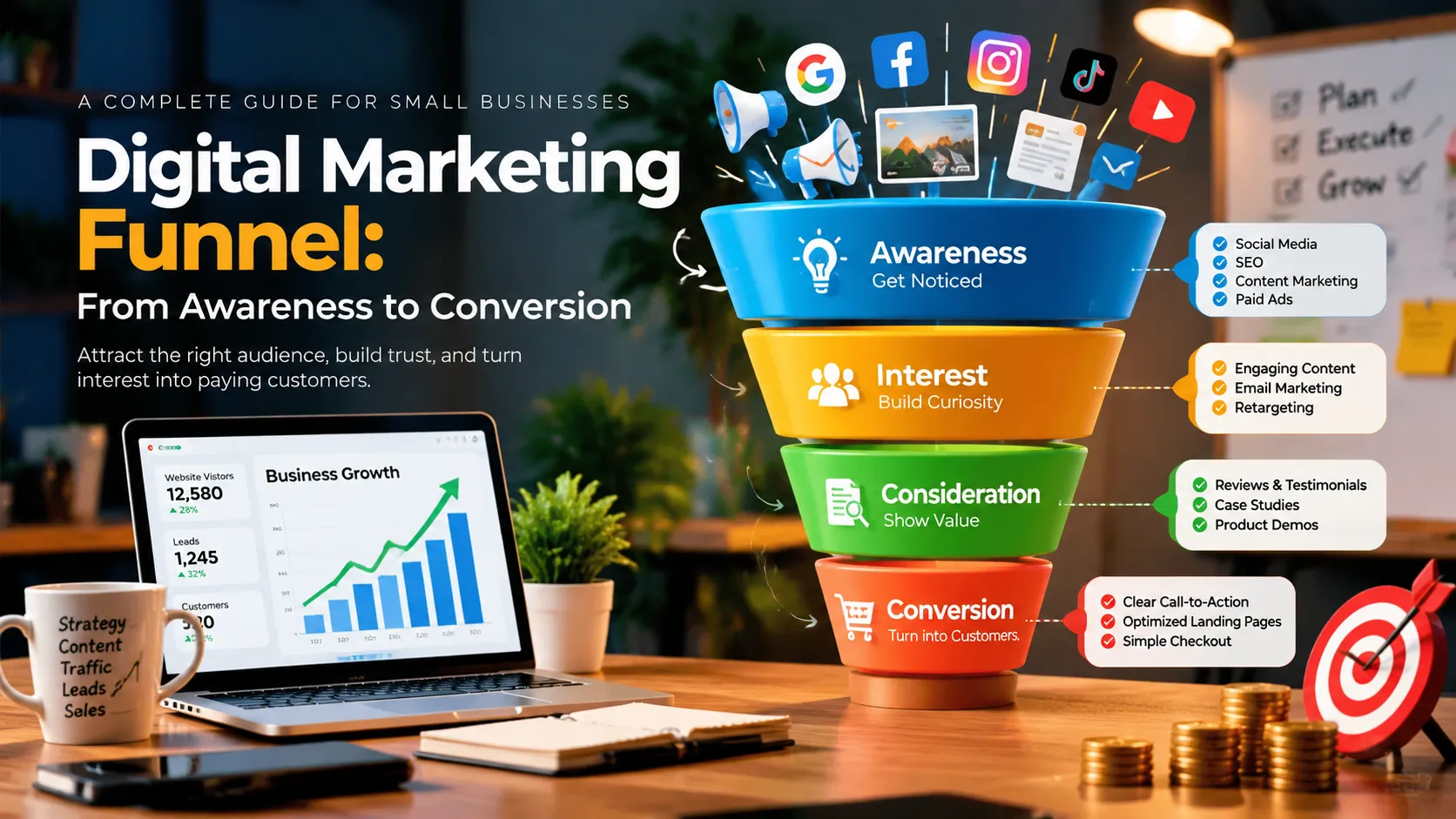
A strong digital marketing funnel connects customer needs with the right message at every stage, turning awareness into measurable action without wasting limited marketing resources.
A successful marketing funnel guides potential customers from discovering your business to evaluating your offer, making a purchase, and returning for future needs. This guide explains each stage, practical marketing channels, content strategies, conversion metrics, and optimization methods, helping small businesses create a measurable customer journey that supports sustainable growth.
What Is a Digital Marketing Funnel?
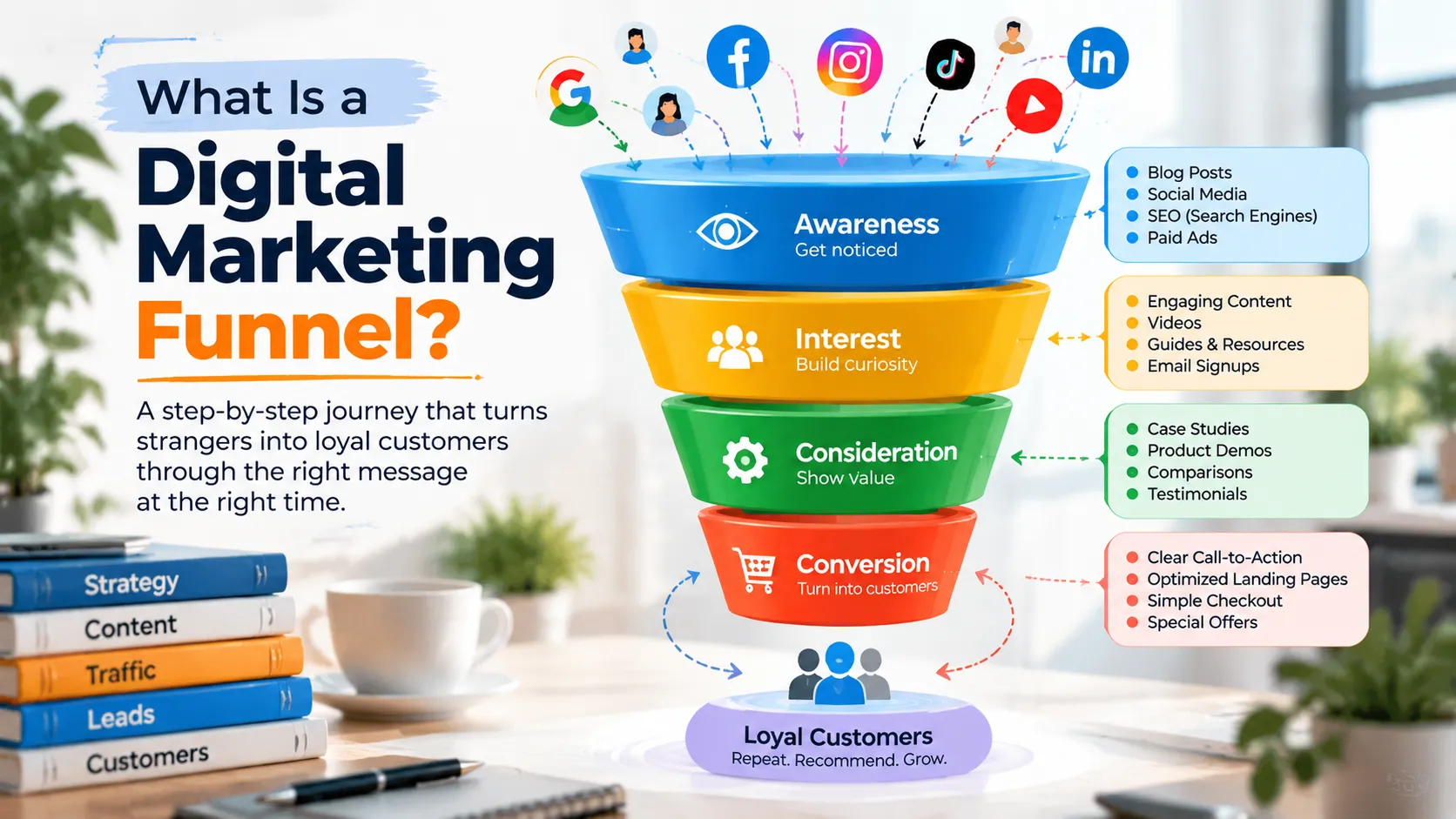
A digital marketing funnel is a framework that explains how potential customers discover a business, explore its products or services, evaluate available options, and eventually take a desired action. That action might involve purchasing a product, booking a consultation, requesting a quote, subscribing to a service, or contacting a sales team.
The term “funnel” describes a common pattern: many people encounter a brand, fewer show meaningful interest, and a smaller group eventually becomes customers. However, a funnel does not mean every customer follows the same sequence. Someone may discover your company through Google, read a review on social media, return through an email, and then contact your sales team several days later.
The purpose of a digital marketing funnel is to help businesses understand these interactions and deliver the right information at the right time. Instead of publishing disconnected content or running advertisements without a clear objective, you build a connected system that moves potential customers toward meaningful outcomes.
For small businesses, this approach can be especially valuable because marketing resources are often limited. A clear funnel helps you prioritize the activities most likely to attract relevant prospects, build confidence, and generate profitable sales.
Why Does a Digital Marketing Funnel Matter?
Marketing becomes difficult to manage when every channel operates independently. Your SEO campaign might attract visitors, your social media accounts might generate engagement, and your website might receive enquiries, yet these activities may not work together to produce consistent sales.
A structured funnel connects those activities. Educational content introduces a problem, comparison resources explain possible solutions, customer evidence reduces uncertainty, and a relevant call to action helps interested prospects take the next step.
A funnel also reveals where potential customers leave the journey. If your website attracts substantial traffic but receives few enquiries, the problem might involve the offer, page experience, credibility, or conversion process rather than traffic volume. If many visitors request quotes but few become customers, pricing, lead quality, response time, or the sales process may need attention.
Research published by Shopify, drawing on a Google-commissioned Nielsen study of 1,300 campaigns across 20 consumer packaged goods businesses, reports that full-funnel strategies achieved up to 45% higher ROI than strategies focused on a single purchase stage. This finding applies to that particular research context; it does not guarantee the same improvement for every business. Nevertheless, it illustrates why marketers should consider the complete customer journey rather than optimizing one stage in isolation. Read the Shopify full-funnel marketing guide for additional context.
What Are the Main Stages of a Digital Marketing Funnel?
Most practical funnel frameworks include awareness, consideration, conversion, and post-purchase engagement. Some divide these stages further into interest, evaluation, loyalty, and advocacy. The most appropriate model depends on your sales process and the actions you want customers to take.
| Funnel stage | Customer need, content, and desired outcome |
|---|---|
| Awareness | The customer discovers a problem or brand through educational articles, search results, social content, or advertising. The objective is relevant discovery. |
| Consideration | The customer compares solutions through detailed guides, service pages, demonstrations, and reviews. The objective is to build understanding and trust. |
| Conversion | The customer evaluates the final offer, pricing, proof, and next steps. The objective is a purchase, booking, qualified enquiry, or another valuable action. |
| Retention and advocacy | The customer receives useful follow-up, support, and relevant recommendations. The objective is repeat business, referrals, and stronger long-term relationships. |
1. Awareness: Help Potential Customers Discover Your Business
Awareness is the first major stage of the digital marketing funnel. At this point, potential customers may recognize a problem without knowing which solution they need. Others already understand their problem but have never encountered your business.
Your responsibility is to become discoverable and provide useful information without immediately demanding a purchase.
Search engine optimization can attract people looking for answers. Social media can introduce your brand to relevant audiences, while paid advertising can increase visibility among people who match your targeting criteria. Educational videos, industry publications, and partnerships can also introduce your business to potential customers.
For example, imagine a local accounting firm that wants to attract small business owners. Instead of publishing only advertisements for accounting services, the firm could create a guide explaining common bookkeeping mistakes, a tutorial about preparing financial records, and an article answering frequently asked tax-related questions.
These resources introduce the firm through information that matches customer needs. Readers who find the guidance useful may explore the firm’s service pages when they need professional assistance.
At this stage, prioritize relevant reach, qualified website traffic, search visibility, and engagement with useful content. A large number of impressions means little if the audience has no interest in your services.
2. Consideration: Help Customers Evaluate Their Options
During consideration, potential customers understand their problem and begin comparing solutions. They may investigate several providers, evaluate prices, read reviews, study features, or seek advice from colleagues.
Your content should answer the questions that influence their decisions. A generic brand message will rarely provide enough information for someone making a considered purchase.
Detailed service pages, comparison guides, case studies, product demonstrations, webinars, and email sequences can help prospects understand the differences between available options.
Suppose a business owner discovers your digital marketing agency through an educational article. The next questions may concern service scope, reporting, implementation time, pricing, and expected outcomes. If your website answers these questions clearly, the prospect can evaluate your services without needing to contact your team for every basic detail.
Consideration content should also acknowledge limitations. Explain who your service suits, what it includes, what affects pricing, and which outcomes depend on factors outside your control. Honest communication can strengthen trust more effectively than unsupported promises.
Useful measurements include returning visitors, visits to service pages, engagement with comparison resources, qualified email subscriptions, and requests for additional information.
3. Conversion: Make the Next Step Clear and Easy
The conversion stage is where interested prospects take a meaningful action. For an ecommerce company, that action may be a completed order. For a service provider, it could be a consultation booking, quote request, or qualified sales enquiry.
At this point, your website must remove unnecessary friction. Visitors should understand the offer, the benefits, the price or pricing process, and the steps required to proceed.
A conversion-focused landing page should communicate one primary objective. If the page asks visitors to purchase, download a guide, follow social media accounts, subscribe to a newsletter, and book a meeting simultaneously, the competing options can distract them from the main action.
Trust is equally important. Genuine testimonials, relevant case studies, transparent policies, clear contact information, and appropriate security indicators can help reduce uncertainty. For professional services, explain the consultation process and what prospects should prepare before contacting you.
The conversion process does not end when someone submits a form. Your team must respond promptly, qualify the enquiry, and provide a useful next step. A well-designed marketing funnel can still lose valuable prospects if the sales process is slow or confusing.
Measure completed purchases, qualified enquiries, conversion rate, cost per acquisition, and the proportion of leads that become paying customers.
4. Retention and Advocacy: Turn Customers Into Long-Term Relationships
A customer’s first purchase creates an opportunity to develop a lasting relationship. After the transaction, useful communication, reliable service, and appropriate follow-up can encourage repeat purchases and recommendations.
Retention activities should reflect the product or service. An ecommerce business might send order updates, product-care guidance, replenishment reminders, or relevant recommendations. A consultancy might provide implementation resources, progress reviews, and advice about the client’s next business challenge.
Email marketing and customer relationship management systems can help deliver these communications consistently. However, personalization should reflect genuine customer needs rather than simply inserting a name into a generic message.
Satisfied customers may also provide testimonials, refer other customers, or share their experiences publicly. Ask for feedback at an appropriate time, make the process straightforward, and never pressure customers to leave positive reviews.
Retention is especially important when repeat purchases or ongoing contracts form a substantial part of your business model. For a one-time service, a useful referral or a future related purchase may be more relevant than a recurring subscription.
The broader lesson is that the funnel should support customers after conversion rather than treating the sale as the end of marketing.
How to Build a Digital Marketing Funnel Step by Step
Building a useful funnel begins with a specific business objective, not a collection of marketing tools. You need to understand your audience, map their decisions, connect relevant content, and measure whether the journey produces valuable outcomes.
The following process provides a practical foundation for a small business or growing marketing team.
- Define the business goal. Decide whether the primary objective is to increase qualified enquiries, grow online sales, book consultations, or improve customer retention. Choose one main outcome before selecting channels.
- Understand your target audience. Research customer questions, buying objections, budget considerations, and decision-making behavior. Review sales conversations, customer feedback, website search queries, and relevant keyword data to identify the information people need.
- Map the customer journey. Identify how people discover your business, what they need to learn before considering your offer, which concerns prevent them from purchasing, and what happens after conversion.
- Create stage-specific content. Develop educational resources for awareness, detailed service information for consideration, persuasive but accurate conversion pages, and useful follow-up for existing customers.
- Connect the channels. Use relevant internal links, email follow-ups, clear calls to action, and consistent messaging so customers can move naturally between resources and offers.
- Set up measurement. Configure analytics and conversion tracking before launching campaigns. Record traffic sources, qualified leads, purchases, costs, and the outcomes that matter to your business.
- Review and improve the journey. Identify where prospects drop out, investigate possible causes, test improvements, and allocate more resources to activities that produce sustainable business value.
The order matters because a funnel is a connected system. Creating advertisements before defining the offer, audience, landing page, and conversion measurement can lead to wasted expenditure.
How to Match Content With Each Funnel Stage
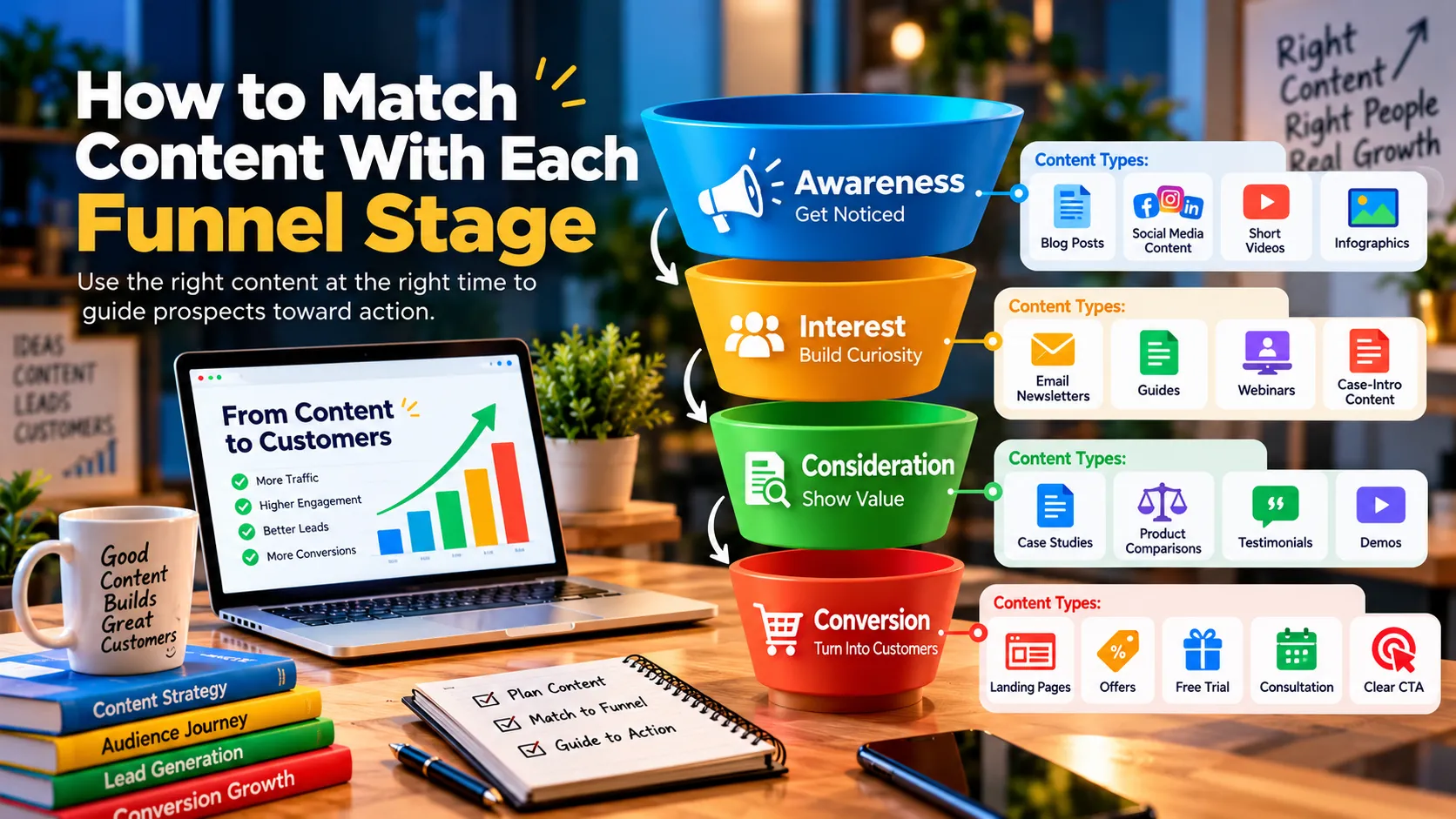
Content should answer the question a customer is asking at a particular moment. A person who has just discovered a problem needs different information from someone comparing providers or preparing to purchase.
At the awareness stage, prioritize educational articles, introductory videos, practical explanations, and social content. These formats can help potential customers recognize their needs and discover your expertise. Avoid making every introductory resource a direct sales pitch.
During consideration, provide deeper information that helps prospects evaluate solutions. Comparison articles, service explanations, implementation guides, demonstrations, and authentic case studies can address concerns that general educational content cannot resolve.
At the conversion stage, focus on decision support. Pricing information, consultation pages, clear service packages, product details, FAQs, and genuine customer evidence can help prospects make an informed choice. The call to action should match the commitment you are asking them to make.
After purchase, provide onboarding information, customer support resources, maintenance guidance, and relevant follow-up. These resources can reduce confusion, improve the customer experience, and create opportunities for future engagement.
A useful content plan connects these stages rather than publishing unrelated articles. For example, an introductory article about improving website performance can link to a detailed guide about conversion optimization, which can then lead to a relevant service page.
This approach supports both usability and search engine discovery. Google’s SEO Starter Guide recommends clear, useful, well-organized content and descriptive links that help people and search engines understand website information.
Which Digital Marketing Channels Support the Funnel?
Different channels contribute to different parts of the customer journey. The right combination depends on your audience, resources, sales cycle, and the type of product or service you offer.
Search Engine Optimization
SEO helps potential customers discover your website when they search for relevant information, products, or services. Educational content can support awareness, while detailed service pages can help visitors evaluating providers.
For local companies, local seo small business planning should reflect the locations served, the services offered, and the questions local customers ask. Related searches such as local small business seo often indicate a need for location-specific visibility and guidance.
GrowthAxis Solutions provides a dedicated Local SEO service that covers local keyword research, Google Business Profile strategy, location-page recommendations, and related activities.
Both search engine optimisation for small business and search engine optimization for small businesses describe efforts to improve organic discoverability. Businesses should focus on relevant content, technically accessible pages, accurate information, and useful internal links rather than repeating keywords unnecessarily.
Google explains that local search visibility depends primarily on relevance, distance, and prominence. Its official guidance on improving local rankings recommends maintaining complete business information and managing customer reviews.
Paid Search and Social Advertising
Paid search can connect your business with people actively looking for solutions, while paid social can introduce offers to selected audiences and stimulate interest.
For example, a prospect searching for a specific professional service may be ready to compare providers. Someone encountering an educational social advertisement may still be learning about the problem. The campaign objective and landing page should reflect that difference.
Paid campaigns can support multiple funnel stages, but each campaign needs a clear purpose and reliable conversion tracking. Evaluate the quality and financial value of the resulting leads rather than judging success exclusively by clicks or impressions.
Email Marketing and Customer Relationship Management
Email marketing can connect different funnel stages by delivering relevant information after a visitor subscribes, requests a resource, books a consultation, or becomes a customer.
A lead-nurturing sequence might begin with a requested guide, continue with practical advice, introduce a relevant service, and invite the prospect to book a consultation when appropriate.
A CRM system can help organize enquiries, record sales interactions, identify follow-up requirements, and reveal which sources produce valuable customers. For businesses with longer sales cycles, this information can prevent promising prospects from being forgotten.
Website Design and Conversion Optimization
Your website is the destination where many marketing interactions become measurable actions. A clear layout, relevant content, responsive design, fast loading, and straightforward forms can support conversion.
Review the complete experience on mobile and desktop. Ensure that visitors can understand your offer quickly, find supporting information, and complete the intended action without unnecessary steps.
GrowthAxis Solutions also offers website and digital services that can support a connected journey through SEO, web development, creative execution, and marketing.
A Practical Digital Marketing Funnel Example for a Small Business
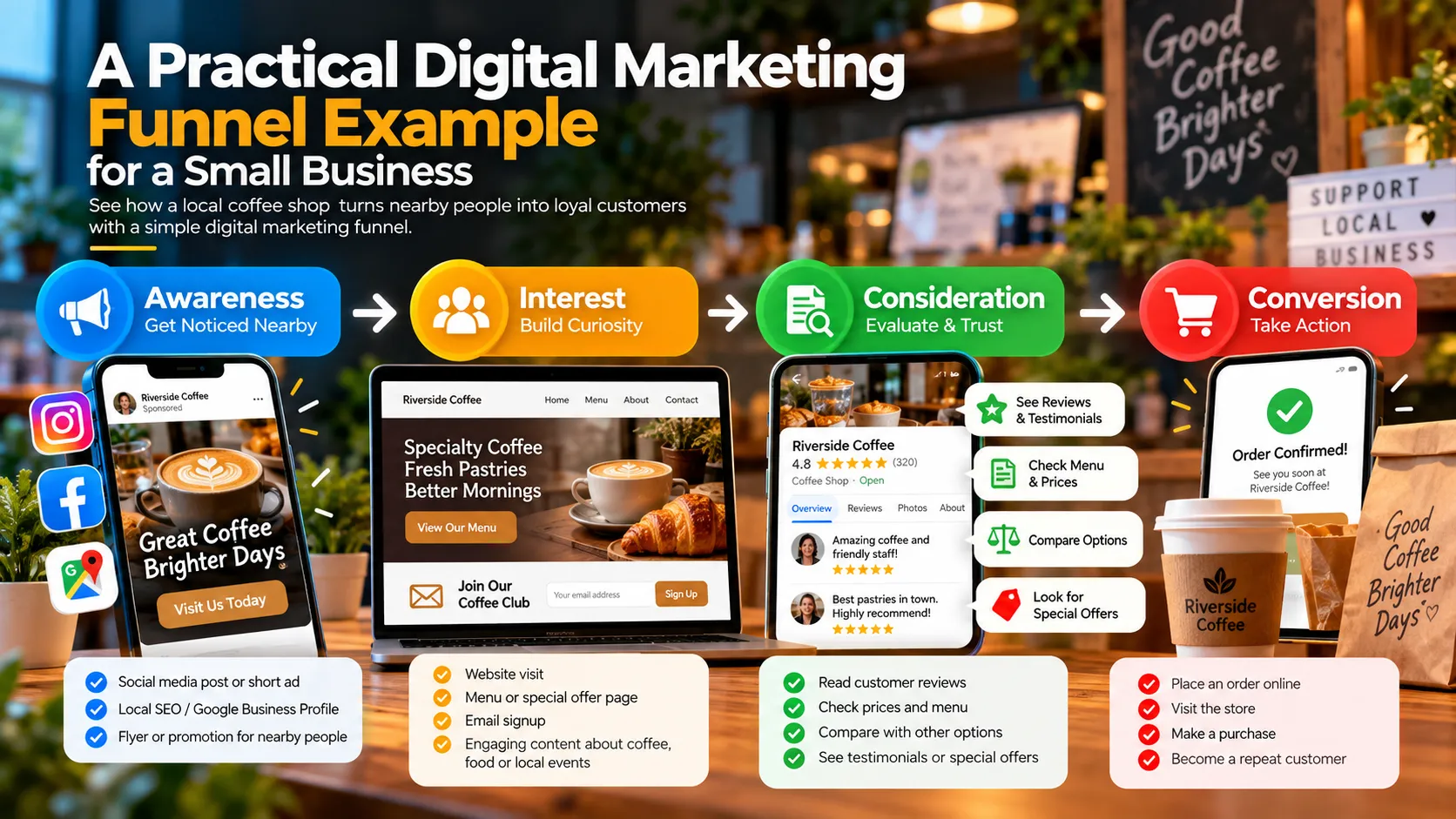
Consider a fictional home-services company that wants to generate more qualified enquiries in its local area. The company has a website, receives some referrals, and maintains a Google Business Profile, but its marketing activities do not follow a consistent process.
At the awareness stage, the company publishes useful articles answering common homeowner questions and improves its location-relevant service pages. It shares selected educational content on social media and tests paid search for services with clear buying intent.
During consideration, interested visitors can read detailed service descriptions, understand the areas covered, review authentic customer feedback, and compare available options. The website answers common questions about the process, scheduling, and what affects pricing.
At conversion, visitors can request an estimate through a short form or call the company. The business tracks each enquiry, responds promptly, and records whether the lead becomes a paying customer.
After the job, the company sends appropriate follow-up information, requests honest feedback, and stays in contact when future maintenance or related services may be useful.
This example demonstrates how a funnel connects discovery, decision support, sales operations, and retention. The company’s results will depend on service quality, competition, demand, pricing, and execution—not simply on publishing more content.
What Do the Numbers Tell You?
The following figures are hypothetical and illustrate how a business might diagnose its funnel. They are not industry benchmarks or predicted results.
| Funnel measurement | Illustrative result and interpretation |
|---|---|
| 2,000 relevant website visitors | Establishes the initial audience entering the measured journey. |
| 200 meaningful enquiries or tracked leads | A 10% visitor-to-lead rate in this simplified example; validate lead quality before judging performance. |
| 40 qualified sales opportunities | Twenty percent of leads meet the company’s qualification criteria. |
| 10 new customers | Twenty-five percent of qualified opportunities become customers. |
| $2,000 in acquisition spending | The media or campaign cost equals $200 per new customer if all 10 customers are attributable to that spend. |
| $500 contribution per new customer before acquisition costs | The 10 customers produce $5,000 in contribution before the stated acquisition spending, leaving $3,000 before other excluded expenses. |
I see that these figures help distinguish performance problems. When traffic is low the company might need visibility or better distribution. When traffic is strong but enquiries are limited I think the company should investigate audience relevance the offer and the landing page. When many enquiries fail qualification I believe targeting and messaging may need improvement.
If qualified opportunities rarely become customers I recommend the company review pricing, sales conversations, response times, customer objections and the fit between the service and the audience.
The useful improvement is not necessarily increasing traffic. I believe the improvement may be strengthening a transition, between two stages.
How to Measure and Optimize Funnel Performance
A funnel becomes useful when it produces evidence that informs decisions. Your metrics should connect marketing activity with customer behavior and financial outcomes.
Measure the Right Indicators
Awareness metrics include relevant reach, impressions, organic search visibility, and qualified website traffic. Consideration metrics include returning visitors, engagement with important service pages, resource downloads, and qualified enquiries. Conversion metrics include purchases, booked consultations, lead-to-customer rate, customer acquisition cost, and revenue. Retention metrics include repeat purchases, renewals, referrals, and customer lifetime value where it can be estimated reliably.
Do not assume that every metric has the same commercial significance. A high click-through rate may indicate an attractive advertisement, but it does not prove that the campaign generates profitable customers.
Define each conversion event clearly. For example, distinguish a form submission from a qualified enquiry and a qualified enquiry from a completed sale. This prevents your reporting from overstating business results.
Use Google Analytics to Find Funnel Drop-Offs
Google Analytics 4 includes Funnel exploration, which lets you visualize the steps users take and examine where they stop progressing through a defined journey.
You can build a funnel around meaningful actions such as visiting a service page, starting a form, submitting an enquiry, and completing a purchase. Depending on your setup, you can also compare segments and examine the time between steps.
Read the official GA4 Funnel exploration documentation before configuring your reports. Make sure the events accurately represent the customer journey and that your tracking setup follows applicable privacy requirements.
A funnel report does not automatically explain why users abandon a step. Combine quantitative data with customer feedback, usability testing, and a review of the page experience to investigate possible causes.
Calculate Conversion Rate and Customer Acquisition Cost
Conversion rate measures the proportion of eligible visitors or prospects who complete a defined action.
Conversion rate = Conversions ÷ Eligible visitors or prospects × 100
If 100 qualified visitors submit 8 enquiries, the visitor-to-enquiry conversion rate is 8%. Always define the denominator and conversion event consistently so that comparisons remain meaningful.
Customer acquisition cost measures how much it costs to acquire a new customer.
Customer acquisition cost = Relevant acquisition costs ÷ New customers acquired
If a campaign and its associated acquisition activities cost $2,000 and produce 10 new customers, the acquisition cost is $200 per customer. For a more complete assessment, include the relevant management, creative, technology, and labor costs rather than relying exclusively on advertising spend.
Compare acquisition cost with contribution margin and customer value. A low acquisition cost is not automatically desirable if customers generate little revenue or require substantial support.
Optimize One Important Problem at a Time
When your data identifies a weak stage, form a specific hypothesis before changing the funnel. If visitors leave a service page without enquiring, you might test a clearer headline, stronger evidence, improved pricing information, or a simpler contact form.
Change one major element at a time when practical, and compare results over an appropriate period. Account for seasonality, changes in traffic quality, and other factors that could influence performance.
Do not make decisions from tiny samples or short-term fluctuations alone. The required sample and observation period depend on your traffic volume, baseline conversion rate, and the size of the improvement you want to detect.
Common Mistakes to Avoid When Building a Funnel
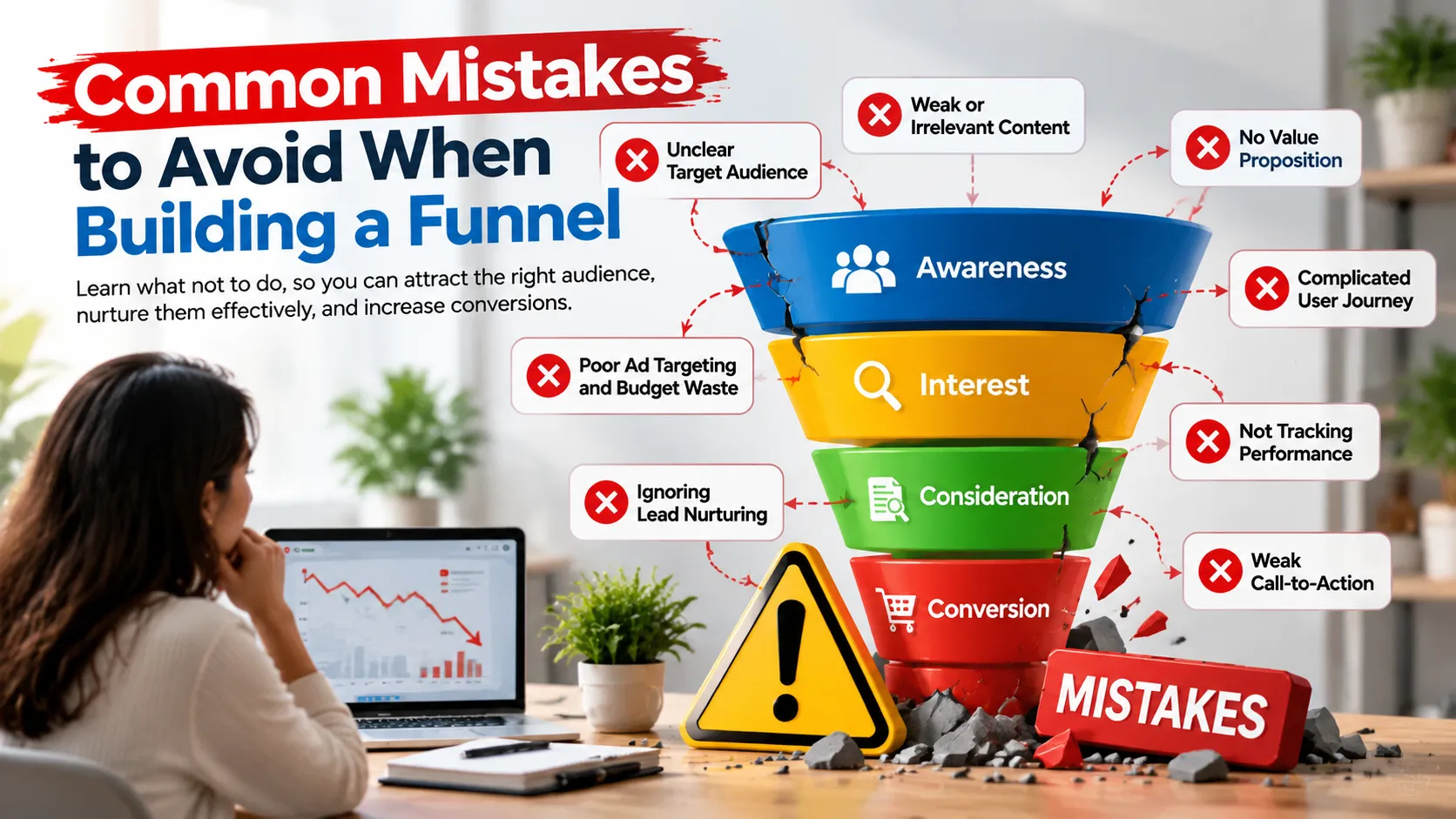
Even a well-planned funnel can underperform when the business focuses on activity instead of customer needs. Avoid the following mistakes when designing and maintaining your process.
- Treating the funnel as a perfectly linear journey. Customers may revisit earlier information, compare several providers, or discover your brand through multiple channels. Design for realistic behavior rather than assuming everyone follows one fixed sequence.
- Using the same message at every stage. An introductory educational article and a high-intent service page serve different purposes. Match the information and call to action to the customer’s current needs.
- Prioritizing traffic over lead quality. A campaign that attracts many irrelevant visitors can consume resources without producing meaningful opportunities. Evaluate qualified leads and actual customer outcomes.
- Ignoring the transition between marketing and sales. Slow responses, inconsistent follow-up, and unclear qualification criteria can waste demand generated by otherwise effective campaigns.
- Overlooking retention. If your business depends on repeat purchases or referrals, ending communication immediately after the first sale can limit long-term value.
- Making unsupported performance claims. Avoid promising guaranteed rankings, conversion rates, or revenue increases. Use accurate evidence, explain assumptions, and communicate uncertainty honestly.
Expert Tips for a More Effective Funnel
The strongest funnels connect customer research, content, distribution, conversion, and measurement into one practical operating system.
Start with the smallest complete journey that can produce a meaningful business result. A local service business may need one useful educational resource, a well-optimized service page, a clear enquiry form, and a reliable follow-up process before expanding into additional channels.
Next, ensure that each content asset has a defined purpose. A blog post should answer a real question. A comparison guide should help readers evaluate alternatives. A service page should explain the offer and support a decision. A follow-up email should deliver relevant information or provide a useful next step.
Review your content structure regularly. Internal links should help readers discover related resources naturally, while external references should support claims or direct readers to authoritative information. Avoid adding links simply to increase link counts.
For a broader plan, review GrowthAxis Solutions’ guide to marketing strategies for small businesses. It can help connect your funnel with channel selection, content planning, and business goals.
Choosing a marketing agency for small business support should follow the same principle. Evaluate whether the provider can connect strategy, execution, tracking, and reporting rather than focusing only on the number of posts or advertisements delivered. When comparing online marketing companies for small businesses, review the proposed scope, communication process, measurement approach, and access to your accounts and data.
The right marketing methods for small business growth depend on your resources and customer behavior. Effective marketing tactics for small businesses should support a clear objective, while practical marketing techniques for small business growth should be measurable and sustainable. A well-defined funnel helps organize these decisions without forcing every company into the same channel mix.
Most importantly, keep improving the experience after publication. Customer questions, search data, sales feedback, and analytics can reveal where your next useful improvement lies. A funnel is not a one-time diagram; it is a working model that should evolve as your audience, offer, and business change.
Conclusion
A well-designed digital marketing funnel connects awareness, consideration, conversion, and retention into a measurable customer journey. By matching content to customer needs, improving the transitions between stages, and tracking meaningful outcomes, businesses can make better marketing decisions and build sustainable growth. Contact GrowthAxis Solutions to explore a practical digital strategy aligned with your audience, goals, and resources.
Frequently Asked Questions
1. What is a digital marketing funnel in simple terms?
A digital marketing funnel describes the journey from discovering a business to evaluating its offer, becoming a customer, and potentially returning or recommending the business. It helps organizations connect marketing channels and content with customer needs at each stage. The model also helps identify where prospects leave the journey and which improvements could increase qualified leads, sales, or retention.
2. What are the four stages of a digital marketing funnel?
The four commonly used stages are awareness, consideration, conversion, and retention. Awareness introduces the business to potential customers. Consideration helps them evaluate solutions. Conversion encourages an appropriate purchase or enquiry. Retention focuses on supporting customers after the transaction and encouraging future engagement. Some businesses add interest, evaluation, loyalty, and advocacy as separate stages when their customer journey requires more detail.
3. How do you create a digital marketing funnel for a small business?
Start by defining one business objective and researching your target customers. Map how they discover your business, what they need to know before buying, and which concerns influence their decisions. Create useful content for each stage, connect it with relevant calls to action, and track qualified enquiries and sales. Review performance regularly, identify weak transitions, and improve the parts of the journey that limit results.
4. Which channels work best at each funnel stage?
SEO, educational content, social media, and relevant advertising can support awareness. Comparison guides, service pages, email sequences, demonstrations, and case studies can help with consideration. Conversion pages, transparent offers, testimonials, and simple enquiry or checkout processes support the decision stage. Email, customer service, onboarding, and relevant follow-up can encourage retention. The best combination depends on the audience and business model.
5. What is the difference between a marketing funnel and a sales funnel?
A marketing funnel generally focuses on discovery, engagement, demand generation, and preparing prospects for a purchase. A sales funnel focuses more closely on qualifying opportunities, managing conversations, addressing objections, and closing deals. The two processes overlap and should share consistent definitions and data. Aligning marketing and sales helps businesses understand which activities produce qualified opportunities and which factors influence completed sales.
6. How can SEO improve a digital marketing funnel?
SEO can attract relevant visitors when they search for questions, products, or services connected to your business. Educational content can support awareness, while detailed service pages can help prospects compare solutions and make decisions. Internal links connect related resources, helping users discover useful information. SEO performance should be evaluated through relevant traffic, qualified enquiries, and business outcomes rather than rankings alone.
7. How do you measure the effectiveness of a digital marketing funnel?
Track the progression from relevant website traffic to engagement, qualified leads, customers, and repeat purchases. Measure conversion rates between stages, cost per lead, customer acquisition cost, revenue, and retention where appropriate. Google Analytics 4 Funnel exploration can help identify drop-off points in defined journeys. Combine analytics with customer feedback and sales data to understand why performance changes and determine which improvements deserve attention.
8. Can a digital marketing funnel work with a limited budget?
Yes. A small business can begin with a focused funnel that uses a useful educational resource, one relevant service page, a clear call to action, and consistent lead follow-up. Organic search, email, and selected social channels may support this process without requiring a large advertising investment. Prioritize the activities most relevant to your audience, measure results, and expand gradually when the business case supports additional spending.
9. How long does it take for a digital marketing funnel to produce results?
The timeline varies by industry, channel, purchase complexity, audience size, and starting position. Paid advertising may generate initial enquiries quickly, although profitable performance is not guaranteed. SEO and content marketing usually require sustained effort, while longer B2B sales cycles can delay completed purchases. Monitor early indicators and final outcomes separately, and allow enough time and data to evaluate performance responsibly.
10. What are the most common digital marketing funnel mistakes?
Common mistakes include treating the journey as perfectly linear, using identical messages for every stage, prioritizing traffic over qualified leads, neglecting follow-up, and ignoring customer retention. Inadequate tracking can also make it difficult to identify the real cause of poor performance. Businesses should define meaningful conversion events, align content with customer needs, and improve weak stages using reliable data rather than assumptions.