SEO, Content Marketing and AI Search Visibility: A Practical SEO Content Strategy
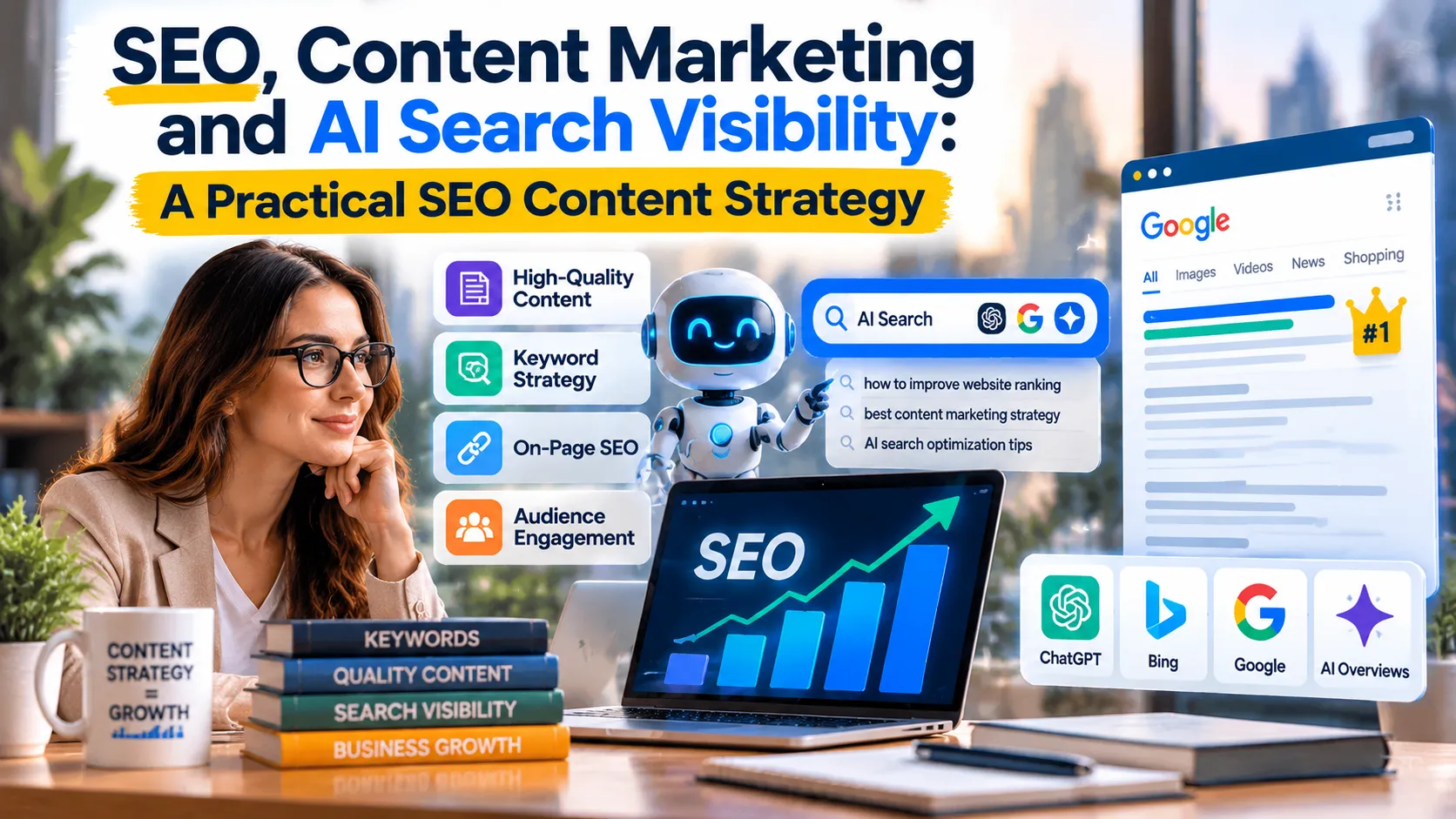
An effective SEO content strategy connects what customers search for with useful answers, trusted expertise, and a clear path from discovery to qualified business enquiries.
A successful SEO content strategy combines keyword research, search intent, helpful content, internal linking, technical foundations, and performance measurement. It also prepares businesses for evolving AI-powered search experiences without relying on unsupported optimization tricks. This guide explains how to plan, create, optimize, and improve content that attracts relevant visitors and supports sustainable business growth.
What Is an SEO Content Strategy?
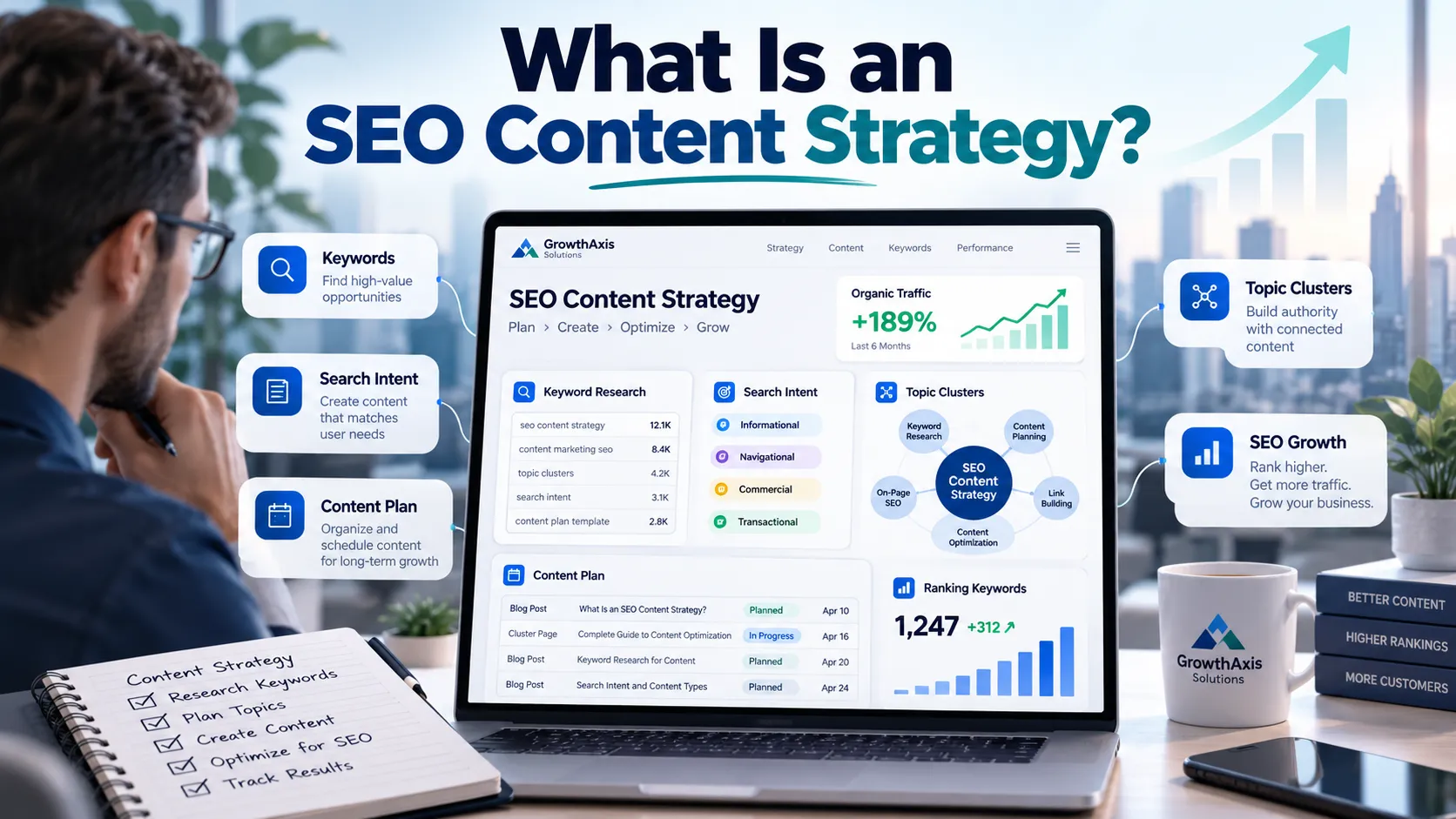
An SEO content strategy is an organized plan. It covers researching, creating, optimizing, publishing and keeping content up to date. The purpose is to help a website reach the people through organic search results.
Of sharing random blog posts a business looks at the questions potential customers are asking. It finds out which topics match what the business offers. Then it builds content that answers those questions.
A strong SEO content strategy connects three goals: visibility, usefulness and business value. A page should help the right people find the business. It should answer a question someone has.. It should give a clear next step when a reader needs more help.
For example a company that offers search engine optimization services might write a guide, on keyword research. That guide could link to a technical SEO resource. It could explain when it’s time to get help.. It could guide interested readers to a service page that fits their needs.
The goal is not to turn every piece of content into an ad. The goal is to earn trust by giving information.. To make sure the right services are easy to find when people are ready to take action.
Google’s Search Essentials and SEO Starter Guide provide foundational guidance for making content accessible, understandable, and useful to searchers.
How SEO, Content Marketing, and AI Search Visibility Work Together
SEO, content marketing, and AI-powered discovery are closely connected, but they serve different functions.
SEO helps search engines discover, understand, and present relevant pages. Content marketing uses helpful information to educate an audience, build confidence, and support customer relationships. AI-powered search experiences can summarize information and provide links to sources that help people explore a subject further.
A connected digital content strategy coordinates these activities around audience needs rather than treating them as unrelated marketing tasks.
The relationship between seo and digital marketing becomes clearer when the entire customer journey is considered. Someone may discover an educational article, explore the company’s website, compare service options, and eventually request a consultation. Each interaction can support the next step.
Similarly, content marketing in digital marketing creates opportunities to answer questions before a prospective customer is ready to buy. A useful guide can establish familiarity long before a sales conversation begins.
Businesses often encounter phrases such as digital content marketing, digital and content marketing, and content marketing and digital marketing when researching how these disciplines connect. Although the terminology varies, the underlying principle remains consistent: useful information should support a defined audience and a meaningful business objective.
A comprehensive digital marketing and content marketing approach therefore requires coordination between research, publishing, distribution, conversion, and measurement.
Understanding the Three Search Environments
Traditional organic search results help users find pages that match their queries. Search features may display snippets, images, videos, and other information alongside standard listings.
Google AI Overviews and AI Mode can provide synthesized responses with supporting links. These experiences create additional ways for users to discover information, but they do not guarantee visibility for any particular publisher.
Google explains these experiences in its official guide, AI Features and Your Website.
The practical implication is straightforward: build a technically accessible website, publish useful information, demonstrate credibility, and organize content so readers can understand it easily.
Do not assume that inserting a particular phrase, adding an unverified AI-specific file, or implementing unnecessary markup will secure a citation.
Start With Search Intent and Business Objectives
Before choosing keywords, determine what the intended reader wants to accomplish.
A search query may indicate that someone wants to learn a concept, compare alternatives, evaluate a provider, or complete an action. These differences influence the appropriate content format.
A guide that explains a process should not be structured like a service landing page. Likewise, a comparison article should explain meaningful differences rather than simply promote one option.
Consider the following content formats and their roles.
| Content format | Primary purpose |
|---|---|
| Educational guide or tutorial | Explain a concept, solve a problem, or teach a process |
| Comparison article | Help readers evaluate alternatives and understand trade-offs |
| Service page | Explain an offer, suitability, scope, and next steps |
| Case study or practical example | Demonstrate how an approach works in a real or clearly labelled illustrative situation |
| Checklist or template | Help readers implement a process and verify their work |
The format should follow the reader’s needs, not an arbitrary publishing formula.
Define the Business Value of Each Topic
Not every high-volume keyword deserves a new article.
A topic can attract substantial traffic but provide little value if its audience is unrelated to the company’s services. Another topic may have lower search demand but attract business owners who need exactly the type of help the company provides.
Before approving a topic, ask whether it connects to a real customer problem, whether the business can provide a credible answer, and whether the article can lead naturally to a relevant resource or service.
For example, an article about technical SEO audit procedures is closely related to an agency that provides technical SEO services. A broad article about an unrelated entertainment trend might generate visits without attracting suitable prospects.
Ahrefs discusses a similar principle in its guide to creating an SEO content strategy, which considers search traffic potential, business value, ranking potential, content quality, and ongoing maintenance.
The best topic is not necessarily the one with the highest estimated volume. It is the one that combines audience relevance, achievable visibility, and meaningful business potential.
Research Keywords Before Writing
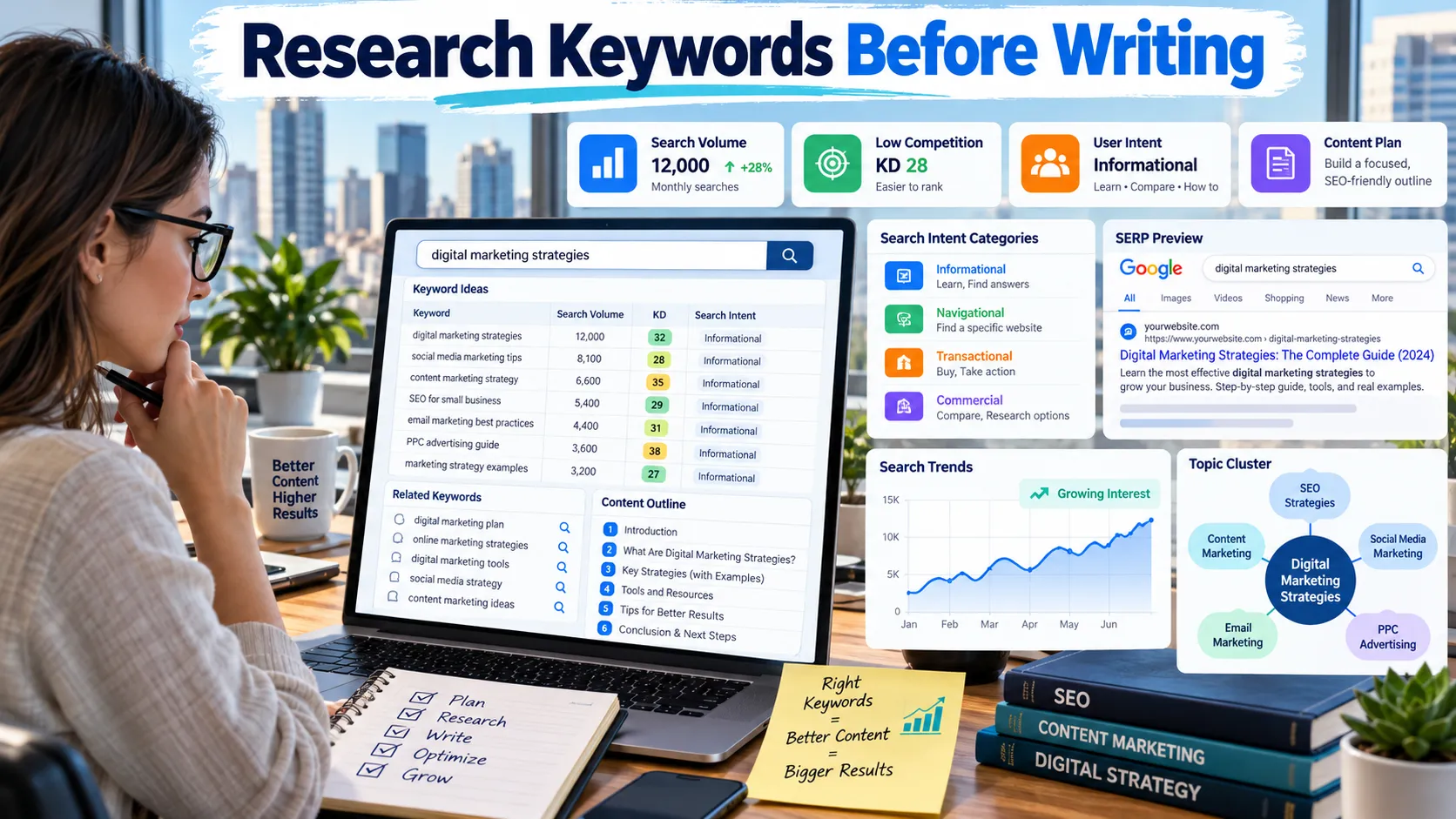
Keyword research helps identify the language people use when searching for information, products, and services.
Start with broad topics connected to the business. Expand these topics into specific questions, problems, comparisons, and tasks. Then examine the search results to understand which pages already satisfy the query.
A phrase such as seo digital marketing may appear in keyword research as shorthand for a broader need. Rather than forcing awkward wording into every paragraph, determine what the searcher is trying to understand and write naturally for that purpose.
Evaluate Keywords in Context
Keyword tools provide useful estimates, but their numbers should not replace judgment.
Semrush can help identify related queries, estimate keyword difficulty, examine competing pages, and find gaps between domains. Its keyword research guide explains ways to discover opportunities and investigate search intent.
Google Keyword Planner can provide advertising-oriented keyword estimates and demand trends. Google Search Console can show the queries and pages associated with a website’s actual search performance once sufficient data becomes available.
Review the following factors before selecting a primary keyword:
- Relevance to the business’s services and intended audience.
- Search intent and the content format visible in current results.
- Estimated search demand in the target country.
- Competition and the quality of pages already ranking.
- Related queries that deserve coverage within the same article.
- Business value, including the likelihood of attracting suitable enquiries.
- Existing website pages that already target the same topic.
Use the findings to choose one primary topic for each URL. Supporting phrases should clarify the subject, address related questions, and improve coverage without creating unnecessary repetition.
Analyze Competitor Content for Opportunities
Competitor research should reveal what users expect from a useful answer and where existing pages fall short.
Review several relevant ranking pages rather than copying a single competitor’s structure. Examine their headings, examples, explanations, sources, visual resources, internal links, and calls to action.
Look for missing practical details, outdated information, unclear definitions, weak examples, or unsupported claims. These gaps offer opportunities to create something genuinely better.
Semrush’s content gap analysis guide recommends examining gaps in topic coverage, intent alignment, content quality, and originality.
Ahrefs also explains how to organize related subjects into a structured SEO topical map. The important lesson is to prioritize relevant, useful topics instead of expanding a content calendar simply to increase the number of URLs.
Build a Pillar-and-Cluster Content Architecture

A pillar page provides a comprehensive overview of an important subject. Cluster articles explore specific questions or subtopics in greater detail and link to the relevant pillar.
This structure can improve navigation and help search engines discover related resources. However, publishing many connected pages does not automatically establish authority or guarantee higher rankings. Every page still needs a distinct purpose and useful content.
For a business offering SEO and digital marketing services, a practical architecture might begin with a central guide to SEO, content marketing, and AI search visibility.
Supporting articles could then address keyword research, technical SEO audits, internal linking, content updates, and optimization for AI search experiences. Each article should answer a focused question without duplicating the main pillar.
GrowthAxis Solutions already has a published guide titled Digital Marketing Strategy for Small Businesses: A Complete Growth Guide. This can provide a related resource when discussing the wider marketing plan in which search and content operate.
The published Brand Identity and Graphic Design for Modern Businesses guide may also be relevant when discussing consistent visual communication, although it should not be linked merely to increase the number of internal links.
A useful architecture connects pages according to the questions readers are likely to have next.
Create a Content Brief Before Drafting
A content brief gives the writer a clear target and reduces the risk of producing an article that repeats existing material.
It should identify the intended audience, primary keyword, search intent, article purpose, related questions, supporting evidence, internal links, and appropriate next step.
The brief should also state what the article will not attempt to cover. For instance, a general guide to SEO content should explain technical SEO at a useful level while directing readers to a dedicated technical resource for detailed implementation instructions.
This division of responsibility helps each page maintain a distinct purpose.
Create Helpful, Original, and Trustworthy Content
Strong content does more than summarize information that already appears elsewhere. It explains what matters, why it matters, and how the reader can apply the information.
Google’s helpful, reliable, people-first content guidance encourages original information, substantial value, accuracy, and clear evidence of expertise where appropriate.
An effective article should answer the primary question early, explain important concepts in plain language, provide useful examples, acknowledge limitations, and link to credible sources for claims that need verification.
Originality does not require inventing a new theory. It can come from a better explanation, an original framework, a carefully worked example, an implementation checklist, or a practical analysis that helps readers make decisions.
For example, an article about content planning could show how a hypothetical small business moves from a broad topic to a researched keyword, a specific article outline, a related service page, and a measurable conversion goal. Label hypothetical examples clearly rather than presenting them as real client results.
Demonstrate Expertise Without Inventing Evidence
Experience and expertise should be shown through useful work. Not just empty claims.
An agency can show how it works by explaining its research process. It should share examples with labels write out the thinking behind its advice and name the sources it used to check technical facts.
If real case studies are available tell the story: what the situation was at the start what work was done how long it took to measure and what actually happened. Be careful to tell the difference between something that happened together and something that caused it. Don’t pretend one change made all the improvements.
If a result wasn’t measured don’t make up a percentage, a quote from a customer or a fake ranking.
Businesses looking at content marketing agencies should be able to see how the agency makes its recommendations what work is. How success will be measured. The same rule matters when an agency writes content, for its own audience.
A researched article should help readers make better decisions. Even if they never buy a service.
Optimize Content for Google AI Overviews and AI Mode
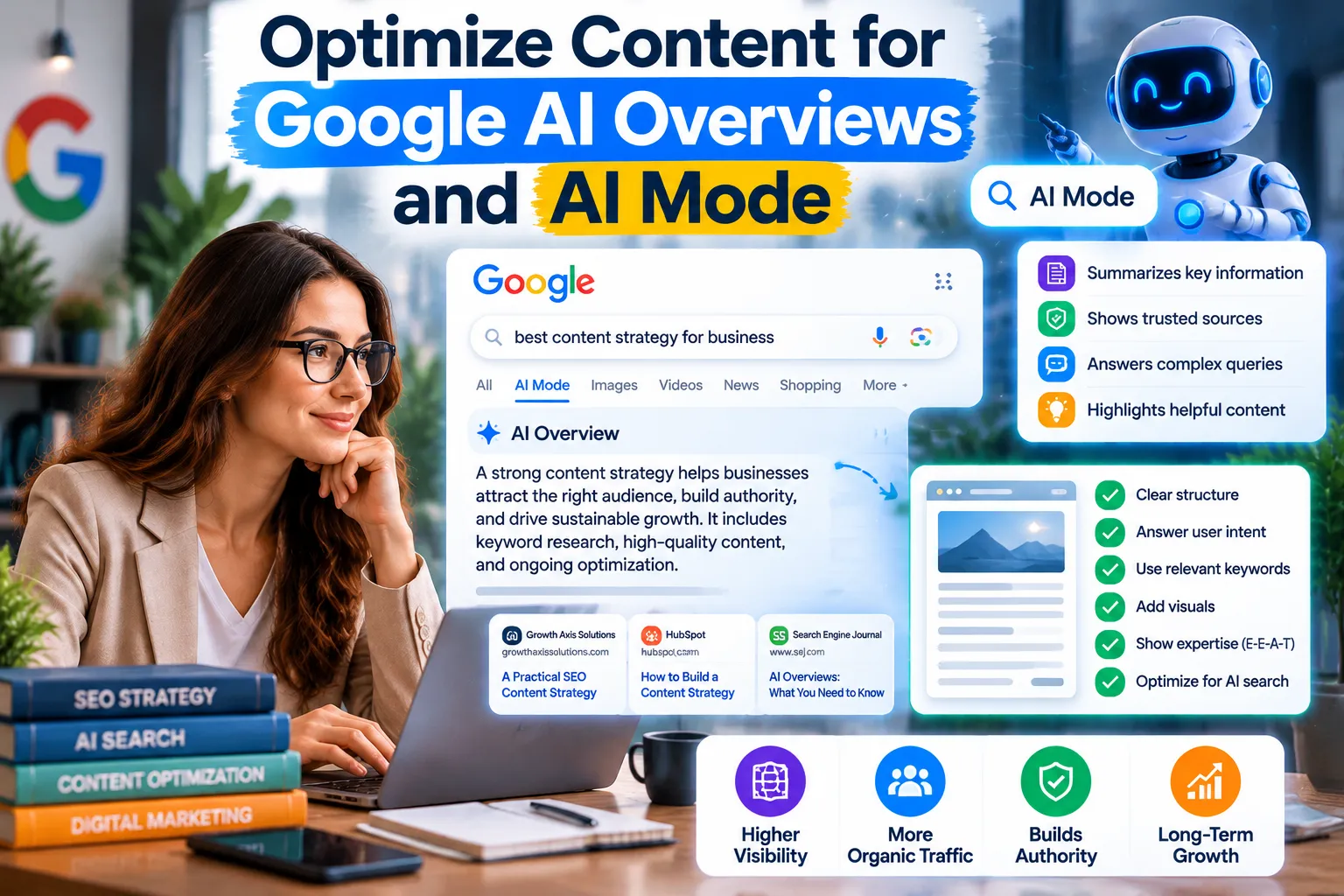
AI-powered search has changed how some users discover and explore information. It has not eliminated the importance of accessible, relevant, high-quality web content.
Google states that its existing SEO fundamentals remain relevant to AI Overviews and AI Mode. Pages must meet the applicable technical requirements and be eligible to appear in Google Search. Meeting those requirements does not guarantee indexing, ranking, or inclusion in an AI-generated response.
Read Google’s current AI search guidance before adopting claims about special optimization techniques.
Make Information Easy to Understand
A clear structure helps both readers and search systems understand a page better.
Use headings that accurately summarize each section. Define terms before you rely on them. Put explanations in visible text rather than hiding important information only inside images.
When a question has an answer give that answer clearly first and then explain the reasoning, context and limitations.
For example if an article asks whether every business needs a blog explain that the answer depends on audience needs, available expertise, commercial goals and the ability to maintain content. A blanket claim would be less informative.
Use supporting images, diagrams or videos when they help explain a concept. Add alternative text to informative images and make sure any structured data accurately reflects the visible content.
Google does not require an AI schema or a separate AI text file for inclusion, in AI Overviews or AI Mode. Avoid selling or buying optimization services that promise guaranteed AI citations.
Answer Related Questions Naturally
Conversational search often involves specific questions, comparisons, and follow-up queries.
An article should therefore cover the important subquestions that a reader would reasonably need answered. A guide about keyword research might explain intent, competition, topic grouping, and how to evaluate opportunities.
Do not add unrelated questions merely because a tool suggests them. Each section should contribute to the article’s main purpose.
The relationship between digital content marketing and AI search visibility is not a reason to produce hundreds of near-identical pages. It is a reason to create genuinely useful information that people can understand, evaluate, and reference.
Google’s guidance on using generative AI content emphasizes accuracy, quality, relevance, and user value. Generative tools may assist with research and structure, but their output still needs human review and fact-checking.
Improve On-Page SEO and Internal Linking
On-page optimization helps readers and search engines understand the purpose of each page.
Use a clear page title, a H1 logical subheadings, an informative introduction and a URL that accurately represents the subject. Write a meta description that reflects the articles actual contents while recognizing that Google may generate a different search snippet for on-page optimization.
Place the keyword where it fits naturally. Supporting terminology should appear when it clarifies the subject not to hit a fixed number of repetitions.
The broader relationship between SEO content marketing strategy and on-page SEO becomes clear when content, structure and navigation work for on-page optimization. A useful page needs more than optimized wording; it also needs to be discoverable and accessible for, on-page optimization.
For technical implementation, readers can explore GrowthAxis Solutions’ Technical SEO services. For titles, headings, and content structure, the On-Page SEO service provides a relevant next step.
Link Pages Together With Purpose
Internal links help readers move from one useful resource to another. They also help search engines discover pages and understand relationships between them.
Google’s link best practices recommend descriptive, relevant anchor text and contextual links.
GrowthAxis Solutions can connect this pillar to its SEO & AI Search services, which describe technical foundations, keyword and intent research, on-page optimization, authority, and AI search visibility.
When readers need help improving the content itself, the AI Content Optimization service is a relevant destination.
Use links because they help readers, not because every paragraph needs one. Avoid repeating the same exact-match anchor text unnaturally or linking to pages that do not yet exist.
The goal is a useful path through the website. A reader should be able to move from a general explanation to a more detailed guide, then to a relevant service page if professional help would be useful.
Distribute Content and Turn Relevant Visits Into Enquiries
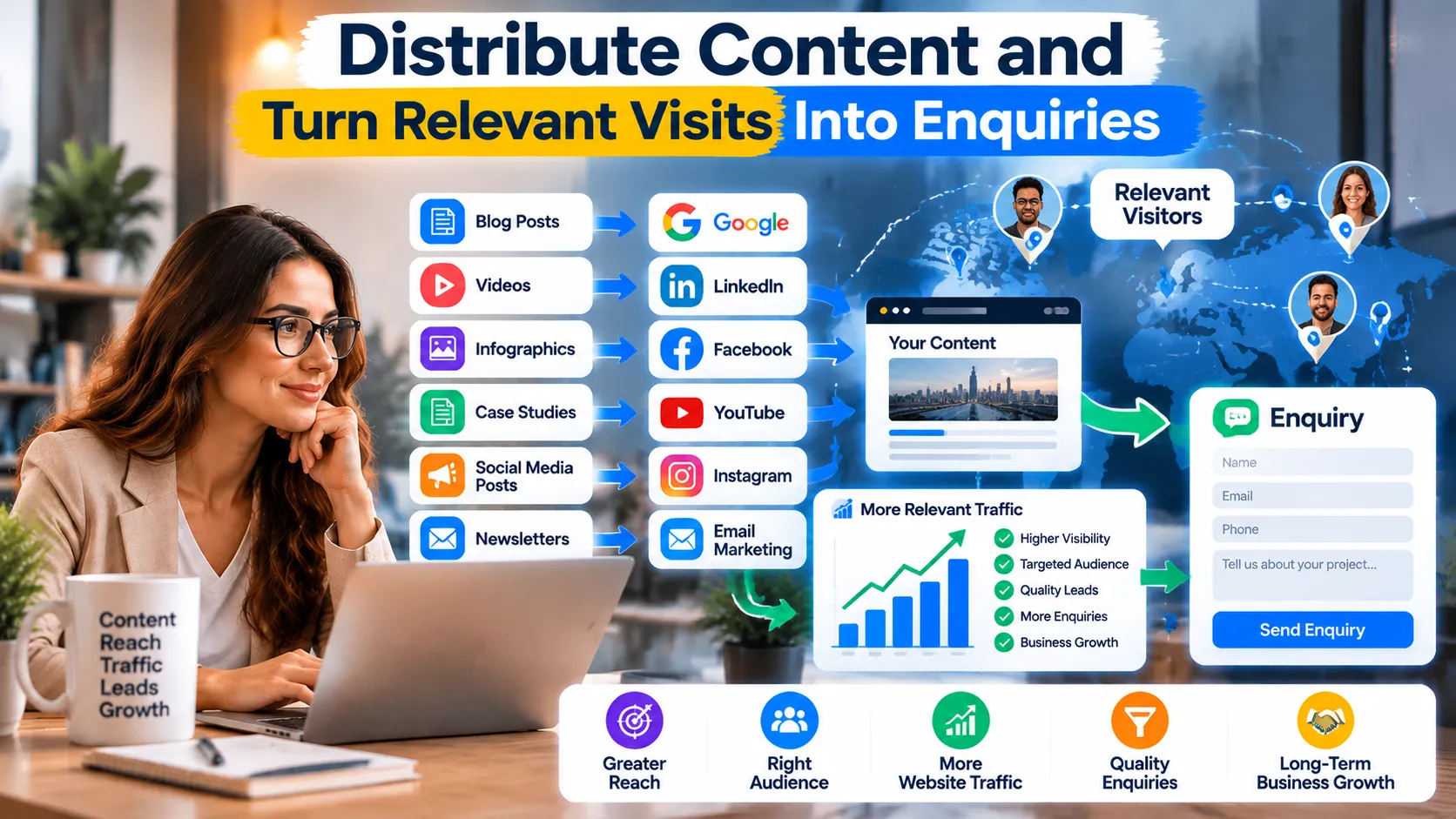
Publishing is the beginning of a content asset’s lifecycle, not the end.
A well-researched article may still reach few readers if the intended audience cannot discover it. Distribution helps introduce the resource to relevant people while supporting the long-term work of organic search.
Share suitable articles through the company’s social channels, newsletters, professional communities, and relevant customer communications. Adapt the presentation to each channel instead of reposting the same message without context.
The wider relationship between digital and content marketing becomes valuable when each channel supports a clear purpose. Social distribution may introduce a new resource, while organic search may continue bringing readers who are actively looking for an answer.
Similarly, content marketing and digital marketing should be coordinated with the website experience. If an article attracts readers but the site makes it difficult to explore related services, the customer journey may end prematurely.
Design a Useful Conversion Path
An informational article should not pressure every visitor to make an immediate purchase. Many readers are researching, learning terminology, or comparing approaches.
Offer a next step that matches the reader’s likely needs. A beginner might benefit from another educational guide. Someone diagnosing a technical issue may want an audit checklist. A business with a defined project may be ready to request a consultation.
GrowthAxis Solutions can direct relevant readers toward its Digital Marketing services or invite them to discuss a project when they need professional assistance.
The CTA should describe a real next step. Do not promise guaranteed rankings, guaranteed AI citations, or a fixed volume of leads unless the claim can be substantiated and the terms are clearly defined.
A Practical SEO Content Strategy Checklist for Implementation
Use the following checklist to turn research into a repeatable publishing process.
- Define the business goal, target audience, and problem the article will solve.
- Research the primary keyword, related queries, search intent, demand, and realistic competition.
- Review relevant competing pages to identify missing explanations, weak examples, and opportunities for original value.
- Map the topic to one primary URL and identify the pillar page or related resources it should support.
- Prepare an outline, verify claims against reliable sources, and add original analysis or clearly labelled examples.
- Review titles, headings, metadata, links, images, readability, and technical accessibility before publication.
- Publish the article, add relevant internal links, distribute it through appropriate channels, and monitor search performance and qualified enquiries.
This process helps prevent rushed publishing and keeps the content connected to a broader business objective.
Measure Performance and Improve the Content Over Time
A published article should be evaluated against the purpose for which it was created.
If the goal is organic discovery, monitor impressions, clicks, click-through rate, and query-level performance. If the goal is qualified enquiries, track relevant form submissions, consultation requests, and the quality of leads generated.
Google Search Console provides search performance information, while Google Analytics can help evaluate on-site behaviour and configured conversion events.
Google explains that traffic from AI features is included in Search Console’s overall web search reporting. Separate measurement of every AI-generated impression or citation may not be available through the standard reports, so avoid treating estimates from third-party tools as exact counts.
The following framework connects measurement to decisions.
| Measurement area | What to review and why |
|---|---|
| Search visibility | Impressions and query patterns reveal whether the page is appearing for relevant searches. |
| Search engagement | Clicks and click-through rate help identify opportunities to improve titles and descriptions. |
| Content usefulness | Engagement and navigation patterns can indicate whether readers find the next relevant resource. |
| Business outcomes | Qualified enquiries and conversions help determine whether the page supports commercial goals. |
| Content maintenance | Accuracy, broken links, changing search intent, and declining performance indicate when an update may be appropriate. |
A low click-through rate does not automatically mean the content is poor. Search features, query intent, ranking position, and the audience’s expectations can all affect clicks.
Likewise, longer time on a page does not always indicate success. A reader may spend a long time because the explanation is difficult to understand. Interpret metrics in context.
For AI visibility, combine available search reporting with careful manual checks of relevant queries and AI-generated responses. Record the date, query, platform, cited sources, and whether the brand appeared. Treat these observations as directional evidence because responses can vary.
Common Mistakes to Avoid
- Writing for keyword density instead of readers. Repeating a phrase to reach a predetermined percentage can damage readability. Use the primary keyword naturally and cover related concepts where they add value.
- Copying competitor outlines without adding insight. Similar headings do not make an article competitive. Provide clearer explanations, stronger examples, and information that addresses gaps in existing resources.
- Publishing pages with overlapping purposes. If multiple URLs target the same query and intent, readers and search engines may struggle to identify the most useful page. Clarify each URL’s role before creating another article.
- Treating AI Search as a shortcut around SEO fundamentals. No special markup guarantees inclusion in AI Overviews or AI Mode. Maintain crawlability, accurate content, and a useful website structure.
- Using unsupported statistics or invented case studies. Unverified numbers can damage trust. Link to reliable sources, explain the context, and label illustrative examples accurately.
- Adding internal links solely to increase link counts. Links should help readers find relevant information. A smaller number of contextual links can be more useful than a large collection of irrelevant links.
- Measuring success through traffic alone. A page may attract visitors who have no interest in the company’s services. Evaluate audience relevance and business outcomes alongside visibility.
- Publishing and never reviewing. Services, search behaviour, technologies, and guidance change. Revisit important content when evidence indicates that an update would improve accuracy or usefulness.
Avoiding these mistakes helps preserve the credibility of the website while making the publishing process more effective.
Pro Tips for Building Sustainable Search Visibility
Start with the topics where your business can provide the strongest, most relevant answers. A focused collection of useful resources is easier to maintain than a large library of loosely related posts.
Build an editorial process that includes research, drafting, review, publishing, and measurement. Assign responsibility for checking technical claims and updating content when important guidance changes.
Keep the business objective visible without allowing it to overwhelm the educational purpose. A useful guide should still help someone who is not ready to buy.
When considering digital marketing and content marketing together, connect editorial planning with service priorities, audience questions, and the website’s conversion paths. Use real customer conversations, enquiries, and recurring objections to discover topics that keyword tools may not reveal.
Finally, review results regularly and use them to make specific decisions. Improve an existing page when it already serves the intended topic but needs clearer explanations. Create a new page when a genuinely distinct question deserves its own answer. Consolidate overlapping pages when doing so produces a more useful resource.
Conclusion
A sustainable SEO content strategy combines search intent, original expertise, useful content, clear internal links, and ongoing measurement. Google AI Search adds discovery opportunities, but it does not replace sound SEO fundamentals. GrowthAxis Solutions can help businesses connect these elements into a practical digital growth plan. Contact GrowthAxis Solutions to discuss the right next step for your website.
Frequently Asked Questions
1. What is an SEO content strategy?
An SEO content strategy is a plan for researching, creating, optimizing, and maintaining content that meets audience needs and supports organic search visibility. It connects keyword research, search intent, content quality, website structure, and business goals so each page has a clear purpose.
2. How do I create an SEO content strategy for a small business?
Start by defining your audience and business objectives. Research relevant keywords, inspect competing pages, map topics to search intent, and prioritize content that supports your services. Publish useful articles, connect them through internal links, and evaluate results using Search Console, analytics, and enquiry data.
3. How does content marketing improve SEO?
Content marketing can support SEO by providing useful pages that answer questions, explain services, and attract relevant visitors. When content satisfies search intent and is technically accessible, it can earn organic visibility. Publishing more articles alone does not guarantee higher rankings or qualified leads.
4. What is the difference between SEO and content marketing?
SEO focuses on helping relevant pages become discoverable and understandable through search engines. Content marketing focuses on creating and distributing useful information for a defined audience. They overlap when content is researched and optimized for real search needs while supporting broader customer education and business goals.
5. How do I choose keywords for an SEO content strategy?
Choose keywords based on relevance, search intent, demand, competition, and business value. Review the current search results, investigate related questions, and compare the opportunity with existing website content. Use keyword tools for estimates, then make the final decision based on audience needs and realistic ranking potential.
6. How can I optimize content for Google AI Overviews and AI Mode?
Follow Google’s established SEO guidance: keep pages accessible to search crawlers, publish helpful and reliable information, organize content clearly, use visible text, and ensure structured data matches the page. Google does not require special AI markup for these features, and no technique guarantees inclusion.
7. How many keywords should one article target?
An article should have one clear primary topic and can naturally address closely related queries that share the same search intent. There is no universal keyword count that guarantees rankings. Focus on answering the reader’s question completely instead of repeating exact phrases to reach a fixed density.
8. How do pillar pages and cluster articles work together?
A pillar page provides a broad overview of a subject, while cluster articles answer narrower questions in greater detail. Contextual internal links connect the resources so readers can explore related information. Each page should serve a distinct purpose rather than repeat the same material across multiple URLs.
9. How can I measure whether my SEO content is generating business?
Track organic impressions, clicks, relevant queries, and click-through rate in Search Console. Use analytics to monitor configured conversion events and evaluate qualified enquiries. Compare performance over suitable periods and consider other factors that may influence results. Traffic alone cannot establish whether content is generating valuable business.
10. Should businesses use AI to create SEO content?
AI can help with research, outlining, summarization, and editing, but its output needs human review. Verify factual claims, add original analysis, check sources, and ensure the content meets a real audience need. Google warns that producing large amounts of low-value content through automation may violate its spam policies.