Digital Marketing KPIs Every Business Should Track
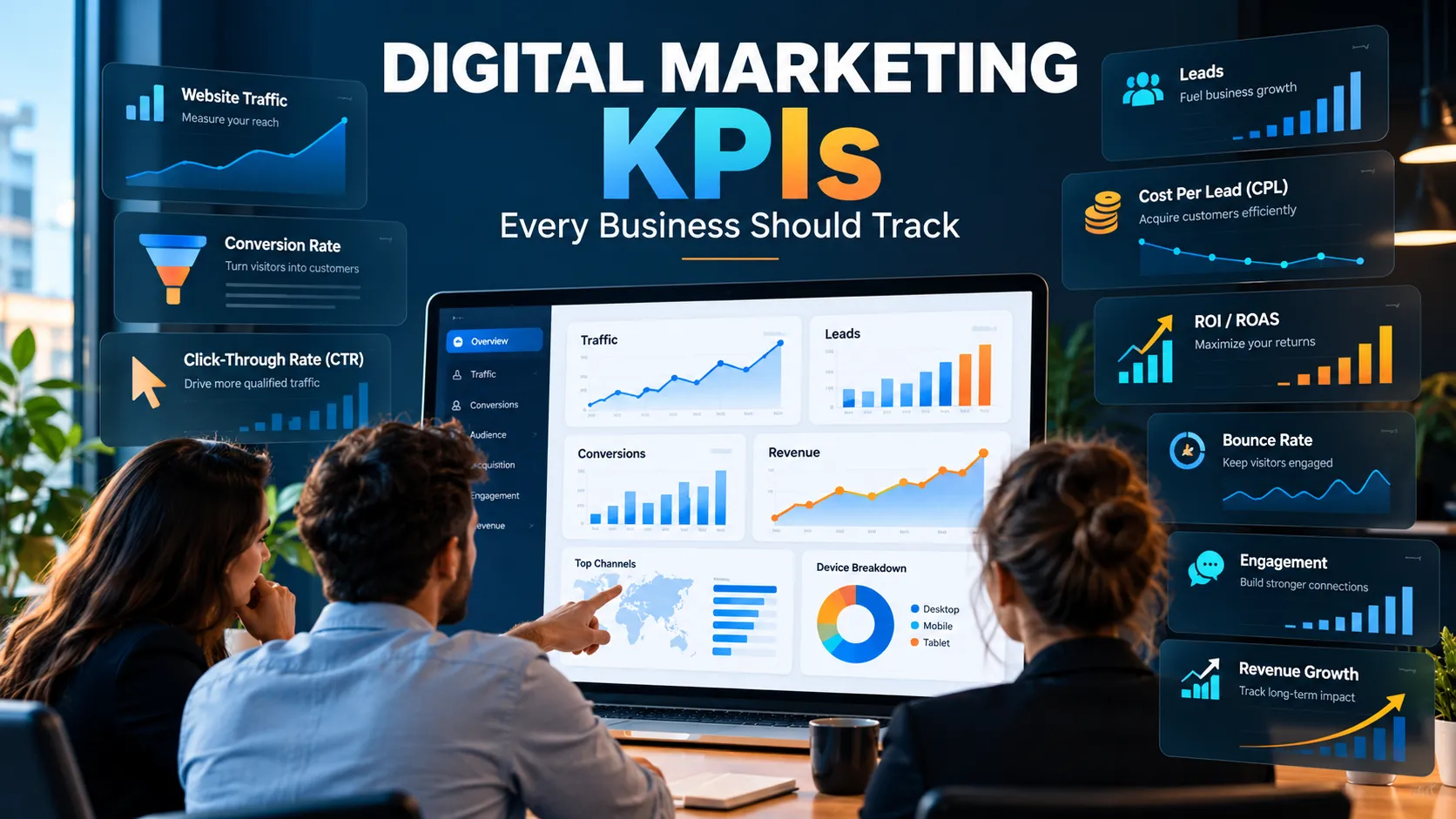
Track digital marketing KPIs that connect campaigns to revenue, reveal customer behavior, and show where every marketing investment creates measurable business value.
Understanding marketing performance requires more than checking website traffic, social media engagement, or advertising clicks. This guide explains the essential KPIs, their formulas, measurement tools, and practical applications. Learn how to evaluate SEO, paid advertising, social media, website conversions, and customer retention to make smarter marketing decisions.
What Are Digital Marketing KPIs?
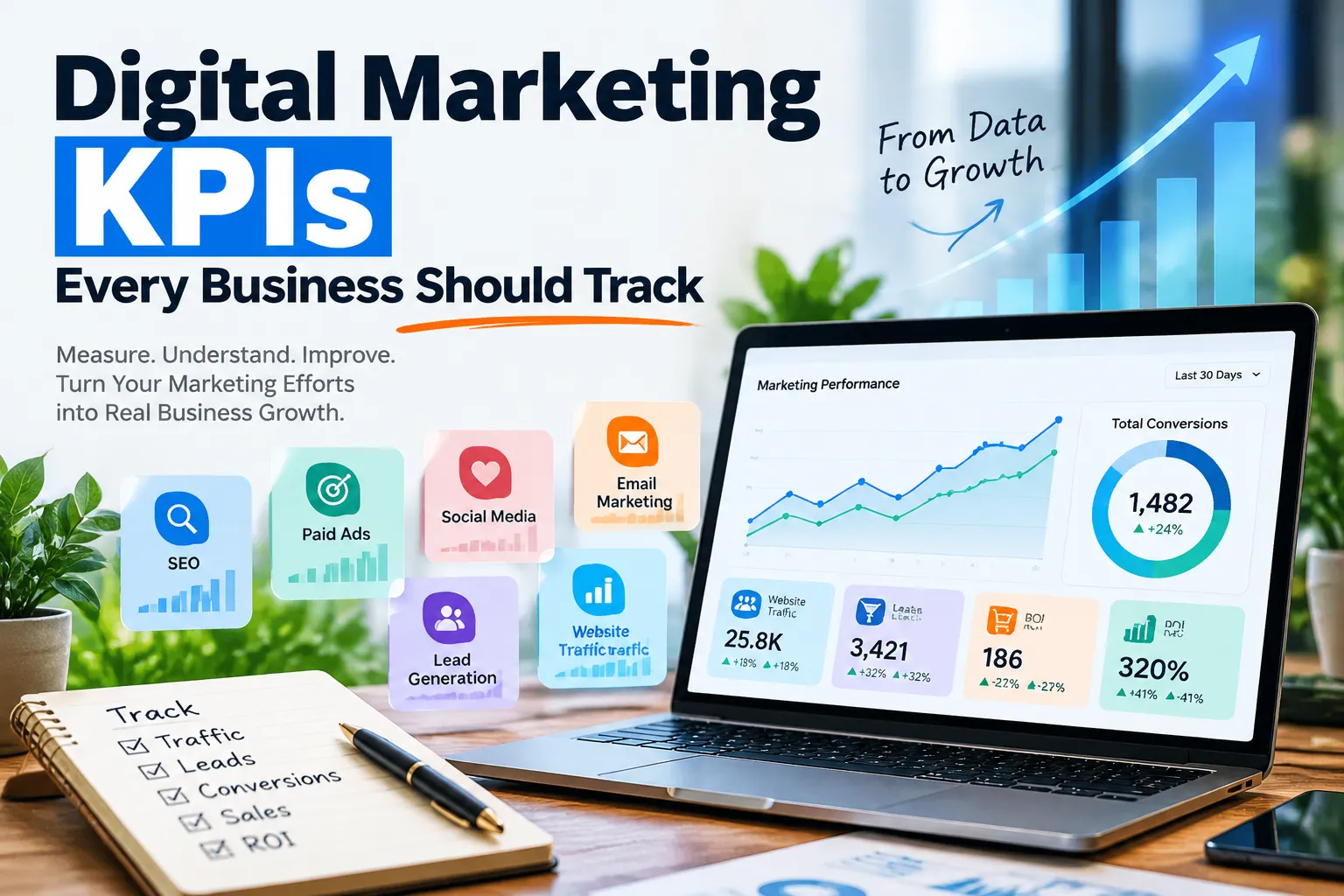
Digital marketing KPIs (Key Performance Indicators) are measurable values that show how effectively your online marketing activities contribute to specific business objectives.
They help businesses understand whether their marketing campaigns generate awareness, attract relevant visitors, produce qualified leads, convert customers, and deliver profitable growth.
For example, a business running Google Ads might receive 5,000 impressions and 400 clicks. These numbers describe campaign activity, but they do not reveal whether the campaign generates profitable customers. To understand its actual performance, the business must also measure conversions, cost per lead, customer acquisition cost, and revenue.
This distinction explains why digital marketing KPIs are important. They connect marketing activity with outcomes that matter to the business.
A useful KPI should answer a specific question. Are more qualified people discovering your website? Are visitors taking the intended action? Is your advertising generating customers at an acceptable cost? Are existing customers returning?
The answers help business owners decide where to invest, what to improve, and which activities no longer justify their costs.
What Is the Difference Between a KPI and a Marketing Metric?
A marketing metric is any measurable value associated with marketing activity. Examples include page views, impressions, email clicks, social media followers, and website sessions.
A KPI is a metric that directly measures progress toward an important business objective.
For instance, a company may track 20 different social media metrics, but if its primary objective is generating qualified enquiries, its most important KPIs might be qualified leads, cost per lead, and lead-to-customer conversion rate.
Every KPI is a metric, but not every metric deserves KPI status.
The distinction helps prevent reporting overload. Businesses should collect useful supporting data while concentrating their attention on a smaller group of indicators that influence actual decisions.
Why Are Digital Marketing KPIs Important for Business Growth?
Marketing without measurement makes it difficult to understand whether an investment produces value. A company may publish content consistently, launch advertising campaigns, and increase its social media following without knowing whether those activities contribute to revenue.
A measurement framework changes this situation. It provides evidence that helps business owners evaluate performance, identify problems, and allocate resources more intelligently.
They Connect Marketing With Business Objectives
Every marketing activity should support a defined objective. A brand awareness campaign may aim to increase relevant reach, while a lead generation campaign may focus on qualified enquiries. An ecommerce campaign may prioritize purchases and revenue.
Digital marketing KPIs help translate these objectives into measurable outcomes.
For example, a small consultancy might aim to generate 20 qualified enquiries per month. Its marketing team can monitor relevant website traffic, enquiry conversion rate, cost per lead, and the number of enquiries that become customers.
This makes performance evaluation more meaningful than simply reporting how many advertisements or social media posts the company published.
They Help Reduce Marketing Waste
Small businesses often have limited budgets and cannot afford to continue funding ineffective campaigns indefinitely.
Suppose one advertising campaign generates 50 leads at $20 each, while another generates 20 leads at $15 each. The second campaign has a lower cost per lead, but that does not automatically make it more profitable.
If the first campaign produces 15 customers and the second produces only two, the first campaign may deliver substantially better business value.
By connecting acquisition costs with lead quality and sales outcomes, businesses can make more informed spending decisions.
They Reveal Customer Behavior
Performance data helps explain how people interact with your website, advertisements, emails, and social media content.
If visitors frequently leave a service page without contacting the business, the page may need clearer information, stronger evidence, or a more relevant call to action.
If an email campaign receives clicks but generates few enquiries, the destination page may not fulfill the expectations created by the email.
Understanding these patterns allows businesses to improve the customer journey instead of guessing what might be wrong.
They Support Long-Term Growth
Marketing performance changes over time. Search competition increases, advertising costs fluctuate, audience preferences evolve, and customer expectations change.
A consistent KPI review helps businesses recognize these developments and adapt their strategies.
This is particularly important when implementing a small business marketing strategy that combines SEO, content, social media, paid advertising, and customer retention.
The Most Important Digital Marketing KPIs Every Business Should Track
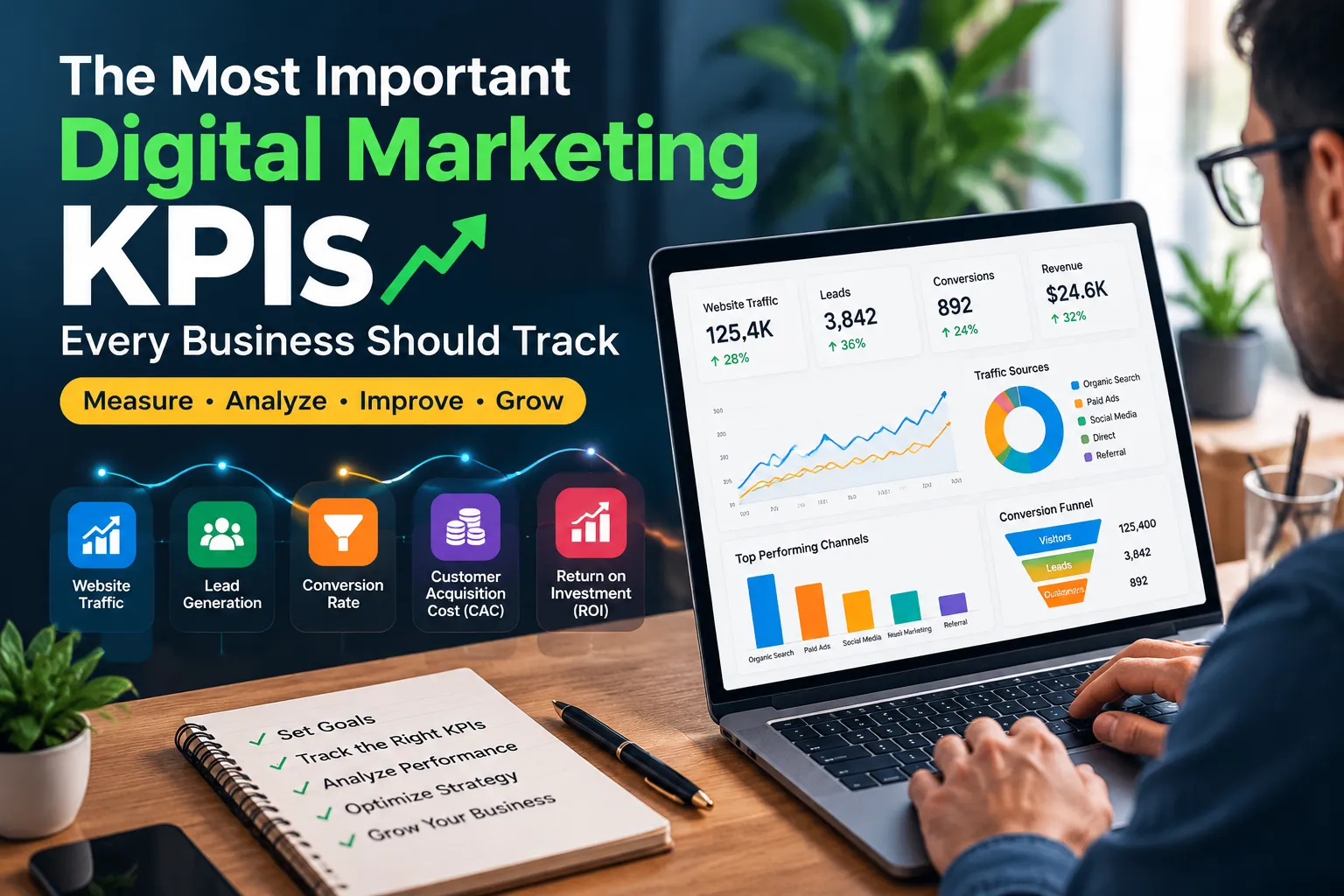
Not every business needs to monitor dozens of indicators. The appropriate selection depends on its industry, marketing objectives, customer journey, and revenue model.
However, certain digital marketing KPIs provide useful insights across most business types.
1. Website Traffic and Qualified Visitors
Website traffic measures the number of visits or users reaching your website during a particular period.
It provides an initial indication of how successfully your marketing activities attract attention. However, total traffic alone cannot establish whether the visitors match your target audience.
For example, a website receiving 10,000 monthly visits may generate fewer enquiries than a competitor receiving 2,000 visits if the competitor attracts people with stronger purchasing intent.
Businesses should examine traffic sources, landing pages, geographic locations, new and returning users, and the actions visitors complete.
Google Analytics 4 can help identify traffic from organic search, paid advertising, referrals, social platforms, and other sources.
A useful measurement approach separates relevant visitors from general traffic. If your company serves customers in particular locations, examine whether website visitors come from those markets. If you sell specialized B2B services, investigate whether the visitors match the industries and organizations you want to reach.
This makes website traffic a more meaningful supporting indicator within your digital marketing KPIs framework.
2. Organic Search Traffic
Organic search traffic represents visits generated through unpaid search engine results.
It helps businesses understand whether SEO activities attract people searching for relevant products, services, and information.
For example, a company providing website development may receive organic visits from searches about website costs, WordPress development, website maintenance, and business website design.
However, organic traffic should not be evaluated independently of search intent.
An educational article may generate considerable traffic but few immediate enquiries. A service page may receive fewer visitors while producing a higher percentage of qualified leads.
Both pages can contribute value at different stages of the customer journey.
Businesses investing in small business search engine optimisation should connect organic traffic reporting with relevant keyword performance, service-page visits, and enquiries.
A reliable small business seo firm should explain how its work supports relevant visibility and business outcomes instead of reporting keyword rankings without commercial context.
GrowthAxis Solutions provides SEO & AI Search services that support technical improvements, search visibility, content relevance, and ongoing optimization.
3. Search Impressions, Clicks, and Click-Through Rate
Google Search Console provides three important measurements for evaluating organic search performance.
Impressions show how often your website appears in eligible Google Search results. Clicks show how often users click through to your website. Click-through rate (CTR) measures the proportion of impressions that produce clicks.
The formula is:
CTR = (Total clicks ÷ Total impressions) × 100
Suppose a page receives 10,000 impressions and 500 clicks.
Its CTR is 5%.
This indicates that 5% of the recorded impressions resulted in clicks. It does not automatically mean that the page has a good or poor performance level because CTR varies according to search intent, query type, position, device, and search result features.
Average position also requires careful interpretation. It represents an aggregate position across impressions rather than a guaranteed ranking for every search.
Google explains these measurements in its Search Console performance documentation.
These indicators are especially useful when a page receives many impressions but relatively few clicks. The title, description, search intent alignment, and competitive search results may deserve closer examination.
4. Website Engagement Rate
Website engagement rate measures the proportion of sessions that meet Google’s definition of an engaged session in GA4.
An engaged session lasts longer than 10 seconds, includes a key event, or contains at least two page or screen views.
The formula is:
Engagement rate = (Engaged sessions ÷ Total sessions) × 100
Suppose a website records 1,000 sessions, of which 650 qualify as engaged sessions.
Its engagement rate is 65%.
This metric helps businesses understand whether visitors interact meaningfully with their website.
However, engagement rate is not a direct measure of purchase intent. A visitor may read a complete article and leave without purchasing because the article successfully answered their question.
Similarly, a visitor may complete a short enquiry form quickly and generate a valuable conversion without spending much time on the website.
Google provides the official definitions of GA4 engagement rate and bounce rate.
5. Conversion Rate
Conversion rate measures the percentage of visitors or interactions that result in a desired action.
A conversion could be a purchase, consultation booking, newsletter subscription, quotation request, or completed contact form.
The formula is:
Conversion rate = (Number of conversions ÷ Eligible visitors or interactions) × 100
For example, if 1,000 eligible website visitors generate 40 enquiries, the visitor-to-enquiry conversion rate is 4%.
Conversion rate is one of the most useful digital marketing KPIs because it connects website activity with customer action.
However, always define the denominator. A conversion rate calculated using website sessions will differ from one calculated using advertising clicks or unique visitors.
Businesses should also distinguish between micro-conversions and primary conversions. Clicking a phone number is a useful action, but a completed consultation or confirmed purchase represents a different level of business value.
A conversion-focused website should make important actions clear and easy to complete.
6. Cost Per Lead (CPL)
Cost per lead measures the average amount spent to generate one lead.
The formula is:
CPL = Total lead generation expenditure ÷ Number of leads generated
Suppose a company spends $1,000 on a campaign and receives 40 enquiries.
Its cost per lead is $25.
CPL helps businesses compare the efficiency of advertising campaigns, lead magnets, social media promotions, and other acquisition activities.
However, the lowest CPL does not always represent the best investment.
A campaign that generates 40 unqualified enquiries may be less valuable than a campaign that generates 15 genuine purchasing opportunities.
For a more accurate assessment, compare CPL with lead qualification rate, lead-to-customer conversion rate, and customer acquisition cost.
7. Customer Acquisition Cost (CAC)
Customer acquisition cost measures the average amount a business spends to acquire a new customer.
It provides a stronger financial perspective than cost per lead because it evaluates the final acquisition outcome.
The formula is:
CAC = Total customer acquisition costs ÷ Number of new customers acquired
Suppose a business spends $3,000 on marketing and relevant sales acquisition activities during a month. During that period, it acquires 15 new customers.
Its CAC is $200.
For accurate reporting, define which costs are included. A media-only CAC includes advertising expenditure, while a fully loaded CAC may also include agency fees, marketing software, creative production, and relevant staff costs.
Compare acquisition cost with the customer’s contribution margin and expected lifetime value.
A $200 acquisition cost may be acceptable for a customer generating substantial long-term contribution, but it may be unsustainable for a low-margin one-time purchase.
Salesforce also emphasizes CAC and customer lifetime value as important measurements for growing businesses in its small business KPI guide.
8. Return on Ad Spend (ROAS)
Return on ad spend measures the revenue attributed to an advertising campaign relative to its advertising expenditure.
The formula is:
ROAS = Attributed advertising revenue ÷ Advertising expenditure
Suppose a Google Ads campaign spends $1,500 and generates $6,000 in attributed revenue.
Its ROAS is 4:1, meaning the campaign generates $4 in attributed revenue for every $1 spent on advertising.
ROAS helps advertisers compare campaigns, keywords, audiences, and creative approaches.
However, revenue is not profit. A campaign generating $6,000 in revenue may still lose money if product costs, fulfillment, discounts, agency fees, and other expenses exceed the contribution generated.
Google Ads supports conversion value measurement so businesses can evaluate the value of different conversion actions. Its official conversion value documentation explains how these values support campaign measurement and optimization.
9. Marketing Return on Investment (ROI)
Marketing ROI measures the financial return generated by marketing relative to the cost of the investment.
A useful formula is:
Marketing ROI = [(Incremental profit attributable to marketing − Marketing cost) ÷ Marketing cost] × 100
Suppose a business invests $2,000 in a marketing campaign and generates $5,000 in incremental contribution profit before marketing costs.
Its marketing ROI is:
($5,000 − $2,000) ÷ $2,000 × 100 = 150%.
This means the campaign generated $1.50 in net contribution after the stated marketing cost for every $1 invested.
The calculation depends on correctly estimating incremental profit. Do not assume that every sale occurring during a campaign resulted from that campaign.
Where possible, use suitable attribution methods, historical comparisons, controlled experiments, and reliable sales records.
Marketing ROI is one of the most important digital marketing KPIs for businesses that need to justify spending and compare acquisition investments with financial outcomes.
10. Social Media Engagement Rate
Social media engagement measures how audiences interact with published content.
Interactions may include likes, comments, shares, saves, and other platform-specific actions.
A common follower-based formula is:
Engagement rate = (Total engagements ÷ Total followers) × 100
For example, a business with 5,000 followers receives 250 engagements across a selected reporting period.
Its follower-based engagement rate is 5%.
The calculation method matters because platforms may define engagement differently. Some marketers calculate engagement against reach or impressions instead of followers. Always use a consistent definition when comparing performance.
A business should also examine link clicks, profile visits, qualified enquiries, and purchases attributed to social media activities.
This is particularly relevant when implementing social media marketing for small business campaigns or evaluating social media advertising for small business.
GrowthAxis Solutions offers Social Media Marketing services focused on content direction, audience research, creative guidance, campaign recommendations, and performance review.
11. Email Click-Through and Conversion Rates
Email marketing metrics help businesses understand whether their messages encourage subscribers to take useful actions.
Click-through rate measures the proportion of delivered emails that generate tracked clicks under the reporting platform’s calculation method.
A simplified formula is:
Email CTR = (Unique email clicks ÷ Delivered emails) × 100
Suppose a campaign delivers 2,000 emails and receives 80 unique clicks.
Its click-through rate is 4%.
Email conversion rate goes one step further by measuring how many recipients complete the intended action after clicking or interacting with the campaign.
For example, a company might send a consultation invitation to 1,000 subscribers. If 30 recipients book a meeting, the campaign has generated 30 bookings.
Businesses should also monitor unsubscribes, spam complaints, delivery failures, and revenue or qualified enquiries generated.
Open rates can provide directional information, but privacy features and automated email loading can make them less reliable as a standalone measure.
12. Customer Lifetime Value (CLV)
Customer lifetime value estimates the financial value a customer generates throughout the relationship with a business.
For subscription companies, this may involve recurring revenue, retention, and contribution margin. For ecommerce businesses, it may reflect repeat purchases, average order value, and purchase frequency.
A simplified historical calculation is:
Customer lifetime revenue = Average purchase value × Purchase frequency × Customer lifespan
For profitability analysis, use contribution margin rather than treating all customer revenue as profit.
For example, if a customer makes four purchases of $150 over an estimated relationship period, the total revenue is $600. If the contribution margin is 40%, the associated contribution is $240 before acquisition and other excluded costs.
CLV helps businesses understand how much they can reasonably invest in acquiring and retaining customers.
However, projected lifetime value depends on assumptions about retention and purchasing behavior. Review those assumptions regularly rather than relying on optimistic forecasts.
13. Customer Retention and Repeat Purchase Rate
Customer retention measures how effectively a business maintains relationships with existing customers.
It is especially important for subscription services, membership businesses, ecommerce stores, and companies providing ongoing professional support.
A common retention formula is:
Retention rate = [(Customers at period end − New customers acquired during the period) ÷ Customers at period start] × 100
Suppose a subscription business starts a month with 200 customers, acquires 30 new customers, and finishes with 210.
Its retention rate is:
(210 − 30) ÷ 200 × 100 = 90%.
Repeat purchase rate provides another useful perspective for businesses that sell products or services repeatedly.
These measurements help identify whether marketing creates lasting customer relationships or merely generates one-time transactions.
14. Lead-to-Customer Conversion Rate
Lead-to-customer conversion rate measures how effectively a business converts captured leads into paying customers.
The formula is:
Lead-to-customer rate = (New customers acquired from leads ÷ Total leads) × 100
Suppose a business generates 100 leads and converts 12 into customers.
Its lead-to-customer conversion rate is 12%.
This KPI connects marketing performance with sales effectiveness. If the rate falls, the business may need to examine lead quality, response time, pricing, sales communication, or the fit between the offer and customer expectations.
For businesses with longer sales cycles, use consistent lead cohorts and allow sufficient time for prospects to complete the purchasing process.
15. Average Order Value and Revenue Per Customer
Average order value (AOV) measures the average amount customers spend per transaction.
The formula is:
AOV = Total sales revenue ÷ Number of orders
If an online store generates $12,000 from 200 orders, its AOV is $60.
This metric helps ecommerce businesses understand whether marketing campaigns attract customers who purchase higher-value combinations of products.
Revenue per customer provides a broader view of the average revenue generated by each customer during a defined period.
Both measurements can help businesses evaluate promotions, product recommendations, bundles, and customer retention activities.
How to Choose the Right Digital Marketing KPIs for Your Business
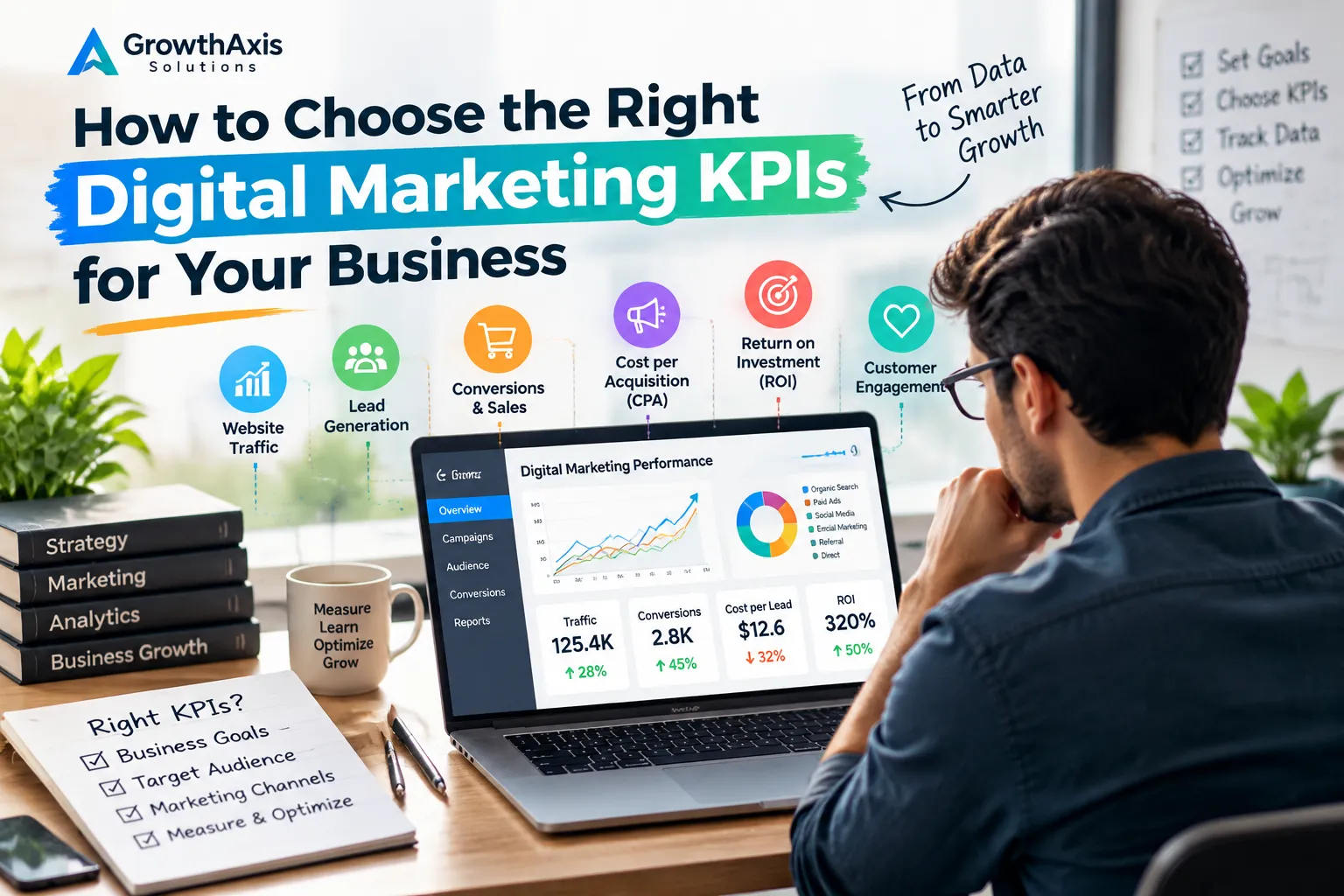
The most useful measurement framework begins with business goals. A local business seeking more enquiries should not use exactly the same KPI set as an ecommerce company focused on repeat purchases.
Your chosen digital marketing KPIs should reflect the outcome you want to achieve and the stage of the customer journey you need to improve.
KPIs for Brand Awareness
Businesses seeking stronger visibility should examine relevant reach, impressions, branded search interest, video views, and website visits from target audiences.
These measurements show whether marketing reaches the intended audience, but they should not be confused with revenue generation.
KPIs for Lead Generation
A lead-focused business should prioritize qualified leads, cost per lead, landing-page conversion rate, lead qualification rate, and lead-to-customer conversion rate.
These indicators help evaluate whether campaigns attract people who genuinely need the company’s services.
KPIs for Ecommerce and Sales
An ecommerce company should focus on revenue, purchase conversion rate, average order value, customer acquisition cost, ROAS, and repeat purchase rate.
Together, these measurements help explain both immediate campaign performance and longer-term customer value.
KPIs for SEO and Organic Growth
SEO performance requires a combination of visibility, traffic, engagement, and commercial measurements.
Businesses should monitor organic clicks, impressions, CTR, relevant keyword visibility, organic landing-page performance, and qualified leads generated through organic search.
This approach helps small business seo marketing programs focus on customer acquisition rather than rankings alone.
Which KPIs Should You Track for Each Marketing Channel?
Each marketing channel produces different types of performance data. Combining channel-specific measurements with business outcomes creates a more complete view of marketing effectiveness.
| Marketing channel | Important KPIs and measurement sources |
|---|---|
| SEO and organic search | Impressions, clicks, CTR, average position, organic sessions, organic conversions; Google Search Console and GA4 |
| Google Ads and PPC | Impressions, clicks, CPC, conversion rate, cost per conversion, conversion value, ROAS; Google Ads |
| Social media | Reach, engagement, link clicks, profile activity, leads, cost per result; platform analytics and advertising dashboards |
| Email marketing | Delivered emails, clicks, conversions, unsubscribes, revenue; email platform and CRM |
| Website and landing pages | Sessions, engagement rate, form submissions, conversion rate, key events; GA4 and CRM |
| Customer retention | Repeat purchases, retention rate, churn, CLV, renewal revenue; CRM and sales records |
The important point is that channel performance should not remain isolated. For example, social media may introduce a prospect, organic search may help them compare solutions, and a later email may contribute to the purchase.
Attribution should reflect this complexity where possible.
How to Track Digital Marketing KPIs Using the Right Tools
Collecting accurate data is essential before evaluating performance. Businesses should select tools according to their requirements, budget, technical capacity, and reporting needs.
Google Analytics 4
Google Analytics 4 helps businesses understand website and app interactions.
It can measure traffic sources, sessions, engagement, key events, landing-page performance, and revenue when the appropriate tracking is configured.
A business should first identify its most important customer actions. These may include form submissions, purchases, booking confirmations, telephone clicks, or other meaningful interactions.
Configure these actions as key events where appropriate, then verify that tracking works correctly.
Read Google’s GA4 documentation for setup and reporting guidance.
Google Search Console
Search Console helps website owners understand how their pages perform in Google Search.
Its performance reporting includes impressions, clicks, CTR, average position, queries, and page-level information.
It is particularly valuable for identifying pages that receive search visibility but may need better titles, content alignment, or conversion paths.
Google also explains how Search Console and Analytics can work together in its guide to combining Search Console and Google Analytics data.
Google Ads Conversion Tracking
Google Ads conversion tracking helps businesses measure valuable actions following advertising interactions.
These actions may include purchases, quotation requests, sign-ups, phone calls, and other defined conversions.
For ecommerce, assign transaction-specific conversion values where appropriate. For service businesses, use realistic values for different lead types if reliable data supports those estimates.
Visit Google Ads conversion tracking to understand the available measurement options.
Social Media Analytics
Social platforms provide native reporting tools that help businesses evaluate content and advertising performance.
Use the reporting features available in Meta Business Suite, LinkedIn, TikTok, and YouTube according to the platforms you operate.
Focus on measurements connected to the campaign objective. A brand awareness campaign may prioritize reach and video views, while a lead campaign should emphasize qualified enquiries and cost per result.
CRM and Reporting Dashboards
A customer relationship management system helps connect marketing enquiries with sales outcomes.
For example, a CRM can record the original lead source, enquiry date, service interest, qualification status, sales stage, and final purchase value.
This makes it easier to understand which marketing activities generate valuable customers rather than simply collecting contact details.
A reporting dashboard can combine selected information from analytics, advertising platforms, Search Console, and CRM systems.
You do not need an expensive reporting platform to begin. A well-organized spreadsheet can provide a useful starting point if the business has a manageable number of campaigns.
Common Mistakes to Avoid When Tracking Digital Marketing KPIs
Businesses often collect more data than they can interpret. This can create complicated reports without improving marketing decisions.
The following mistakes can make performance measurement misleading.
- Tracking too many metrics: Monitoring every available number makes it difficult to identify the indicators that matter. Semrush recommends focusing on approximately three to five primary KPIs for an individual campaign, supported by relevant diagnostic metrics.
- Confusing activity with results: Impressions, followers, and clicks show activity, but they do not prove profitable customer acquisition.
- Ignoring lead quality: A campaign can produce many enquiries while attracting people who cannot or will not purchase.
- Using inconsistent formulas: Changing the denominator or cost definition between reporting periods makes comparisons unreliable.
- Ignoring attribution limitations: Different platforms may assign conversions differently. Avoid adding platform-reported revenue together as if every channel independently generated the same sale.
- Making decisions from insufficient data: Small samples and short reporting periods can produce misleading conclusions. Consider seasonality, sales-cycle length, and normal performance variation.
- Failing to connect marketing with sales: Marketing teams need feedback about lead quality, closed deals, and customer value to evaluate acquisition performance accurately.
Expert Tips for Improving Your KPI Performance

Start With a Small, Useful Scorecard
A small business does not need a dashboard containing 50 indicators.
Start with a few core measurements that represent the complete customer journey. A service business might prioritize qualified leads, cost per lead, lead-to-customer rate, customer acquisition cost, and marketing ROI.
An ecommerce business may prioritize revenue, conversion rate, AOV, CAC, ROAS, and repeat purchase rate.
Keep additional measurements available for investigating problems, but avoid presenting every supporting metric as a primary KPI.
Set Targets Based on Your Own Baseline
There is no universal conversion rate, CPC, or ROAS that guarantees success for every industry.
A target that works for a high-margin B2B consultancy may be unsuitable for a low-margin ecommerce store.
Establish your baseline using reliable historical data. Then set a realistic target based on the improvement your business needs and can reasonably support.
For example, if a landing page converts 2% of relevant visitors into enquiries, you might test whether clearer messaging and improved evidence can increase that rate.
Review Performance at the Right Frequency
Different KPIs require different review schedules.
Advertising campaigns may need frequent monitoring, especially during their initial testing period. SEO performance usually benefits from broader comparisons over longer periods. Customer retention and lifetime value require observation across appropriate customer cohorts.
A weekly review can identify operational issues, while a monthly review can help evaluate channel performance. A quarterly review can support larger budget and strategic decisions.
Avoid changing campaigns repeatedly in response to insignificant daily fluctuations.
Connect SEO With Revenue
A website ranking for relevant keywords is useful, but visibility should ultimately support business goals.
Track which organic landing pages generate qualified enquiries and which service pages attract visitors with stronger purchase intent.
For companies exploring small business seo marketing, the most useful improvements often involve connecting search intent, page quality, internal links, and conversion opportunities.
A small company marketing strategies framework should also consider the role of SEO alongside paid advertising, content, and customer retention.
If you are comparing affordable business seo small-business options, evaluate the quality of the work, reporting transparency, technical improvements, and relevance of the strategy instead of choosing a provider solely by its lowest price.
Measure Social Media Beyond Likes
Strong engagement can support brand awareness, but it should not become the only measure of social media success.
Businesses implementing social media marketing in small business operations should examine whether content attracts the right audience, encourages meaningful interactions, generates website visits, and contributes to enquiries.
Similarly, effective advertising methods for small businesses should be judged by their ability to reach suitable customers and produce valuable outcomes.
GrowthAxis Solutions can help connect these activities through its Digital Marketing services, including paid campaigns, social media, content marketing, and email marketing.
A Practical 30-Day Digital Marketing KPI Implementation Plan
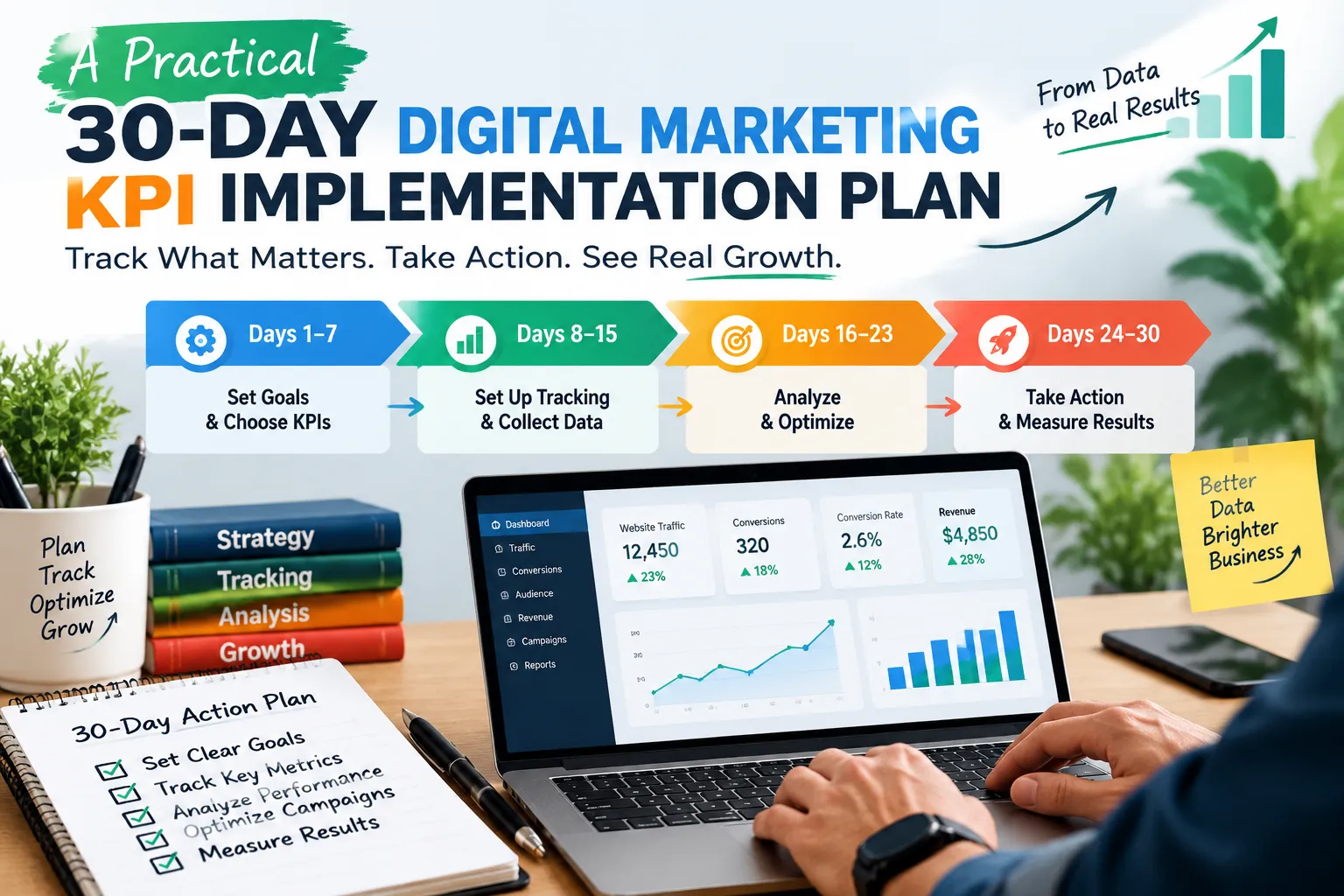
A measurement system becomes useful when a business applies it consistently. The following 30-day framework provides a manageable starting point.
Days 1–7: Define Goals and Measurement Requirements
Identify the main business objective. Determine whether the priority is awareness, qualified leads, online sales, or customer retention.
Review the existing website, advertising accounts, social media profiles, and sales records. Identify the data currently available and the conversions that need proper tracking.
Days 8–14: Configure Tracking
Set up or review Google Analytics 4, Search Console, advertising conversion tracking, and relevant CRM records.
Define each conversion clearly. For example, distinguish between a contact-page visit, a form start, a completed form, and a qualified enquiry.
Test tracking before using the data for important decisions.
Days 15–21: Establish Baselines and Targets
Record current performance for the selected KPIs.
Calculate conversion rates, cost per lead, customer acquisition cost, and other relevant financial indicators.
Use actual business data to establish targets rather than adopting generic industry benchmarks without considering your business model.
Days 22–30: Review and Optimize
Review campaign performance and investigate meaningful changes.
Identify which pages attract qualified traffic, which advertising campaigns produce valuable enquiries, and which customer segments convert most effectively.
Document the findings and select the next improvement to test.
This process creates a foundation for continuous optimization. Over time, your digital marketing KPIs should become part of regular business planning rather than a report reviewed only when something goes wrong.
How GrowthAxis Solutions Can Help Improve Marketing Performance
Effective marketing measurement requires a connected strategy. SEO, website development, creative execution, social media, and paid advertising should work toward shared business objectives.
GrowthAxis Solutions provides digital growth services for businesses worldwide, helping organizations improve visibility, customer experiences, and measurable marketing performance.
For businesses seeking better organic visibility, SEO & AI Search services can support technical health, on-page optimization, keyword research, content relevance, and authority development.
Companies looking for professional social media marketing for small business support can explore Social Media Marketing, which covers audience research, content direction, creative guidance, and performance review.
For a broader approach, Digital Marketing Strategy for Small Businesses explains how businesses can connect their marketing channels with customer needs and growth objectives.
The goal is not to collect more marketing data than necessary. It is to identify the measurements that reveal opportunities, improve decisions, and help businesses invest in activities that create lasting value.
Conclusion
Tracking digital marketing KPIs helps businesses understand what works, identify wasted spending, and connect marketing performance with revenue. Focus on qualified traffic, conversions, acquisition costs, and customer value rather than vanity metrics alone. Build a consistent measurement system and improve it over time. Contact GrowthAxis Solutions to develop a data-driven digital marketing strategy for sustainable business growth.
Frequently Asked Questions
1. What are the most important digital marketing KPIs?
The most important indicators depend on your business objectives. Common choices include website traffic, organic search clicks, conversion rate, cost per lead, customer acquisition cost, ROAS, marketing ROI, customer lifetime value, and retention rate. A small business should prioritize the few measurements that directly influence its marketing and financial decisions rather than tracking every available metric.
2. How many digital marketing KPIs should a small business track?
Most small businesses can begin with approximately five to eight primary indicators across their main marketing activities. Each individual campaign may need only three to five primary KPIs, supported by diagnostic measurements. The right number depends on the business model, marketing channels, and reporting requirements. Keeping the scorecard focused makes it easier to identify problems and take action.
3. What is the difference between marketing KPIs and marketing metrics?
Marketing metrics are measurable values associated with marketing activity, such as impressions, website visits, and email clicks. KPIs are the specific metrics selected to measure progress toward important business objectives. For example, a business may monitor social media likes as a supporting metric while treating qualified enquiries and customer acquisition cost as primary KPIs.
4. How do you calculate digital marketing ROI?
Digital marketing ROI can be calculated by subtracting marketing expenditure from incremental profit attributable to marketing, dividing the result by marketing expenditure, and multiplying by 100. For example, if a campaign generates $5,000 in incremental contribution profit and costs $2,000, its simplified ROI is 150%. Use profit rather than revenue alone when evaluating financial return.
5. Which tools are best for tracking digital marketing KPIs?
Google Analytics 4 helps measure website activity and conversions, while Google Search Console provides organic search performance data. Google Ads offers advertising and conversion reports, and social platforms provide native analytics. A CRM helps connect enquiries with customer acquisition and sales outcomes. A reporting dashboard can bring the most important information together for regular review.
6. What are the most important SEO KPIs for small businesses?
Useful SEO indicators include organic clicks, search impressions, CTR, average position, relevant organic sessions, qualified leads from organic search, and conversions on important landing pages. Businesses should evaluate search visibility alongside customer acquisition outcomes. Ranking improvements are valuable when they help attract relevant audiences and support the company’s business objectives.
7. What is a good conversion rate for digital marketing?
There is no universal conversion rate that applies to every industry, campaign, or website. Conversion rates vary according to audience intent, product price, traffic quality, offer, device, and the action being measured. Establish your own baseline and compare results over consistent periods. Use industry benchmarks only as context rather than treating them as guaranteed performance targets.
8. Why is customer acquisition cost important?
Customer acquisition cost shows how much a business spends to gain a new customer. It helps determine whether marketing investments are financially sustainable. Comparing CAC with contribution margin and customer lifetime value provides a more complete picture of profitability. If acquisition costs exceed the value customers generate, the business may need to improve targeting, conversion, retention, or pricing.
9. How often should businesses review digital marketing KPIs?
The review frequency depends on the metric and channel. Paid campaigns may require frequent monitoring, while SEO trends and customer retention often need longer observation periods. Many small businesses benefit from weekly operational checks, monthly performance reviews, and quarterly strategic evaluations. Consistent definitions and reporting periods are essential for reliable comparisons.
10. How can digital marketing KPIs improve business growth?
They help businesses identify successful marketing channels, understand customer behavior, reduce inefficient spending, and improve conversion processes. By connecting website performance, advertising costs, qualified leads, sales, and retention, companies can make decisions based on evidence. Consistent KPI measurement also helps businesses adapt their marketing strategy as customer needs and market conditions change.