SEO vs Google Ads: Which Should Your Business Choose?
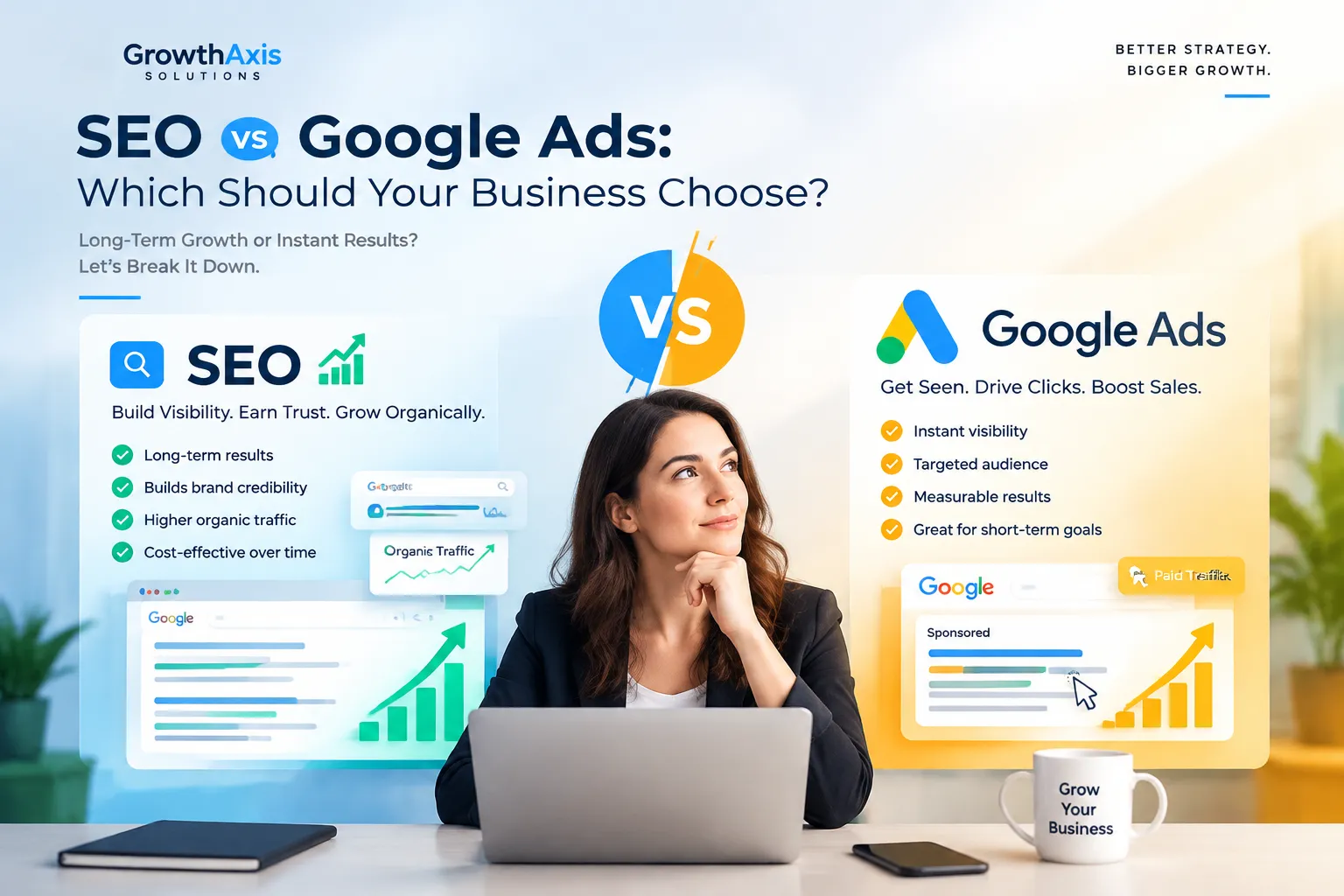
Trying to attract customers without wasting your marketing budget? SEO vs Google Ads comes down to how soon you need leads and what each customer is worth.
Google Ads can generate search visibility quickly, while SEO builds visibility that may keep attracting customers over time. This guide compares both options using 2026 benchmarks, unit economics, and business scenarios. Learn when to start with one channel, when to combine them, and what to measure before increasing spending.
SEO vs Google Ads: The Short Answer for Busy Owners
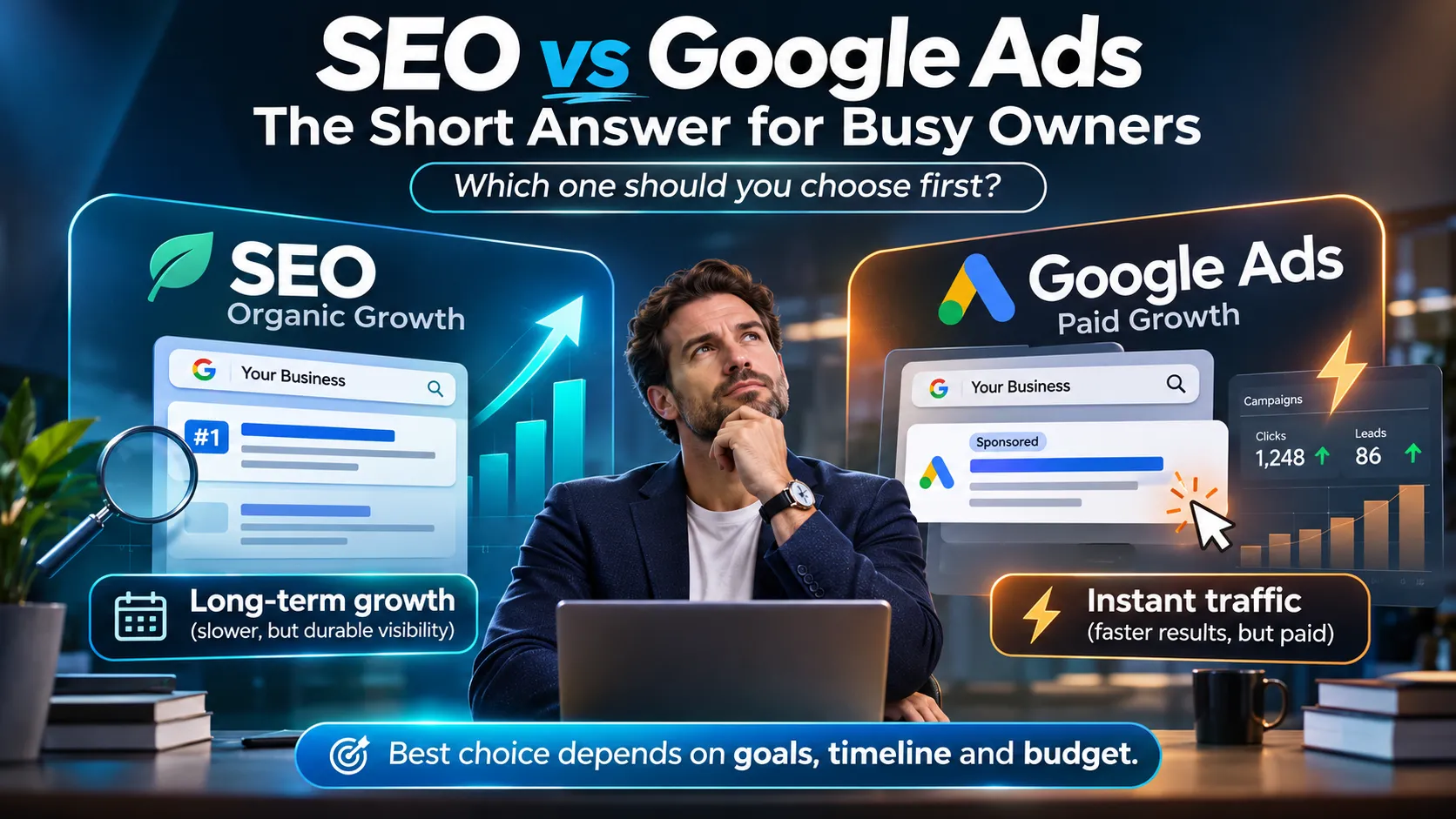
The best first investment depends on your cash flow, sales cycle, website readiness, and the urgency of demand. A business that needs bookings this month has a different problem from a company building a dependable source of enquiries over the next year.
- Choose Google Ads first when speed matters. You have a proven offer, customers already search for it, and you can afford to test clicks without risking essential operating cash. Ads can enter auctions soon after approval, but profitable leads are never automatic.
- Choose SEO first when you have time to build. You can invest consistently in helpful pages, technical improvements, and trust signals without needing immediate search revenue. Organic clicks do not carry a per-click ad charge, although content and optimization still cost money.
- Fix the website first when neither channel can convert. Broken forms, vague offers, slow mobile pages, and poor follow-up waste both organic and paid opportunities.
- Use both deliberately when the numbers support it. Paid search can test commercial keywords while SEO develops service pages and useful answers for customers who are still researching.
- Avoid choosing from traffic alone. Judge qualified leads, customer acquisition cost, contribution margin, and repeat business—not impressions or rankings in isolation.
A practical rule: if a profitable new customer would solve a near-term sales problem, test a small, tightly controlled ad campaign. If you have runway and customers research extensively before buying, invest in your organic foundation immediately. The SEO vs Google Ads decision should follow business economics, not agency preferences.
How Organic Search and Paid Search Actually Work
What does search engine optimization buy you?
Search engine optimization improves how search engines discover, understand, and present a site’s useful pages. Work may include repairing indexing problems, making navigation clearer, writing original service content, earning relevant mentions, and improving page experience. Google’s SEO Starter Guide explains that changes may take hours or several months to appear in search results. No legitimate provider can guarantee a number-one ranking.
SEO creates an asset rather than a reserved traffic slot. A helpful comparison, location page, or product guide may continue earning visits after publication, but rankings can fall when competition, search features, or user needs change. Maintaining that asset remains important. Businesses with crawlability issues should prioritize a technical SEO review before publishing dozens of new articles.
What does Google Ads buy you?
Google Ads lets an advertiser compete for placements on relevant searches, subject to eligibility, auction dynamics, targeting, bids, and budget. You control which offerings to promote and which locations to target. You pay according to the campaign’s pricing model; in common Search pay-per-click campaigns, clicks incur charges, not guaranteed sales. Better message relevance and landing-page experience can improve efficiency, but Google’s Quality Score guidance says the score itself is a diagnostic tool, not your business KPI.
The strongest paid campaign usually targets a specific buying need and sends visitors to a matching page. A local roof repair search should lead to emergency roof repair information, not a generic homepage. Businesses seeking this approach can explore Google Ads and PPC campaign management.
Do paid ads influence organic rankings?
No. Google explicitly says that paid search investment has no effect on organic ranking. Still, the channels share insights: search queries that generate profitable paid leads may reveal subjects worth targeting organically, while strong organic pages can improve the overall experience for visitors who later click an ad. SEO vs Google Ads is a resource decision, not a choice between two different versions of the same ranking system.
SEO vs Google Ads: A Side-by-Side Business Comparison
| Decision factor | SEO | Google Ads | What it means for your business |
|---|---|---|---|
| Time to visibility | Often gradual; timing varies | Eligible campaigns can appear quickly | Ads suit urgent, validated offers |
| How you pay | Content, tools, technical work, expertise | Ad spend plus setup and management | Neither channel is genuinely free |
| Cost per visit | No direct advertising charge per organic click | Often charged per ad click | Compare full acquisition cost, not click price alone |
| Targeting control | Influence through pages and relevance | More direct control over location, budgets, and keywords | Ads help test specific markets |
| Traffic after stopping investment | Existing pages may continue attracting visits | Campaign-driven traffic generally stops | SEO can create more durable visibility |
| Main uncertainty | Ranking competition and algorithm changes | Auction costs, conversion rates, and wasted clicks | Both require testing and maintenance |
| Best early measurement | Indexing, relevant impressions, qualified organic enquiries | Search terms, conversion quality, cost per qualified lead | Revenue quality matters more than raw traffic |
This comparison explains why there is no universal winner. SEO vs Google Ads becomes easier to assess once you know your target customer’s journey: Are they ready to buy today, comparing providers next month, or learning what problem they have? The answer determines the first page you build and the first campaign you fund.
What 2026 Data Says About Costs, Timing, and Search Behavior
The 2026 WordStream/LocaliQ search advertising benchmarks analyzed more than 13,000 US-based Google Ads and Microsoft Ads campaigns active from April 2025 through March 2026. Their reported overall figures include a 6.64% click-through rate, $5.42 cost per click, 8.18% conversion rate, and $66.69 cost per lead. These describe the publisher’s sample across industries, not a promise for a particular Google Ads account.
That distinction makes SEO vs Google Ads forecasting more reliable. A specialized legal service, local plumber, ecommerce store, and B2B software company face different bids, margins, sales cycles, and definitions of a lead. A form submission might look like a conversion in an ad dashboard but never become a paying customer. Use current keyword estimates and actual landing-page results before forecasting. For Canadian and Australian campaigns, research each country’s auction conditions rather than transferring US averages into a budget.
SEO timelines also vary. Search Engine Land’s 2026 guide describes three to six months as a common window for measurable progress, while competitive work can take longer. This is an industry guideline, not a deadline. Improving a page that already ranks on page two may work faster than launching a new domain into a crowded market.
Search behavior keeps evolving through AI-generated answers and changing result layouts. Google says its AI search features rely on established SEO fundamentals; they do not require a separate shortcut or special file. For a 2026 strategy, helpful original content, clear product information, technical accessibility, and credible evidence matter more than chasing a fashionable label.
Which Channel Should You Fund First at Each Business Stage?
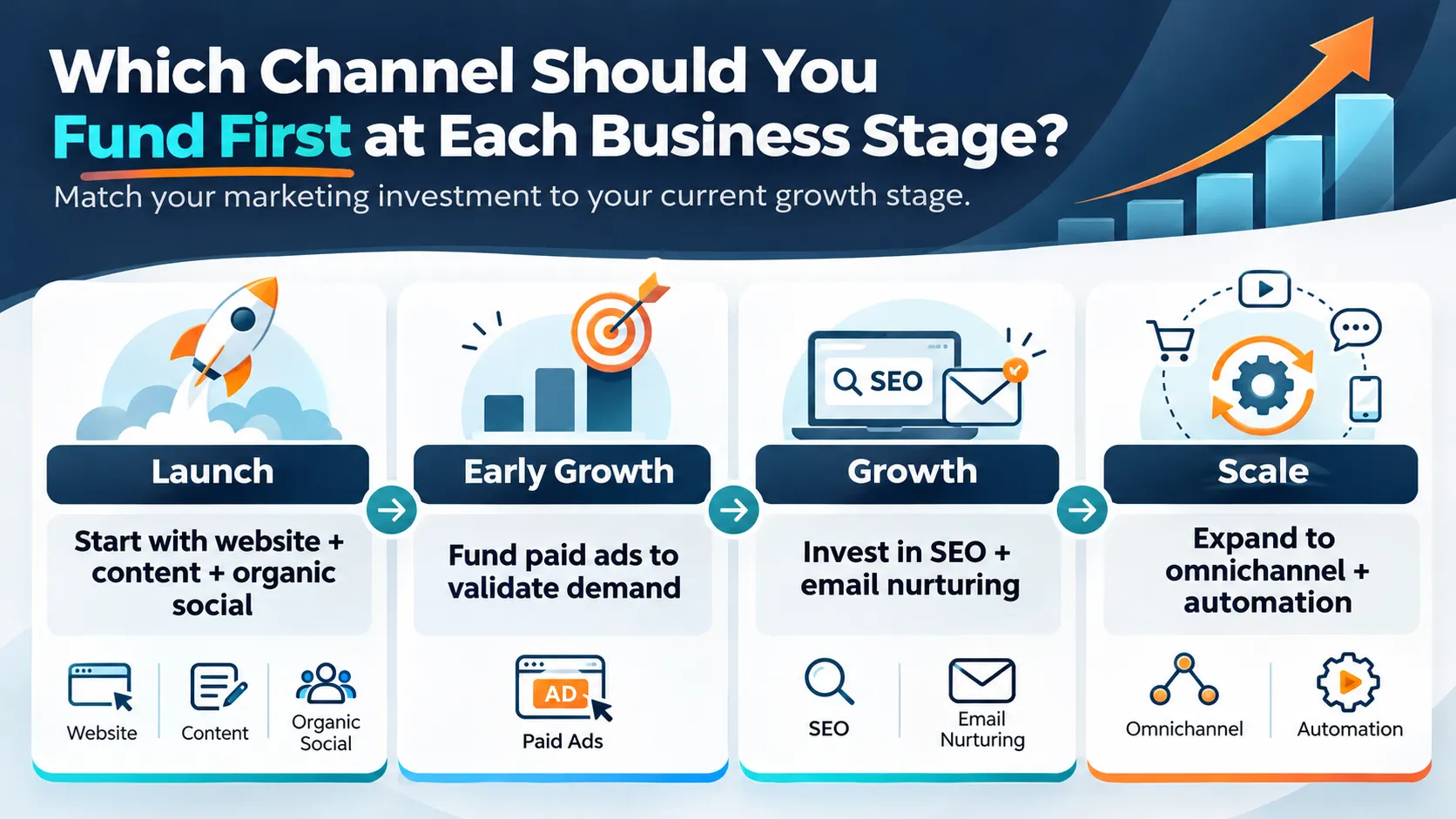
New business with no customers yet
A new business must answer two questions: Does anyone want the offer, and can the website turn interest into revenue? If prospects already search with strong commercial intent, a limited Search campaign can test the offer quickly. Keep the geography narrow, exclude irrelevant search terms, and check whether callers or form-fillers match your target customer. If search demand barely exists, ads may not validate the idea; interviews, referrals, or other channels may be more informative.
This early SEO vs Google Ads test should focus on learning rather than instant scale. At the same time, claim accurate business profiles where relevant and publish a trustworthy homepage, contact information, and one strong service page. These are useful foundations whether you choose SEO vs Google Ads first or postpone both while improving the product.
Local service company with existing demand
Imagine a Toronto home-cleaning company that can accept ten new bookings next month. Paid search could test searches such as “move-out cleaning Toronto” with tightly matched ads. SEO can develop neighborhood service pages, authentic reviews, clear pricing guidance, and helpful cleaning checklists. The ideal first channel depends on available appointment capacity, local cost per lead, and the profit left after labor and transport.
For local owners, SEO vs Google Ads works best when judged by booking value rather than traffic alone. For ongoing visibility, local SEO services can support relevant business information and location-focused pages. For urgent leads, test ads only after someone can answer calls quickly. Unanswered phone enquiries make apparently affordable clicks surprisingly expensive.
Ecommerce business with numerous products
Stores need healthy product feeds, stock information, persuasive product pages, shipping clarity, and returns policies. Search and Shopping ads can test purchase intent; SEO can strengthen categories, product descriptions, comparisons, and buying guides. Avoid advertising low-margin items simply because they attract cheap traffic. A profitable cart matters more than a high click-through rate.
B2B company with a long decision cycle
A software consultant or industrial supplier may wait weeks or months for a deal to close. SEO often helps buyers compare methods, specifications, risks, and vendors throughout that journey. Ads can reach narrower, high-intent queries, but the advertiser needs CRM tracking to connect the first enquiry with a later sale. In this setting, SEO vs Google Ads must account for pipeline value and lead quality rather than same-day purchases.
SEO vs Google Ads: Break-Even Calculations Before You Spend
A channel only makes business sense when expected customer value exceeds the cost of acquiring and serving that customer. Use contribution margin—revenue minus direct costs of delivering the product or service—rather than treating every dollar of sales as profit.
| Metric or calculation | Illustrative service business | Why it matters |
|---|---|---|
| Revenue per new customer | $1,500 | Sales value alone can mislead |
| Direct fulfillment cost | $500 | Labor and delivery reduce available margin |
| Contribution margin per customer | $1,000 | Amount available for acquisition and overhead |
| Paid search cost per click | $6 | Hypothetical auction price, not a benchmark |
| Landing-page lead rate | 6% | About 6 leads per 100 clicks |
| Cost per lead | $100 | $6 ÷ 0.06 |
| Qualified lead-to-customer close rate | 25% | One sale per four leads on average |
| Advertising cost per acquired customer | $400 | $100 ÷ 0.25 |
| Margin remaining after ad cost | $600 | Before management, tools, taxes, and overhead |
Every number in this table is an illustrative assumption. With 200 paid clicks, this business spends $1,200, expects 12 leads and approximately three customers, and generates $3,000 in contribution margin before advertising. That leaves $1,800 before agency fees and other overhead. Results may deviate substantially, especially with a small sample.
The calculation owners often miss
Your break-even cost per lead equals contribution margin per customer multiplied by the percentage of qualified leads that become customers. In this example, $1,000 × 25% = $250. A $100 lead looks workable, but it becomes less attractive if many enquiries are unqualified, refunds rise, or sales staff take too long to respond.
SEO needs its own financial model. If you spend $900 monthly on research, content, and improvements for six months, you have invested $5,400 before counting internal labor. Ask how many additional profitable customers those assets must produce over a realistic evaluation period. Do not divide an early SEO invoice by only this month’s organic leads and declare failure. Equally, do not assume future traffic will arrive just because you published content.
Why cheap traffic can be expensive
Suppose one campaign attracts 300 curious visitors and two customers, while another attracts 100 visitors and five customers. The second may create more value even with a higher price per click. For SEO vs Google Ads, compare qualified acquisition costs, gross profit contribution, and the quality of actual sales—not visits purchased or rankings gained.
Your First 90 Days: A Practical Implementation Plan
Use this SEO vs Google Ads sequence to avoid launching two underprepared channels at once. The timings are planning windows, not guarantees of traffic or revenue.
- Days 1–15: Build measurement and remove friction. Define a qualified lead, calculate customer margin, test forms and call handling, confirm mobile usability, and set up Google Analytics, Search Console, and conversion tracking where appropriate. Review search demand and choose one offer with a clear buyer benefit.
- Days 16–30: Choose the first experiment. If you need rapid demand, run a limited campaign around high-intent searches and a focused landing page. If cash flow permits a longer horizon, repair indexation issues and improve the most commercially relevant organic pages. Document what success would look like before paying for clicks or content.
- Days 31–60: Improve evidence, not just activity. Review search terms and lead quality for ads; refine page titles, useful examples, and internal links for SEO. Speak to actual customers about the questions they asked before buying. A content marketing strategy should answer those questions instead of filling a calendar with generic posts.
- Days 61–90: Reallocate based on economics. Pause wasteful keywords, strengthen proven landing pages, and prioritize organic topics that connect to real enquiries. Review lead-to-sale conversion, margin, and operating capacity before increasing budgets. Keep a written record of what changed and why.
For a small company, the purpose of this plan is learning. A modest, carefully tracked experiment often teaches more than an ambitious campaign that cannot explain where its leads came from. The SEO vs Google Ads choice can change after ninety days because actual customer data replaces guesses.
How to Make Paid and Organic Search Strengthen Each Other
An integrated SEO vs Google Ads strategy begins with shared customer insights. Paid search data can reveal valuable buyer language. If customers convert after searching “same-day furnace repair,” that phrase may signal the need for a dedicated emergency service page. However, do not publish a thin page for every variation of the wording. Build one genuinely useful resource that explains service availability, eligibility, process, and the next step.
Organic search can reduce dependence on buying every visit. A detailed pricing guide may attract prospects early, answer objections, and make subsequent sales conversations easier. Strong on-page SEO optimization also makes service pages clearer for people arriving through ads. Google does not reward your organic rankings for buying ads, but customers benefit when both channels lead to accurate, persuasive content.
Match keywords to the stage of the customer journey
Informational searches such as “how much does a kitchen remodel cost?” call for transparent guidance and examples. Comparison searches such as “wood cabinets vs laminate” benefit from evidence and clear trade-offs. Transactional searches such as “kitchen remodel contractor near me” need a specific offer, trust signals, and an easy way to request a quote. SEO can address all three stages; paid search often starts with the third because purchase intent is stronger.
Build trustworthy measurement across channels
Use Google Search Console’s performance report to review organic impressions, clicks, relevant queries, and page performance. Use Google Ads conversion reports and your CRM to identify which searches led to qualified customers. In Google Analytics 4, define meaningful key events and check that they reflect real customer actions. Channel reports can disagree because attribution methods and lookback windows differ; reconcile them against orders, booked calls, and recorded sales.
The goal of SEO vs Google Ads integration is not to claim credit twice. It is to discover the search experiences that create more profitable customers with less unnecessary spending.
Common Mistakes That Drain Small-Business Marketing Budgets
Mistake 1: Buying clicks before fixing the offer
An ad cannot rescue an unclear price, an unconvincing service explanation, or a broken enquiry form. Before spending heavily, test the entire journey from search to landing page to follow-up. The same applies to SEO: traffic to a confusing page rarely becomes dependable revenue.
Mistake 2: Treating all leads as equally valuable
A free-guide download and a qualified request for a paid consultation have different commercial meaning. Separate micro-conversions from sales opportunities, and measure whether leads match your geography, budget, and service criteria. Set reasonable response-time expectations with your team.
Mistake 3: Assuming SEO means free traffic forever
Organic clicks do not carry a Google Ads click fee, but audits, skilled writing, technical upkeep, and original research require investment. Rankings may fluctuate; content becomes outdated. If someone promises permanent first-page results, ask for the methodology and evidence behind the claim.
Mistake 4: Copying a competitor’s budget or keyword list
A competitor may have different margins, brand awareness, conversion rates, and customer retention. Their apparent success cannot justify your spend. Use competitor research to identify questions worth answering and offers worth differentiating, not to imitate every headline or bid.
These mistakes matter regardless of who wins the initial SEO vs Google Ads debate. Fixing the customer experience often improves the economics of both.
Choosing Affordable SEO Without Sacrificing Quality
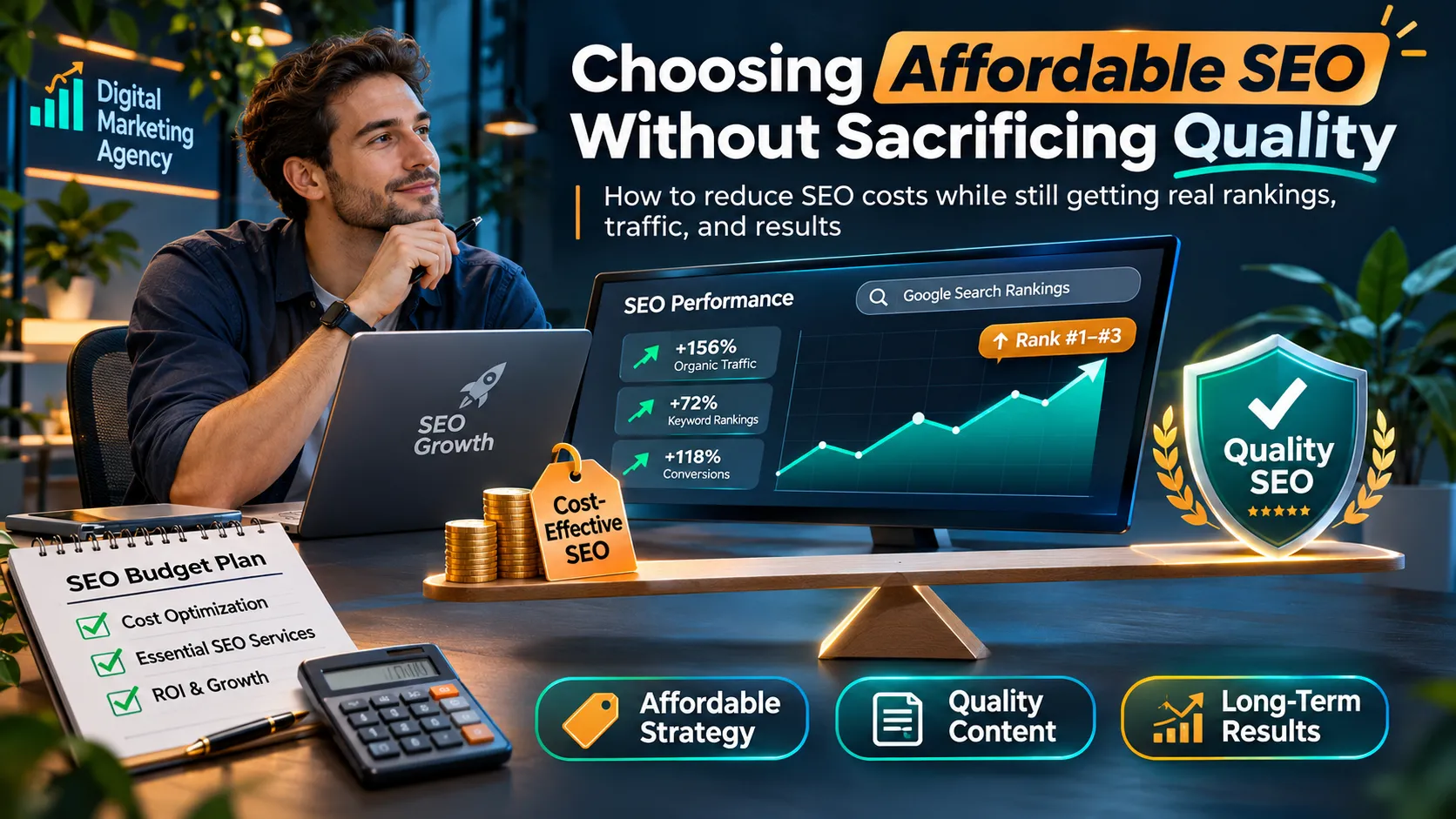
In the SEO vs Google Ads debate, choosing a low-cost agency is not the same as choosing a cost-effective strategy. Small-business owners frequently search for affordable seo for small business, but affordability should describe a suitable scope, not the lowest advertised price. The right first project might be fixing five important service pages, improving local information, and publishing two expert-reviewed guides—not buying fifty shallow articles.
When comparing affordable seo packages for small business, request deliverables, ownership of content, the pages prioritized, the reporting schedule, and the assumptions behind any forecast. Affordable seo services for small businesses should explain which tasks they will not perform within a limited budget. That honesty protects both the buyer and the provider.
For businesses exploring affordable small business seo, a focused technical audit, accurate service descriptions, and strong internal links may create a better foundation than an unfocused monthly package. Firms researching the best digital marketing agencies for small business should also ask how the agency measures qualified leads and whether ad spend, management fees, writing, and development are billed separately.
A sensible partner will explain SEO vs Google Ads through your numbers, offer staged priorities, and avoid guaranteeing rankings or fabricated case studies. Ask for a written plan that reflects your industry, country, competition, and actual capacity to serve new customers.
Pro Insights: Metrics That Reveal Which Strategy Is Working
Start SEO vs Google Ads reporting with contribution margin per customer, customer acquisition cost, and lead-to-customer close rate. For ecommerce, track profit after product costs, refunds, shipping, discounts, and advertising—not return on ad spend alone. For services, inspect calls, booked consultations, and completed jobs. A channel with fewer but better enquiries may be the stronger investment.
Use a consistent reporting period, but respect different timelines. Paid campaigns can produce usable query and conversion signals relatively quickly if they receive enough relevant data. SEO often needs longer trend windows, especially after major site changes. Compare new organic demand with branded searches, because existing customers searching your company name do not necessarily represent fresh acquisition.
Review your market by country and city. Search intent and competition in Sydney can differ from Vancouver or Chicago. Use local landing pages only when your business genuinely serves those places; do not create interchangeable city pages that offer no distinct information. Review the cost of responding to leads, too: a campaign that generates enquiries outside business hours may require staffing changes before scaling.
Finally, watch for an unusual outcome: some businesses should invest in neither channel first. If customer retention is poor, stock is unreliable, or the product-market fit remains uncertain, improving those problems may produce a higher return than purchasing more attention. The strongest SEO vs Google Ads strategy sometimes begins with a better business process.
Conclusion
SEO vs Google Ads is not a contest with one permanent winner. Choose ads first for urgent, measurable demand when your margins support acquisition costs; choose SEO first when you can build lasting, useful search assets. Before committing, calculate customer value, fix conversion barriers, and track real sales. Contact GrowthAxis Solutions to discuss a starting plan.
Frequently Asked Questions
1. Is SEO or Google Ads better for a new small business?
Start with the channel that can answer your most urgent business question. If people already search for your service and you have a tested offer, a tightly controlled Google Ads campaign can validate demand faster. If you have time but limited advertising cash, begin with a technically sound site and useful, locally relevant content. In many cases, basic website improvements should come before either. The SEO vs Google Ads decision is less important than whether a customer can understand and buy your offer.
2. How long does SEO take compared with Google Ads?
Eligible Google Ads campaigns can gain visibility after setup and approval, but generating profitable customers can require sustained testing. SEO changes can take weeks or months to show measurable effects, and competitive topics can require longer. Google’s documentation offers no universal SEO deadline. Plan around your cash runway and monitor early signals such as indexing, relevant impressions, qualified enquiries, and actual sales rather than promising results by a fixed date.
3. Is SEO free if I can write my own content?
Organic search does not charge you for each click, but SEO still consumes resources. Someone must research questions, verify claims, keep information fresh, troubleshoot technical issues, and improve page experience. You can reduce outside costs by writing from genuine experience, but your time has value. Publishing articles without understanding search intent or conversion paths can also create work without sales. Evaluate the opportunity cost alongside any agency or tool fees.
4. How much should a small business spend on Google Ads first?
Treat SEO vs Google Ads budgets as experiments. Start with an amount you can afford to lose while learning, not a universal monthly figure. Estimate likely click costs in your location, the number of clicks needed to evaluate a landing page, and your maximum profitable cost per customer. A budget that buys only a handful of clicks may not provide useful evidence. Remember that ad spend and professional management are separate costs, and Google’s average daily budgets can permit higher spending on individual days within its stated limits.
5. Can running Google Ads improve my organic SEO rankings?
No. Google separates its paid advertising business from organic ranking. Ads do not purchase stronger organic positions. However, paid campaigns may help you discover converting search queries, offers, and geographic markets. You can use those findings to improve helpful organic pages, provided the content serves visitors rather than copying keywords into thin pages. The indirect learning benefit should never be presented as a ranking boost purchased from Google.
6. Which approach produces a better long-term return on investment?
In SEO vs Google Ads ROI comparisons, neither has a guaranteed higher return. Strong SEO pages can attract relevant visitors over time without a per-click ad charge, but content and maintenance costs continue. Google Ads can generate profitable returns when conversion rates and customer contribution margins justify bids. Compare total acquisition cost, the number of new profitable customers, and the evaluation period. A short SEO payback window or an ad report that ignores management fees can distort the comparison.
7. Should an ecommerce store start with SEO or Google Shopping Ads?
In SEO vs Google Ads planning for ecommerce, a store with a healthy margin, accurate product data, stock availability, and proven demand may use Shopping or Search ads to test high-intent products. SEO can build durable product-category visibility and useful buying guides. If the store has poor product information, unclear shipping charges, or frequent stockouts, improve those first. Review contribution margin after discounts, fulfillment, and returns; revenue-based ad metrics alone may hide losses.
8. What if my Google Ads leads are expensive but SEO traffic is low?
Investigate both problems separately. For ads, review search terms, geography, landing-page conversion, lead quality, and sales follow-up before adjusting bids. For SEO, inspect indexing, query relevance, competition, and whether important pages actually answer buying questions. Do not cut every ad just because clicks look costly, and do not publish more content merely to increase page count. Compare the next realistic improvement in each channel against its likely cost.
9. Can I use SEO and Google Ads together with a limited budget?
Yes, but SEO vs Google Ads budget sequencing matters. Maintain a minimum organic foundation—clear service pages, accurate business details, and working tracking—then concentrate paid spending on one or two high-intent offers if quick demand is essential. Reinvest what you learn into useful organic pages. Alternatively, build SEO first and reserve a small ad test for a launch or seasonal period. Avoid splitting a tiny budget so widely that neither channel receives enough attention to improve.
10. How do I choose an agency to manage SEO and Google Ads?
Ask for a tailored diagnosis, realistic timescales, clear deliverables, and transparent reporting. The agency should explain how it measures qualified leads, sales, and acquisition costs; who owns the accounts and content; and how it handles country-specific competition. Request examples with verifiable context, not unsupported promises. A trustworthy agency can recommend a smaller project—or no campaign—when the economics do not justify spending. That judgment matters more than flashy rankings claims.