
Brand Identity and Graphic Design for Modern Businesses: A Complete Guide
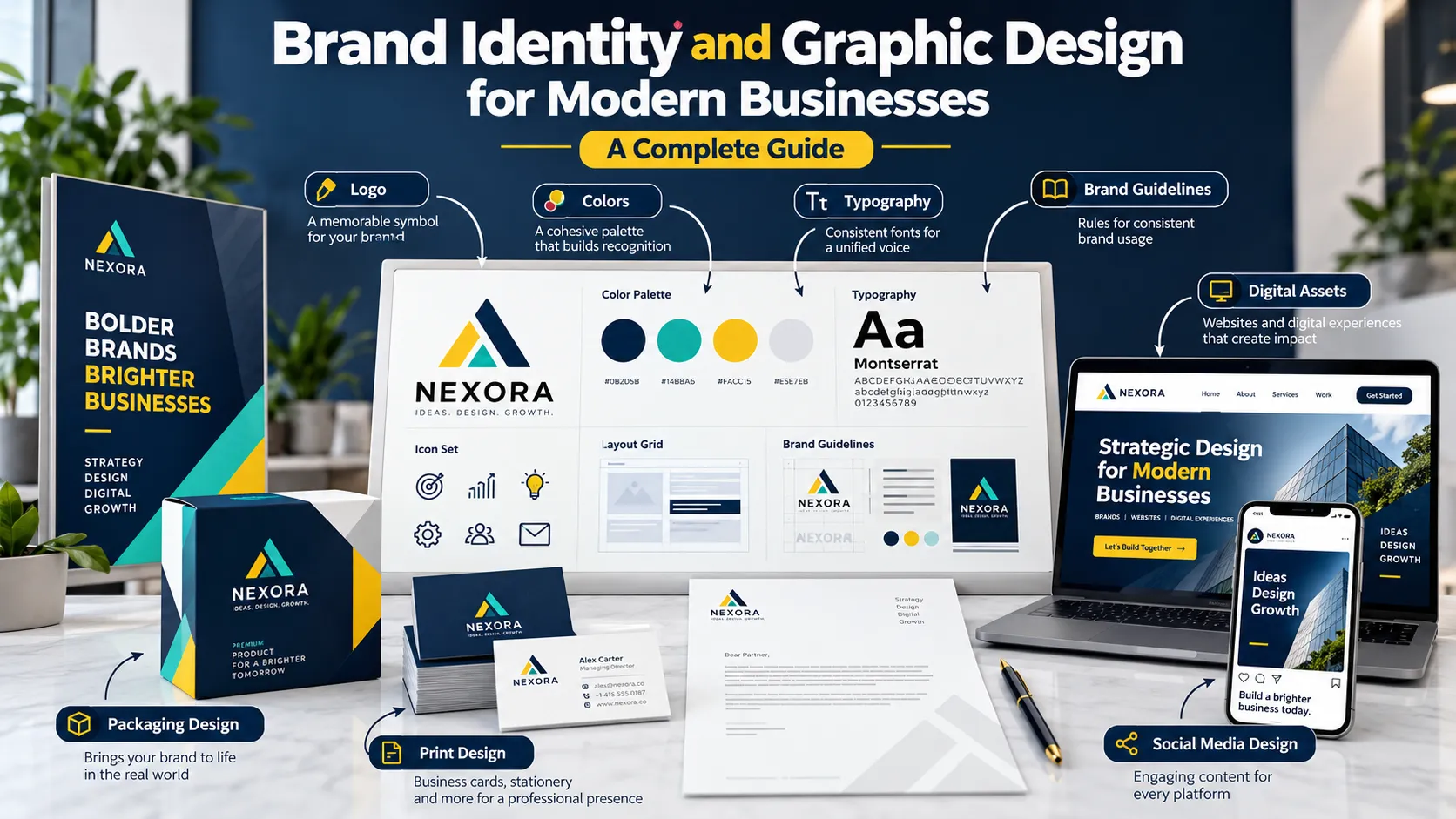
Build a recognizable business with brand identity and graphic design that connect your values, visual language, and customer experience across every touchpoint.
Brand identity goes beyond a logo. It combines positioning, messaging, colors, typography, imagery, and design standards into a consistent business experience. This guide explains how to build a distinctive identity, select professional design support, maintain consistency across digital and print channels, protect creative assets, and measure whether your investment supports business goals.
What Are Brand Identity and Graphic Design?
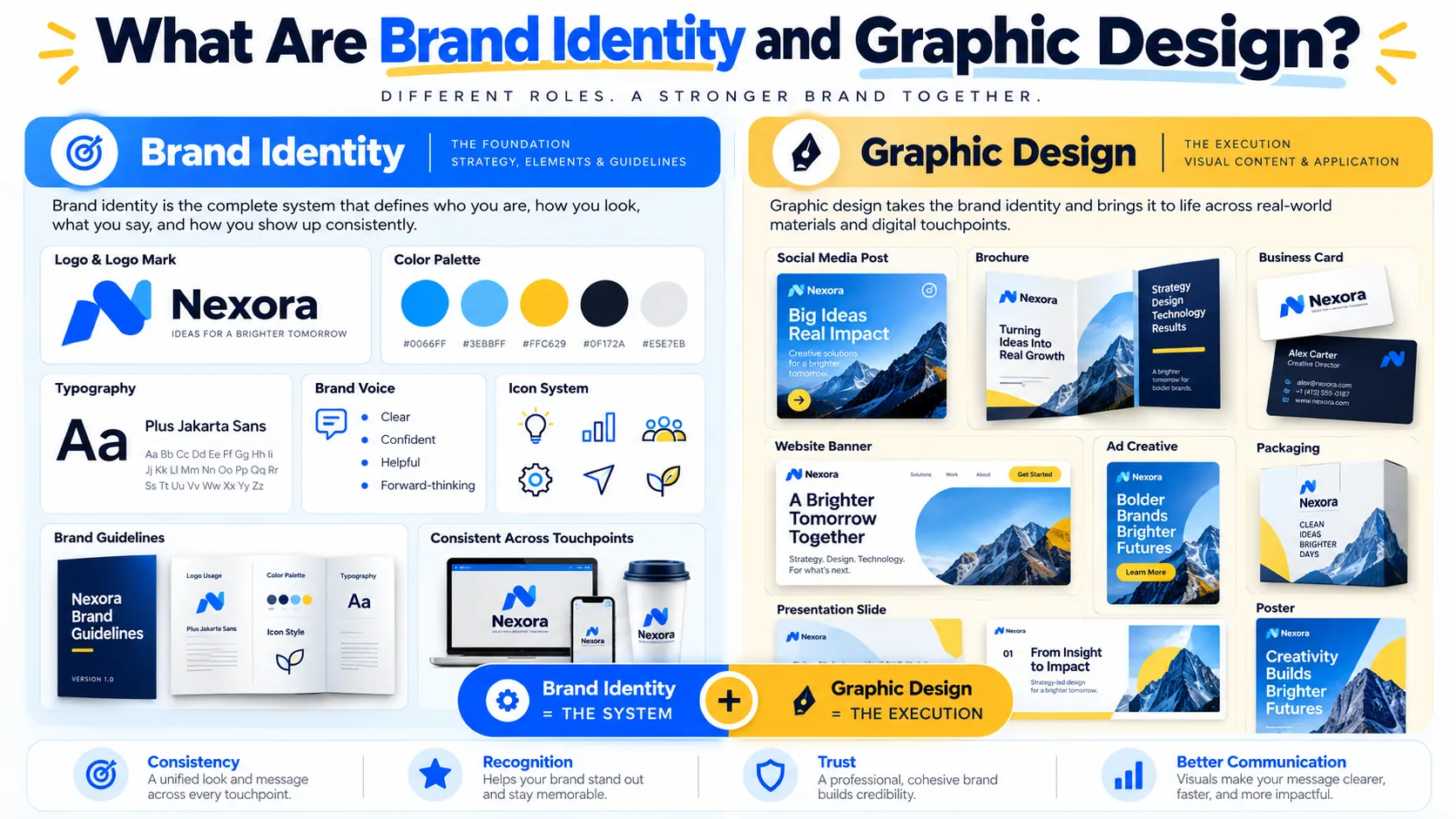
Brand identity and graphic design serve related but different purposes. Brand identity establishes how a business presents itself, while graphic design translates that identity into visual communication people can understand and recognize.
A company might have an attractive logo but still look inconsistent across its website, advertisements, social media, product packaging, presentations, and customer documents. Different colors, conflicting typography, unrelated images, and inconsistent messages can make the business difficult to recognize.
A well-developed identity system gives every creative asset a common foundation.
For example, a software company might want to communicate clarity, reliability, and technical expertise. Its identity could use a restrained color palette, readable typography, simple interface illustrations, and direct language. Those decisions would then guide its website, product interface, social media graphics, sales presentations, and advertising.
The goal is not simply to make a business look attractive. It is to make its value easier to understand, its personality easier to recognize, and its communication more consistent.
Adobe’s guide to brand identity explains how visual elements contribute to a cohesive identity. Its brand style guide resource also explains how documented standards help teams maintain consistency.
For modern businesses, brand identity and graphic design work best when strategy informs the creative decisions and a clear system governs how employees and external partners use the resulting assets.
Brand Strategy, Brand Identity, Visual Identity, and Graphic Design: Key Differences
Businesses frequently use branding terminology interchangeably, but each term describes a different part of the process.
| Term | Meaning and business purpose |
|---|---|
| Brand strategy | Defines the audience, positioning, value proposition, competitive difference, and long-term direction |
| Brand identity | Establishes how the business expresses its personality, promise, messaging, and visual characteristics |
| Visual identity | Covers the visual components, including the logo, colors, typography, imagery, and graphic elements |
| Graphic design | Arranges visual elements to communicate information, ideas, offers, or instructions |
| Brand image | Describes how customers actually perceive and remember the business |
These distinctions matter because each solves a different problem.
Brand strategy answers why customers should choose a business. Brand identity translates that strategic direction into a recognizable expression. Visual identity determines what the business looks like, while graphic design applies that visual language to individual communication materials.
Brand image develops through customer experience, public perception, product quality, service delivery, and repeated interactions. A business can influence its reputation, but design alone cannot control what customers think.
Consequently, a logo redesign cannot solve every branding problem. If customers do not understand the company’s offer, the business may need clearer positioning and messaging before investing in new visual assets.
Why Brand Identity Matters for Business Growth

A coherent identity supports communication across the customer journey. It helps potential customers recognize the business, understand its offer, and experience a consistent presentation as they move between channels.
Recognition Across Multiple Channels
Customers may encounter a business through a search result, social media advertisement, website, presentation, email, or recommendation. Consistent visual cues help connect those interactions.
A recognizable color palette, logo system, typography, and imagery style can make different materials feel as though they belong to the same organization.
Consistency does not require every asset to look identical. A website homepage, product label, and social media video have different purposes. The underlying identity should remain recognizable while the layout adapts to the medium.
Clearer Communication
Strong design establishes visual hierarchy. It helps readers distinguish the headline from supporting information, identify the primary benefit, and understand what to do next.
For a service business, this might mean placing the service outcome and intended audience before decorative graphics. For an ecommerce business, it might mean prioritizing product imagery, essential product information, and purchase details.
Credibility and Customer Confidence
Professional presentation can help a business communicate care and attention to detail. However, visual polish should support genuine credibility rather than substitute for it.
Customers also evaluate service quality, accurate information, customer support, reviews, transparent terms, and whether the business delivers what it promises.
More Efficient Marketing Production
Without documented standards, every new campaign may require decisions about fonts, colors, image styles, layouts, and logo placement.
A reusable identity system reduces this repeated work. Designers and marketing teams can use approved templates and guidelines while adapting individual assets to different campaigns.
For companies coordinating SEO, websites, paid advertising, and social media, these efficiencies become especially valuable. The broader Digital Marketing Strategy for Small Businesses guide explains how consistent communication fits into a coordinated marketing plan.
The Essential Elements of a Strong Brand Identity
A complete identity should contain enough structure to maintain consistency without restricting every future design decision.
| Brand element | What businesses should define |
|---|---|
| Logo system | Primary logo, secondary versions, symbol, spacing, minimum size, and approved backgrounds |
| Color palette | Primary and supporting colors, neutral shades, color values, and approved combinations |
| Typography | Heading and body fonts, hierarchy, weights, readability, and licensing |
| Imagery and graphics | Photography direction, illustration style, icons, patterns, textures, and cropping |
| Brand voice | Tone, vocabulary, messaging principles, and communication style |
| Brand guidelines | Usage rules, examples, templates, file organization, and approval responsibilities |
1. Logo Design and Usage
A logo provides a recognizable visual identifier. Depending on the business, it might use a wordmark, symbol, monogram, or combination of text and imagery.
A professional logo system normally considers several practical applications. A full logo may work well in a website header, while a compact symbol may be more suitable for a social profile or browser icon.
Designers should test the logo against light and dark backgrounds, in monochrome, at small sizes, and in actual print or digital applications.
A logo that looks impressive on a large presentation slide may become difficult to recognize when reduced to a small mobile avatar. Real-world testing helps reveal those limitations before launch.
2. Brand Colors and Their Practical Use
Color influences visual emphasis and can contribute to brand recognition, but its meaning depends on context, culture, industry, and individual perception.
Choose colors according to the business’s positioning, audience, applications, and practical readability requirements. Review competitor palettes to understand familiar category conventions, then identify opportunities to establish a distinctive visual direction.
Document exact color values for digital and print use. RGB and HEX values are useful for screens, while print production may require CMYK or other specifications appropriate to the printer and material.
Accessibility should also influence color decisions. The W3C Web Content Accessibility Guidelines specify a minimum contrast ratio of 4.5:1 for normal text and 3:1 for large text under the relevant WCAG 2.1 Level AA criterion. These requirements are especially important for website text, advertisements, and digital interfaces.
3. Typography and Readability
Typography communicates personality while determining how comfortably people can read the information.
A traditional professional-services brand may prefer restrained serif typography, while a technology company may choose a clean sans-serif system. These are starting points rather than fixed rules; the correct choice depends on the audience and the brand’s intended personality.
Define the roles of each typeface. Headings need a clear hierarchy, body text needs comfortable readability, and labels or buttons must remain legible at their intended sizes.
Limit unnecessary font variations. A small, well-defined type system generally makes communication more consistent and simplifies production.
Before adopting a typeface, verify its licensing, available weights, language support, and suitability for web and print use.
4. Photography, Illustration, and Graphic Elements
Images and supporting graphics help communicate ideas that a logo cannot express on its own.
A food brand might use consistent product photography and natural textures. A consulting company might emphasize diagrams, editorial photography, and clean layouts. A software business might use product screenshots, interface illustrations, and process visualizations.
The important factor is coherence. Photography, illustrations, icons, patterns, and decorative elements should support the same brand direction.
A reusable collection of graphic design graphics can help teams work efficiently, but only when those assets fit the established visual system. Unrelated stock images or inconsistent illustration styles can weaken recognition.
5. Messaging and Brand Voice
Brand identity includes how the business communicates in words as well as images.
Define whether the company should sound direct, friendly, technical, formal, educational, or conversational. Then establish practical guidance for headlines, service descriptions, product claims, customer support, and calls to action.
The voice should remain recognizable without forcing every message into the same tone. A customer-support response may need more empathy than a short advertisement, but both should reflect the same underlying personality.
How to Build Brand Identity and Graphic Design Step by Step
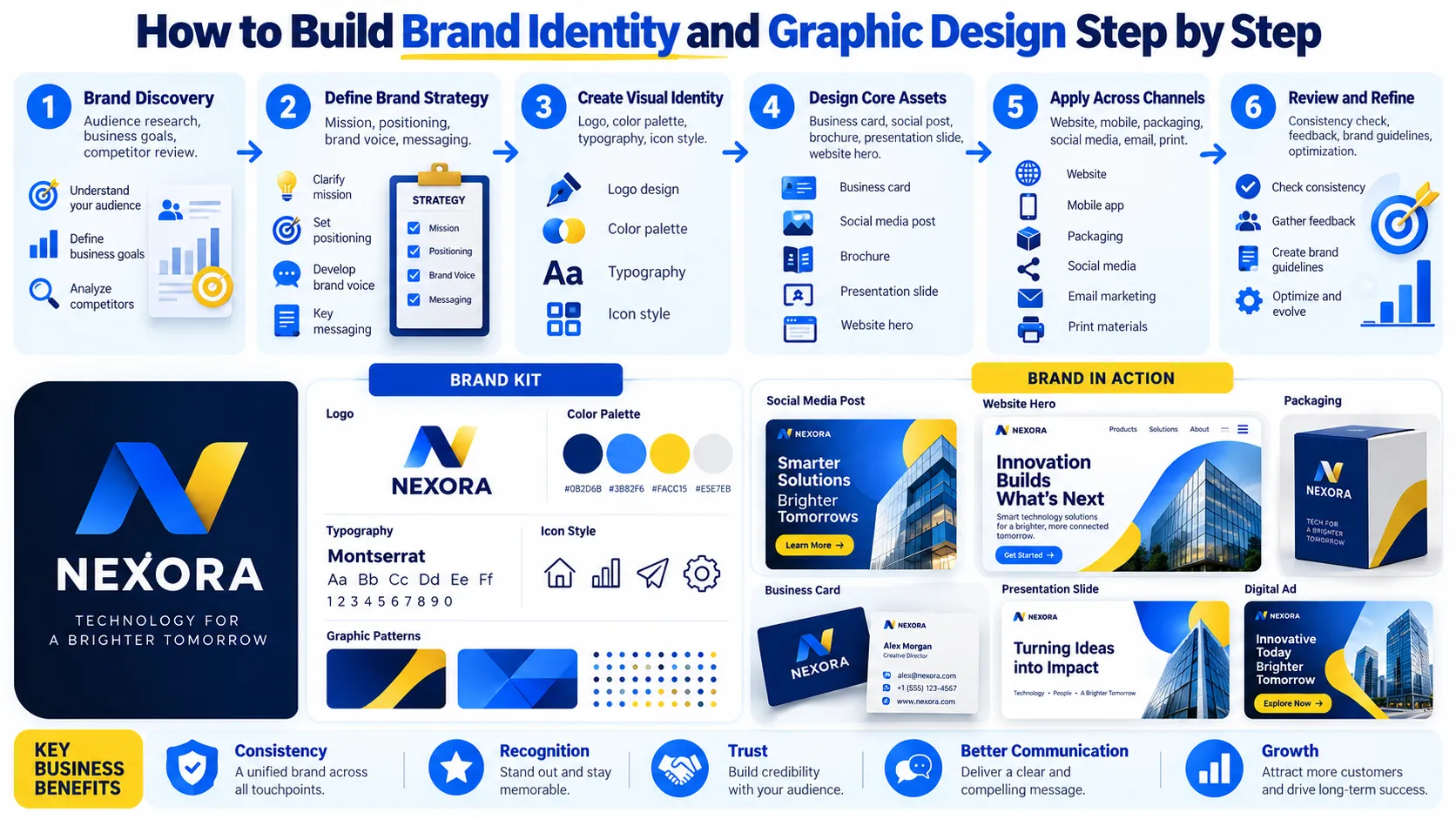
A structured process reduces subjective revisions and keeps design decisions connected to business needs.
Step 1: Audit the Existing Brand
Collect the current logo files, website pages, social media profiles, advertisements, product images, presentations, email templates, and printed materials.
Review them together to identify inconsistencies. Look for outdated logos, different color values, competing fonts, unclear messaging, and visual elements that no longer fit the business.
Also consider customer feedback. Ask whether people understand what the company offers, what makes it different, and which materials they recognize most easily.
The audit should produce a clear problem statement rather than an immediate demand for a complete redesign.
Step 2: Research the Audience and Competitors
Identify the customers the business wants to serve, the problems they need solved, the alternatives they consider, and the evidence that influences their decisions.
Research competitor presentation to understand category conventions. This does not mean copying the market leader. It means recognizing which visual cues help customers understand the category and deciding how the business can communicate its own difference.
A premium service may need to communicate expertise and reliability. A youth-focused consumer brand may emphasize energy and cultural relevance. A complex B2B provider may prioritize clarity and confidence.
The creative direction should follow these business requirements rather than the personal preferences of the decision-maker.
Step 3: Define Positioning and the Creative Brief
Prepare a concise brief that establishes the business context before design work begins.
The brief should identify the intended audience, customer problem, value proposition, differentiators, desired personality, practical applications, constraints, and approval process.
For example, a fictional software company might want to make its product easier for nontechnical managers to understand. The brief could prioritize clarity, accessibility, and practical benefits rather than futuristic visuals that make the product seem more complicated.
This document becomes the reference point for evaluating design concepts. Stakeholders can assess whether a direction serves the intended purpose instead of choosing an option solely because it looks attractive.
Step 4: Develop and Evaluate Creative Directions
Explore a small number of meaningfully different creative directions. Each should demonstrate how the brief translates into color, typography, imagery, composition, and overall personality.
Moodboards and sample applications can help decision-makers compare these directions before approving a final logo.
Ask which option communicates the offer most clearly, fits the audience, differentiates the business, and works across real applications.
A strong concept should also support future growth. If the business launches another product or enters another market, the identity should remain adaptable without losing its core characteristics.
Step 5: Create the Logo and Supporting System
After approving the direction, develop the logo system and supporting visual components.
Test the logo in the website header, mobile profile image, presentation, invoice, advertisement, and any other important application. Then refine the palette, typography, imagery style, layout rules, and reusable templates.
At this stage, brand identity and graphic design become a practical operating system for communication. The goal is to make future materials easier to produce consistently.
Step 6: Document Guidelines and Prepare Assets
Create a brand guideline document that explains how employees and external partners should use the approved assets.
The document should cover logo variations, spacing, color specifications, typography, imagery, layouts, accessibility, and examples of incorrect usage.
Provide appropriate file formats for the intended applications. Editable vector masters support future revisions and scalable production; SVG, PNG, and print-ready PDF files serve different use cases.
Organize the files in a shared location with clear naming conventions. Assign someone to maintain the approved library and remove outdated versions when the system changes.
Step 7: Launch and Review the Identity
Prepare a rollout plan for the most visible customer touchpoints. Update the website, social profiles, advertising templates, presentations, email signatures, packaging, and other materials according to priority.
Avoid leaving important channels with conflicting logos or outdated messaging for extended periods.
After launch, test actual applications and collect feedback. If customers misunderstand the offer or the new identity becomes difficult to use in certain contexts, investigate the problem before making further changes.
Applying Brand Design Across Digital and Print Channels
A consistent identity should adapt to each channel without losing its underlying character.
Website and Landing Pages
A website needs a coherent logo, readable typography, clear page hierarchy, consistent buttons, and imagery that supports the business message. It must also work across screen sizes and help visitors complete their tasks.
Brand identity and graphic design should therefore connect with usability and responsive implementation.
For businesses that need help applying visual direction to their website, Business Website Design is a relevant complementary service.
Social Media and Advertising
Social platforms require flexible formats for profile images, posts, stories, short-form videos, and advertisements. Each format has different space and readability constraints.
Use reusable templates while allowing enough variation to match each message. Important text should remain readable on mobile screens, and campaign visuals should communicate the offer quickly.
Businesses can connect their visual standards to Social Media Design and Ad Creative services when they need platform-specific creative production.
Video and Motion Graphics
Video introduces movement, pacing, transitions, sound, and animated typography. These elements should reinforce the established identity rather than introduce unrelated visual styles.
Define title-card treatments, captions, colors, logo placement, and motion principles. The system should work for educational content, advertisements, product demonstrations, and short-form social videos.
For this type of production, Video Content can complement the broader identity system.
Packaging, Presentations, and Print
Physical materials introduce requirements such as print resolution, bleed, material, finishing, and color reproduction. A design that works on a bright digital screen may not reproduce identically on a printed surface.
Test proofs with the production supplier before approving a large run. Presentations, proposals, invoices, and sales documents should also use the same basic identity rules so customers experience a coherent business.
Brand Identity for International Businesses
Companies serving multiple countries need consistency without assuming every market responds to the same imagery, language, or visual conventions.
Begin with a stable core identity: the primary logo, underlying brand promise, typography principles, and essential visual characteristics. Then identify which elements require adaptation.
International implementation may involve translated content, longer headlines, different character sets, local product imagery, regional examples, or changes in how a color or symbol is interpreted.
For example, a design that accommodates short English headlines may need a different layout for a language with longer translated text. A logo containing a wordmark may require additional versions to maintain legibility in different applications.
Test localized designs with relevant audiences rather than relying on assumptions about cultural preferences. Also check font support, local legal requirements, and whether the brand name creates unwanted meanings in a target language.
The goal is a recognizable global identity with enough flexibility to communicate naturally in each market.
How to Choose a Branding Agency or Graphic Designer

Businesses evaluating best branding agencies or best branding companies should look beyond portfolio aesthetics. The right partner should understand the business problem, explain the reasoning behind creative decisions, and deliver a system that works in practice.
An agency creative team may combine brand strategists, graphic designers, copywriters, and production specialists. A freelance designer may be the better fit for a narrowly defined project, such as a logo refresh or a set of marketing templates.
The correct choice depends on the project’s complexity, required expertise, timeline, and internal resources.
Evaluate the Portfolio and Process
Review work that resembles your business needs. Examine how the design performs across actual applications rather than relying only on polished mockups.
Ask how the provider researches audiences, develops concepts, gathers feedback, manages revisions, and checks final files. A credible designer should be able to explain why a visual direction suits the brief.
Searches for best logo design often emphasize the finished mark, but a logo is only one component of a broader identity system.
Clarify Scope, Deliverables, and Rights
Before agreeing to a project, establish what the fee includes. Confirm the number of concepts, revision rounds, final formats, editable source files, brand guidelines, templates, and implementation support.
Discuss font licenses, stock imagery, third-party assets, and ownership or usage rights in writing.
The lowest quote may cover only a basic logo, while a more comprehensive proposal may include research, strategic direction, a flexible logo system, guidelines, and rollout assistance. Compare the actual deliverables rather than price alone.
When Is Brand Consulting Useful?
Brand consulting can help when a business is uncertain about positioning, audience, differentiation, or the need for a redesign.
A consultant may help clarify the strategy before a designer begins producing assets. This is especially valuable when a company is entering a new market, merging product lines, or repositioning an established offer.
For broader creative implementation, explore GrowthAxis Solutions Creative Studio and its Brand Identity service.
Protecting Brand Assets and Avoiding Copyright Problems
Businesses should verify that their visual identity is original enough for its intended purpose and that they have appropriate rights to use the delivered work.
Do not copy a competitor’s logo, distinctive artwork, or branded materials simply because the style looks suitable. Similarities may create confusion or legal risk.
The U.S. Copyright Office explains that original visual artwork can receive copyright protection, while names and short phrases are generally not protected by copyright in the same way. Some names and logos may qualify for trademark protection. Read its guidance on copyright for visual artists and what copyright protects.
For businesses considering U.S. trademark registration, the USPTO trademark search guidance recommends searching for potentially conflicting marks before applying. A search is only one part of a comprehensive clearance process.
Trademark and copyright rules vary by jurisdiction. Businesses operating internationally should check the relevant local requirements and obtain qualified legal advice when necessary.
The design contract should also specify what the client receives, whether ownership transfers or a license applies, and which third-party assets remain subject to separate terms. Payment alone does not necessarily resolve every ownership question.
Common Mistakes to Avoid
Even a visually attractive identity can fail when the business overlooks strategy, practical usage, or long-term management.
- Starting with the logo instead of the business problem. Define the audience, promise, and positioning before selecting visual concepts.
- Copying competitors. Understand familiar category conventions, but develop a distinctive expression that belongs to your business.
- Choosing colors and fonts based only on personal taste. Test readability, accessibility, context, and suitability for the intended audience.
- Designing only for presentation mockups. Test the identity at real sizes and on actual digital and print applications.
- Ignoring brand guidelines. Without documented standards, employees and suppliers may gradually introduce conflicting styles.
- Overlooking ownership and licensing. Clarify source files, font usage, stock assets, and rights in the written agreement.
- Treating design as a substitute for business quality. A polished identity cannot compensate for weak service, unclear offers, or unsupported claims.
- Changing every marketing variable at once. When testing campaign performance, isolate important changes so the business can learn what influenced the outcome.
A Practical Brand Identity Launch Checklist
Before approving a new identity or a major refresh, use this checklist to verify that the work is ready for implementation.
- Confirm that the brand strategy identifies the intended audience, value proposition, positioning, and differentiation.
- Approve a logo system that works at small sizes, in monochrome, and across light and dark backgrounds.
- Document color values, typography, imagery direction, layout rules, and accessible design choices.
- Prepare the appropriate editable source files and export formats for web, social media, presentations, and print.
- Create brand guidelines and reusable templates for common marketing activities.
- Confirm ownership, usage rights, third-party licenses, and the responsibilities of the people maintaining the assets.
- Assign rollout responsibilities and prioritize the most visible customer touchpoints.
- Establish baseline measures for recognition, message clarity, consistency, and relevant business outcomes.
- Schedule a review to identify problems and update the guidelines when the business or its markets change.
How to Measure Whether Your Brand Identity Is Working
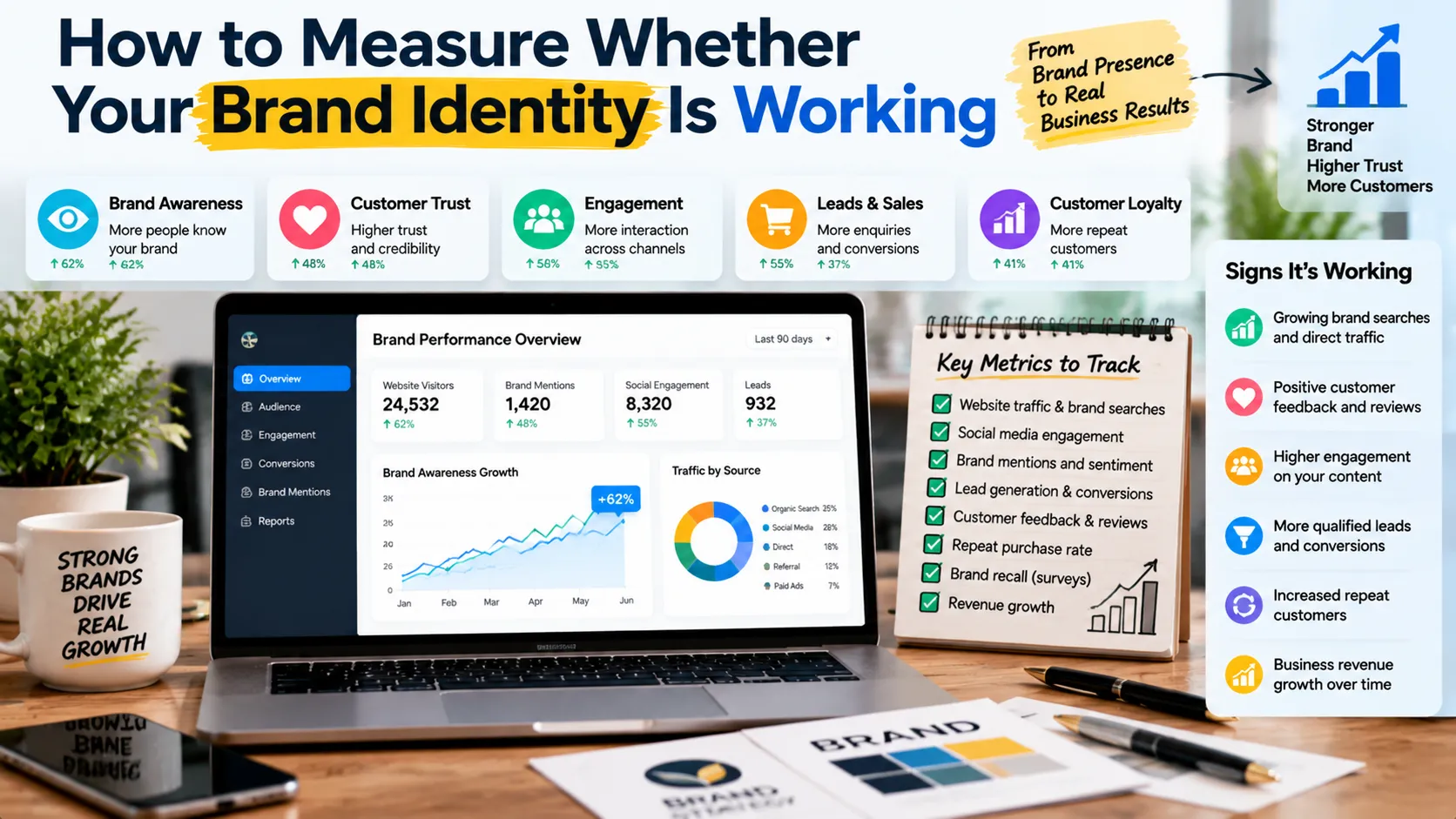
Brand design should support a defined business objective. A new logo does not automatically increase sales, improve conversion rates, or strengthen customer loyalty. Measurement helps determine whether the identity is solving the intended problem.
Brand Recognition
Ask customers whether they recognize the business when shown approved visual assets without additional context. Compare the results over time using a consistent method.
Message Clarity
Ask target customers to explain what the business offers, who it serves, and what makes it different. If people consistently misunderstand the offer, the problem may involve positioning, messaging, or visual hierarchy rather than the logo alone.
Visual Consistency
Review the website, advertisements, social media, presentations, and customer documents against the approved guidelines. Record recurring problems, such as incorrect logo versions, inconsistent colors, or unreadable text.
Marketing and Conversion Performance
When a redesign supports a campaign or website improvement, track relevant measures such as qualified enquiries, conversion rates, engagement with key pages, and lead quality.
Use a suitable baseline and review period. Consider other factors that may influence performance, including pricing, traffic sources, seasonality, and changes to the offer.
A fictional ecommerce company might introduce a more consistent product-image style and improve the hierarchy of product information. The business could then compare customer feedback, product-page engagement, and purchase behavior before and after the change. Those observations would help evaluate the redesign, but they would not prove that visual changes alone caused any improvement.
Good measurement connects the design decision to an observable outcome and supports better decisions about future investment.
Pro Tips for a Brand System That Lasts
A successful identity needs clear governance as well as creative quality.
First, maintain a single source of truth for approved logos, fonts, colors, guidelines, and templates. Make it easy for employees and external partners to find the current versions.
Second, document decisions instead of relying on memory. Record why the business selected a direction, which applications it supports, and who can approve exceptions.
Third, balance consistency with flexibility. Templates should make routine work easier, but they should not prevent teams from responding to different audiences, platforms, or campaign objectives.
Fourth, use customer feedback to identify meaningful problems. A visual element that internal stakeholders love may still confuse the intended audience. Test important decisions when the cost of being wrong is significant.
Finally, review the system periodically. A new market, product, service, or business position may require changes. Update the identity deliberately rather than allowing unrelated adjustments to accumulate across individual assets.
For companies that want to connect brand identity with a wider growth strategy, the GrowthAxis Solutions service portfolio brings creative services together with digital marketing, SEO, and website development.
Conclusion
Brand identity and graphic design help modern businesses express their value through a consistent, recognizable experience. Start with strategy, build a flexible visual system, document its rules, protect creative assets, and measure meaningful outcomes. When your business needs a clearer identity or more consistent creative execution, contact GrowthAxis Solutions to discuss the most practical next step.
Frequently Asked Questions
1. What is the difference between brand identity and graphic design?
Brand identity is the system a business uses to express its personality, positioning, message, and visual characteristics. Graphic design arranges visual elements to communicate information or ideas. Graphic design helps bring brand identity to life through logos, advertisements, websites, packaging, presentations, and social media.
2. Why does a business need more than a logo?
A logo identifies a business, but it does not define every color, font, image style, layout, message, or customer interaction. A broader identity system helps the business communicate consistently across channels and gives employees and designers practical guidance for creating future materials.
3. What should a brand identity package include?
A brand identity package may include a primary logo, alternative logo versions, a color palette, typography rules, imagery guidance, graphic elements, brand guidelines, and reusable templates. It may also include editable source files and production-ready exports. The exact scope should match the business’s needs and the written agreement.
4. How do I choose the right colors for my brand?
Begin with your audience, positioning, industry, applications, and desired personality. Review competitors to understand common visual conventions, then choose a palette that supports differentiation and readability. Test color combinations on websites, mobile screens, advertisements, and print samples before approving them.
5. Can a small business create its own brand identity?
Yes. A small business can define its positioning, select a practical color palette, establish typography, create basic templates, and document usage rules internally. Professional design support becomes valuable when the business needs a distinctive logo system, strategic research, multiple applications, or production-ready assets across different channels.
6. How do I choose a professional branding agency?
Review relevant portfolios, research methods, concept-development processes, revision policies, final deliverables, and client communication. Ask how the agency evaluates design decisions and prepares assets for actual use. Compare written proposals carefully so you understand the difference between a logo-only service and a comprehensive brand identity project.
7. What files should I request from a logo designer?
Request an editable vector master where applicable, SVG for supported digital applications, transparent PNG files, and a print-ready PDF. A JPG may also be useful for simple applications. Confirm source-file delivery, font and stock-asset licenses, and the ownership or usage rights specified in your agreement.
8. How often should a business update its brand identity?
Review the identity when the business changes its audience, positioning, products, markets, or customer experience. Do not redesign solely because a visual style feels old. Identify the underlying problem first, then determine whether a small refresh or a more substantial rebrand is appropriate.
9. How can I measure whether my brand identity is effective?
Define the intended outcome before launch. Evaluate brand recognition through customer research, message clarity through interviews or usability tests, consistency through asset audits, and marketing outcomes through suitable analytics. Compare results against a baseline and account for other changes that may influence performance.
10. What is the difference between logo design and brand identity design?
Logo design focuses on creating a recognizable mark for a business. Brand identity design covers a broader system that may include the logo, colors, typography, imagery, messaging, and usage guidelines. A logo is one component of brand identity, not a substitute for the complete system.