
Social Media Design, Ad Creative and Video Content
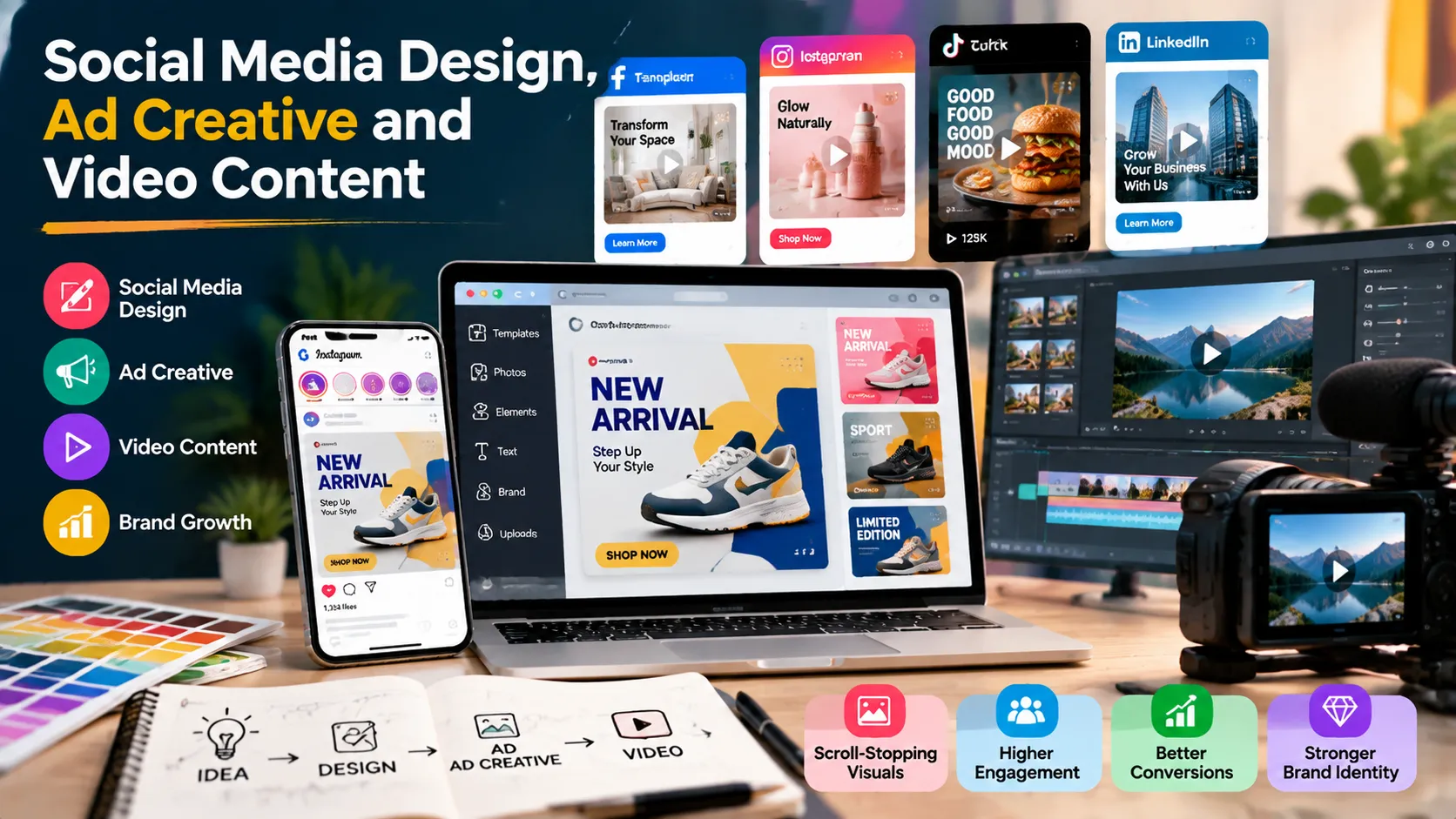
A clear creative system starts with audience insight. A practical social media design strategy connects visuals, paid ads, and video to business goals.
Effective social media design combines consistent branding, persuasive advertising creative, and engaging video content. This guide explains how to understand your audience, select suitable formats, develop a creative system, test advertising variations, measure meaningful results, and connect social content with business objectives to build a more effective digital marketing operation.
What Is a Social Media Design Strategy?
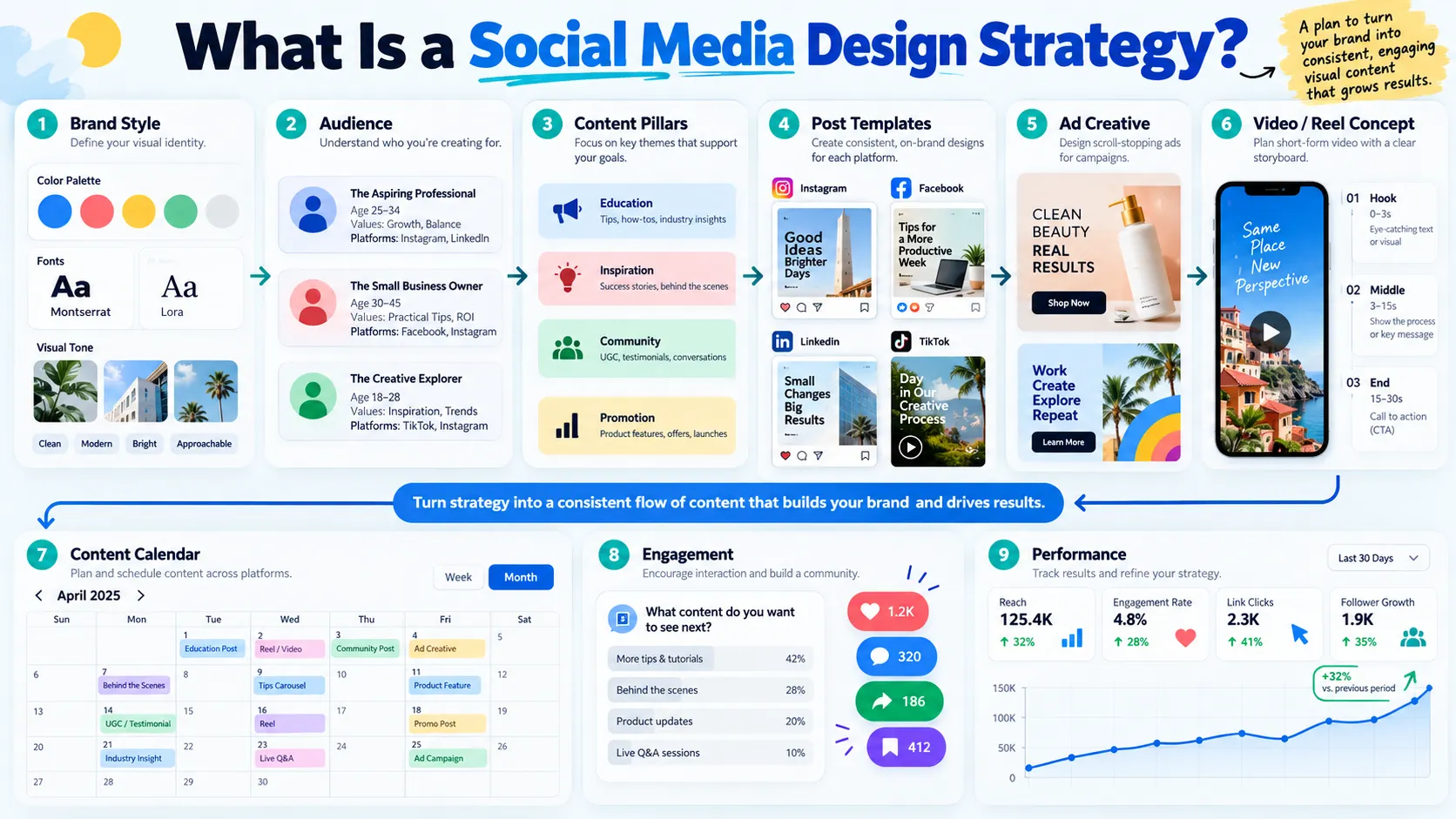
A social media design strategy is a structured approach to creating visual content that communicates a brand’s message, supports its marketing objectives, and encourages an appropriate audience response.
It goes beyond choosing attractive colours, selecting templates, or publishing graphics regularly. It determines what the business should communicate, who needs to see the message, which creative format best communicates it, and how the business will evaluate the result.
For example, a software company might use an educational carousel to explain a common business problem, a short video to demonstrate its solution, and a paid advertisement to invite qualified prospects to request a consultation. Although the formats differ, each asset supports the same customer journey.
The strongest social media design strategy connects three complementary capabilities: social media design, advertising creative, and video content production.
Social media design establishes visual consistency and makes information easy to understand. Advertising creative translates an offer into a persuasive message designed for a particular campaign objective. Video content uses movement, sound, storytelling, and demonstrations to communicate information dynamically.
When these capabilities work together, a business can develop a recognisable visual presence instead of publishing disconnected assets.
GrowthAxis Solutions provides these capabilities through its Social Media Design service, Ad Creative service, and Video Content service.
Why Social Media Design, Advertising Creative, and Video Need One Strategy
Many businesses create social media graphics, launch paid advertisements, and produce videos as separate activities. This approach can create inconsistent messaging, duplicated effort, and difficulty understanding which creative decisions contribute to business results.
A coordinated social media design strategy gives each asset a clear purpose while preserving a consistent brand identity.
Connect Creative Work to Business Objectives
Begin with the business outcome rather than the design software or video format.
A company seeking brand awareness needs creative assets that communicate its identity quickly and make the brand memorable. A business generating enquiries needs to explain a relevant problem, establish credibility, and make the next step clear. An ecommerce business may need product demonstrations, comparison visuals, customer experiences, and purchase-focused advertising.
These objectives require different messages, formats, and measurement approaches.
A practical framework connects creative work with four stages of the customer journey: discovery, consideration, conversion, and retention.
During discovery, visual content introduces the brand or highlights a problem the audience recognises. During consideration, carousels, demonstrations, and educational videos explain possible solutions. During conversion, advertising creative communicates the offer, relevant evidence, and a suitable next step. During retention, tutorials, customer stories, product updates, and useful tips help existing customers continue receiving value.
Not every customer follows these stages in order. The framework simply helps marketers identify what each piece of content should accomplish.
Understand the Difference Between Organic and Paid Creative
Organic social content primarily supports ongoing communication, community interaction, and brand discovery. Paid creative operates within an advertising campaign and must communicate effectively to a selected audience under a defined budget and objective.
The two approaches can reinforce each other, but they should not be treated as identical.
An educational post may perform well organically because followers already understand the brand. A paid advertisement shown to unfamiliar users may need a clearer opening message, stronger explanation of the offer, and more explicit context.
A social media design strategy should therefore account for audience familiarity, placement, campaign objective, and the amount of information a viewer needs before acting.
Organic performance can also inform future creative decisions. A useful demonstration or customer question may inspire a paid advertisement, provided the business verifies that the message suits the campaign and has the necessary permissions to use the material.
How to Build a Social Media Design Strategy Step by Step
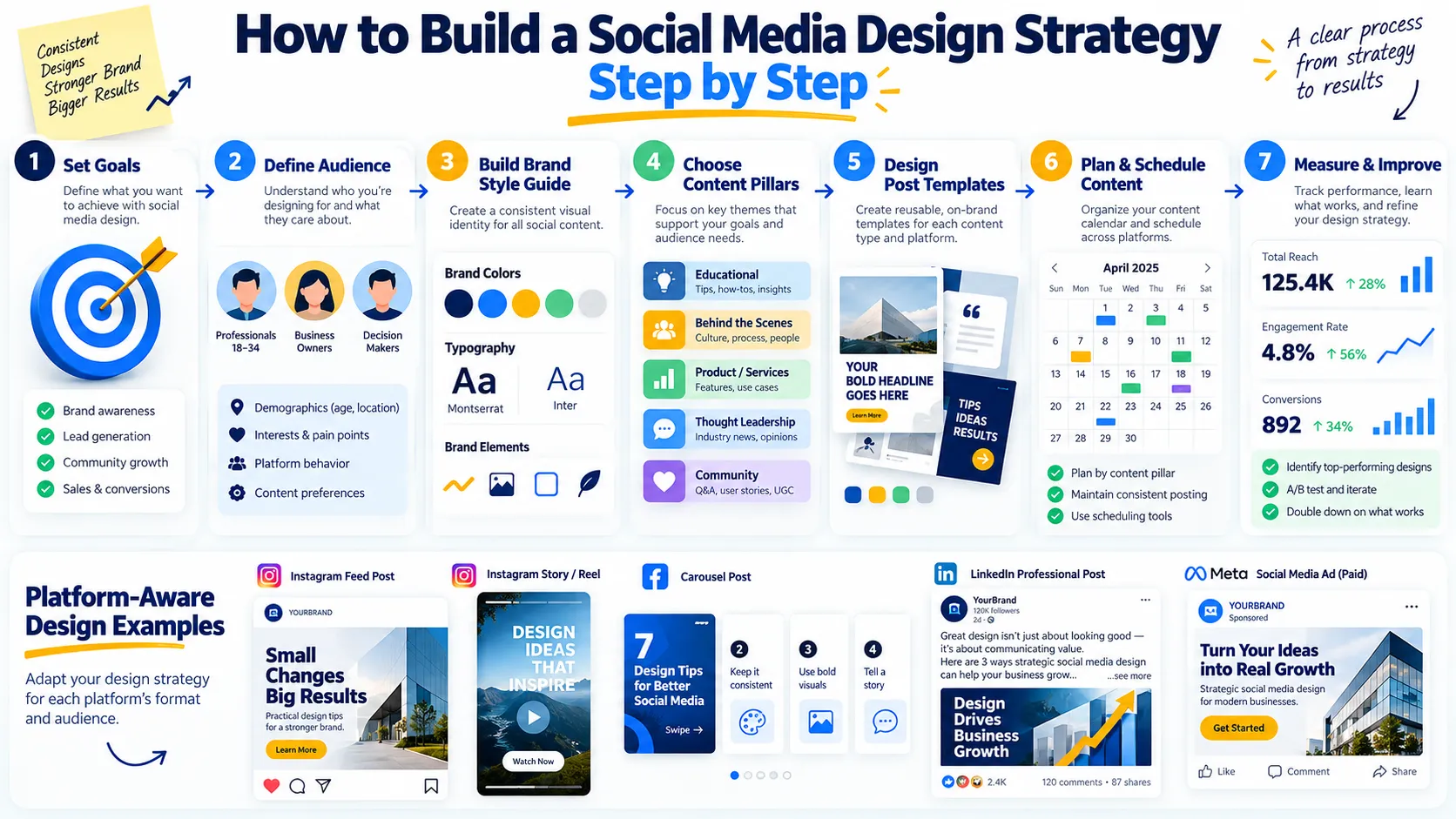
Step 1: Research the Audience and Its Problems
Useful creative begins with understanding the people it needs to reach.
Demographic information may help describe an audience, but demographics alone rarely explain what makes a message persuasive. A business should also investigate its audience’s needs, objections, motivations, purchasing context, and preferred ways of learning.
Customer enquiries, sales conversations, product reviews, support questions, website analytics, and social media comments can reveal recurring problems. These observations help marketers identify messages that deserve attention.
For example, a web development agency might discover that prospective clients worry about slow websites, unclear pricing, poor mobile experiences, or difficulties maintaining their existing sites. Each concern could become an educational graphic, a short explanatory video, or a campaign-specific advertisement.
A useful social media design strategy translates those observations into creative concepts. Rather than starting with “What should we post today?”, ask “What does our audience need to understand, believe, or do?”
This change makes content planning more purposeful.
Step 2: Define a Clear Brand Identity
A consistent visual identity helps people recognise a business across different channels and content formats.
The brand system should establish how the business uses its logo, colours, typography, imagery, illustration style, spacing, and tone of voice. It should also define how those elements adapt to different placements without losing their recognisable characteristics.
Consistency does not mean every graphic must look identical. It means different designs should feel like expressions of the same brand.
A business can maintain a consistent identity while using different layouts for educational carousels, product demonstrations, customer testimonials, promotional offers, and video thumbnails.
GrowthAxis Solutions’ Brand Identity service can support businesses that need clearer visual direction, typography and colour guidance, logo usage recommendations, and brand asset standards.
Step 3: Establish Content Themes
Content themes give the creative team a repeatable system for deciding what to publish.
A business might organise its content around educational information, product or service demonstrations, customer questions, brand stories, and promotional messages. The appropriate themes depend on the audience, industry, available evidence, and business objectives.
For example, a professional services company could explain common mistakes, demonstrate its working process, answer frequently asked questions, share verified customer experiences, and introduce relevant services.
A strong social media design strategy balances these themes rather than relying exclusively on promotional graphics.
The purpose is to help the audience understand the brand’s expertise while giving interested people opportunities to explore its products or services.
Step 4: Choose the Right Format for Each Message
The format should support the message rather than dictate it.
A static graphic works well when the audience needs to understand one central idea quickly. A carousel can explain a process in stages. A short video can demonstrate movement, show a product in use, or communicate a story. A paid advertisement can combine visual evidence with an offer and a clear call to action.
The following comparison helps match creative formats to their intended purpose.
| Creative format | Best use and strategic role |
|---|---|
| Static graphics | Communicating one clear idea, announcement, offer, or visual message |
| Carousel posts | Explaining processes, comparisons, educational sequences, or multiple product benefits |
| Short-form video | Demonstrations, storytelling, quick tutorials, and attention-focused messages |
| Paid social advertisements | Reaching selected audiences with a defined campaign objective and measurable action |
| Customer or creator videos | Showing product use, answering objections, and communicating authentic experiences |
| Motion graphics | Explaining abstract concepts, software workflows, data, or complex services visually |
A business does not need to use every format on every platform. Select formats according to audience preferences, production capacity, campaign requirements, and the evidence available from previous content.
Step 5: Design for Mobile Viewing and Accessibility
Social media users often encounter content on small screens while moving quickly through a feed. A design that looks attractive on a large desktop monitor may become difficult to read on a phone.
Prioritise a clear visual hierarchy. The main message should be immediately apparent, supporting text should remain legible, and decorative elements should not compete with the information that matters.
Use contrast to separate text from backgrounds. Avoid placing important information over visually busy photographs. Keep typography readable and use sufficient spacing between elements.
Accessibility should be part of the creative process, not a final correction. The W3C Web Content Accessibility Guidelines explain contrast requirements for readable text, including a minimum contrast ratio of 4.5:1 for ordinary text under WCAG Level AA.
For video content, include accurate captions when speech carries important information. Captions help people who cannot hear the audio and those who watch without sound. Text should remain visible long enough to read, and important information should not depend solely on colour.
A social media design strategy that prioritises clarity and accessibility can make content easier to understand across different devices and viewing conditions.
Step 6: Adapt Creative to Each Platform
A creative asset should reflect the placement where the audience will encounter it.
Instagram Reels, Facebook Reels, TikTok, and YouTube Shorts support vertical video experiences, but their interfaces, audience expectations, advertising options, and creative conventions differ.
For example, TikTok’s video advertising guide recommends mobile-first creative, vertical framing, clear opening hooks, and messages focused on audience benefits. The guide also recommends keeping important text within the interface’s safe zones.
Google’s YouTube Shorts advertising guidance recommends vertical 9:16 assets and describes the importance of short, engaging creative that fits the mobile experience.
These recommendations are useful starting points, not universal guarantees of performance.
A business should also adapt creative for LinkedIn, Pinterest, Facebook feed placements, or other channels where the audience and content context differ. Professional audiences may need detailed explanations and evidence. Product discovery audiences may respond better to demonstrations, comparisons, or visual examples.
The principle is simple: retain the core brand message, but adapt the presentation to the placement.
How to Create More Effective Paid Social Advertising Creative
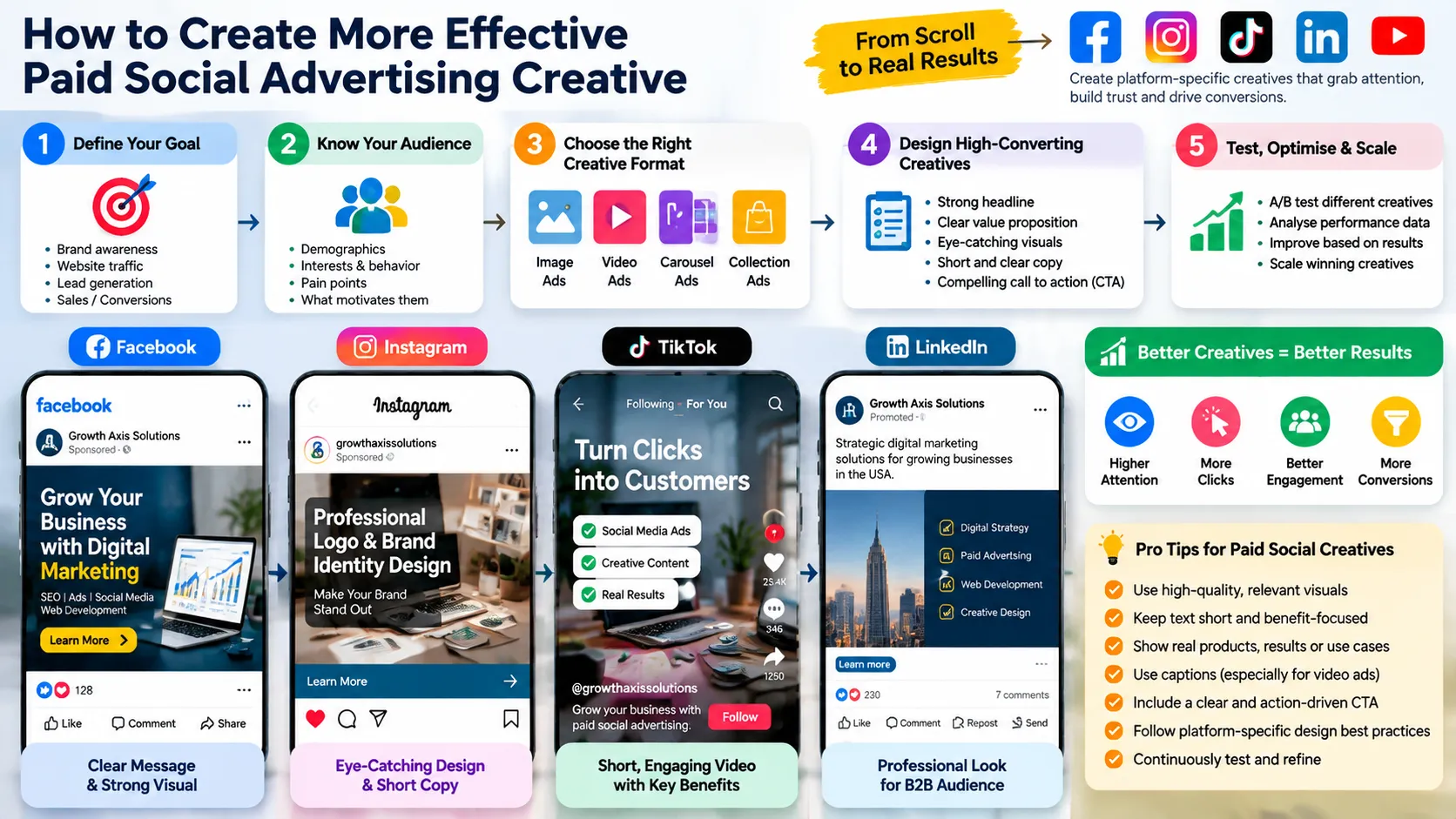
Paid creative has to communicate quickly. The viewer may not know the brand, may not have searched for the product, and may have little reason to stop scrolling.
A social media design strategy for paid advertising should therefore combine message clarity, relevant audience context, credible proof, and a suitable next step.
Start With a Strong Opening
The opening frame or first line should give viewers a reason to continue.
A business can open with a recognisable problem, a demonstration, a surprising but accurate observation, or a question that reflects a genuine customer concern.
For example, a website agency could begin with a mobile website that makes a contact button difficult to find. A software business might demonstrate a repetitive manual task before showing a more efficient workflow.
Avoid exaggerated claims that the business cannot substantiate. A dramatic visual may attract attention, but misleading messaging can damage trust and attract unqualified enquiries.
Communicate Benefits Before Listing Features
Features explain what a product or service includes. Benefits explain why those features matter to the customer.
For example, “includes reusable social templates” describes a deliverable. “Helps your team produce consistent posts without redesigning every asset from scratch” explains its practical value.
The best advertising creative makes that connection clear without promising outcomes that depend on factors outside the business’s control.
Make the Offer Easy to Understand
An advertisement should communicate what the business offers, who it helps, and what action the viewer can take next.
Depending on the campaign, the next step might involve viewing a service page, requesting a quotation, booking a consultation, downloading a resource, or exploring a product.
A social media design strategy should align the creative with the destination. If the advertisement promises a detailed service comparison, the landing page should provide that comparison rather than sending the visitor to a generic homepage.
GrowthAxis Solutions’ Ad Creative service focuses on creative concepts, visual variations, offer and message hierarchy, platform-ready asset direction, and creative testing recommendations.
Use Paid Social as Part of a Wider Campaign
paid social marketing can help businesses distribute creative to selected audiences through advertising placements. However, the creative itself is only one part of campaign performance.
Audience selection, bidding, budget, placement, tracking, landing-page quality, offer relevance, and competition can all influence results.
Every digital advertising campaign should have a defined objective and a measurement plan before launch. A campaign designed for awareness should not be evaluated in exactly the same way as one designed to generate qualified enquiries.
Likewise, a documented digital advertising strategy should explain why the business selected particular audiences, messages, placements, and conversion goals.
Businesses evaluating ppc advertising agencies should ask how the agency connects creative testing with campaign measurement. A ppc advertising company should be able to explain what it will test, which metrics it will monitor, and how it will distinguish creative problems from landing-page or targeting problems. The same questions matter when comparing ppc marketing agencies for a wider campaign.
A thoughtful digital ad strategy makes these decisions explicit before money is spent.
Build a Video Content System That Holds Attention
Video is useful when movement, demonstration, personality, or narrative can communicate more effectively than a static asset.
HubSpot’s article on social media content formats, citing its 2025 Marketing Trends Report, notes that 21% of surveyed social media marketers identified short-form video as the format with the highest return on investment. This is a survey finding, not a guarantee that video will outperform other formats for every business.
The correct format depends on the message and the audience.
Structure Videos Around One Clear Idea
A short video should not attempt to explain an entire business, demonstrate every feature, and communicate several unrelated offers at once.
Begin with a clear hook. Introduce the problem or opportunity. Show the useful information, demonstration, or evidence. Finish with a logical next step.
A video about website design might show a confusing mobile interface, explain the usability problem, demonstrate a clearer alternative, and invite viewers to review the business’s website.
A video about a design service might show how an inconsistent set of graphics becomes a cohesive collection of brand assets. The visual transformation supports the explanation rather than replacing it.
GrowthAxis Solutions’ Video Content service supports short-form video concepts, hooks, scripts or outlines, visual storytelling direction, and social-first content structure.
Keep Important Information Within Safe Zones
Vertical videos often include interface elements such as captions, profile details, buttons, and engagement controls. Placing essential text too close to the edges can make it difficult to see.
Google’s Shorts ad asset guidance explains how vertical assets fit the Shorts environment. TikTok provides its own advertising specifications and safe-zone guidance.
Use the current specifications for the specific placement before exporting assets. A single file may need several versions to display properly across different platforms.
Audio also deserves attention. Use clear voice-over where it helps explain the message, balance music against speech, and verify that the business has the necessary rights to use commercial music. Captions should remain accurate even when music or background noise is present.
Repurpose Content Without Making It Look Recycled
Repurposing helps a business extend the value of a strong idea.
A detailed tutorial can become a carousel, a short video, a set of visual tips, and an advertisement highlighting one useful benefit. The message remains connected, but each asset should be adapted to the platform and the audience’s likely attention level.
Simply cropping the same graphic into different dimensions does not always produce a strong result. Important text may become too small, the focal point may disappear, and the composition may no longer guide attention effectively.
Canva’s guide to social media design discusses consistent visual styles, branding, useful content variety, and reusable templates. These principles can support efficient production without forcing every post into an identical layout.
Connect Organic Social, Paid Advertising, and Search
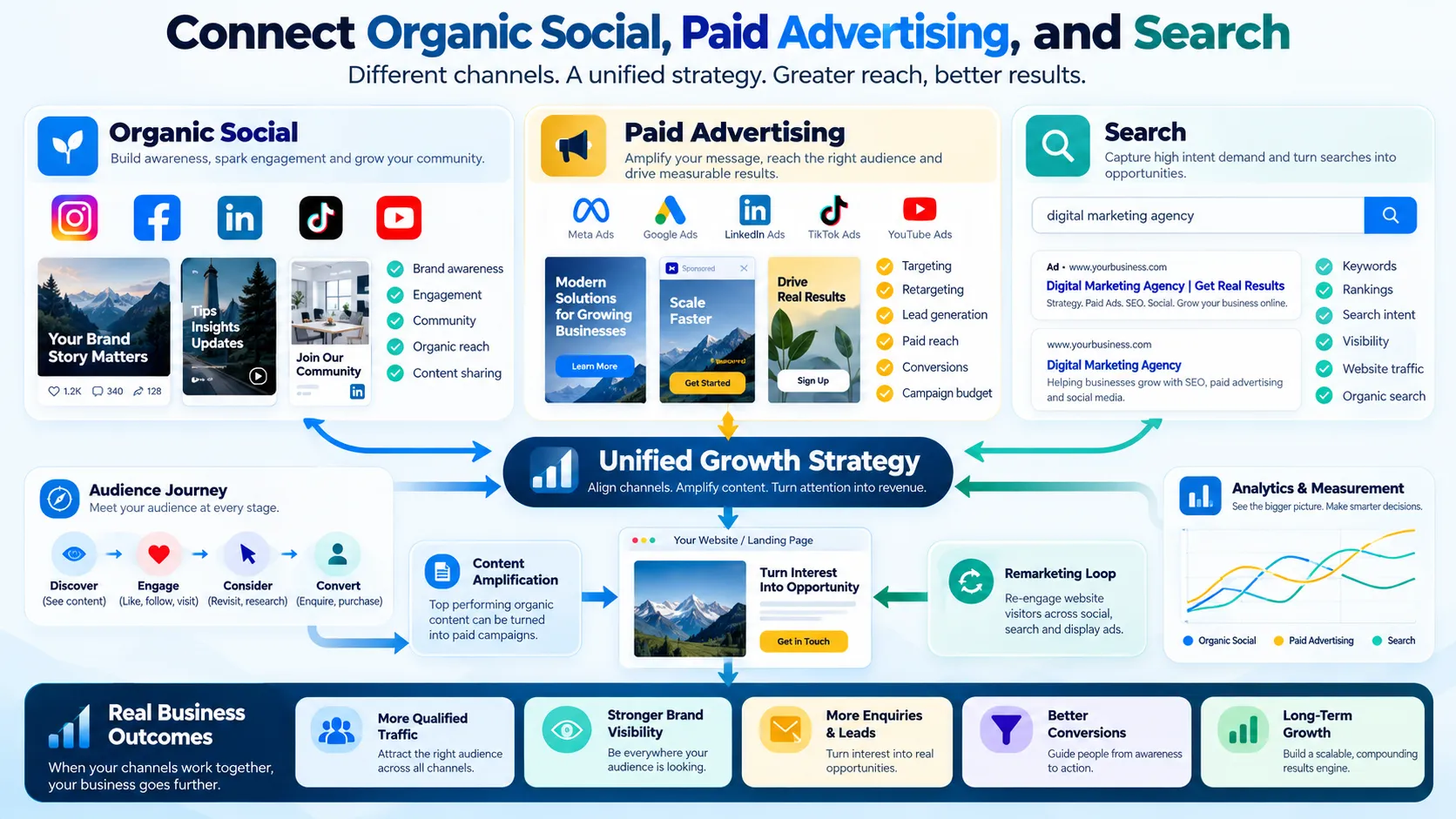
Creative performs within a wider digital ecosystem. Organic social content may introduce a business to new audiences, paid advertising may expand distribution, and search-focused content may help people discover the business while researching a problem.
The relationship between seo and social media marketing is complementary rather than interchangeable. Social engagement does not guarantee higher organic rankings, but social content can distribute useful resources, introduce brand expertise, and encourage people to explore a website.
Similarly, digital advertising campaign planning should account for what happens after the click. A well-designed advertisement can still underperform if the landing page is confusing, slow, inconsistent with the creative, or poorly aligned with the visitor’s expectations.
A connected approach allows the business to coordinate visual identity, content themes, campaign messages, website destinations, and conversion measurement.
For a broader view of how these activities work together, readers can explore GrowthAxis Solutions’ Digital Marketing services and Social Media Marketing service. Businesses considering paid Facebook and Instagram campaigns can also review the Meta Ads service.
Measure Creative Performance and Test Improvements
Creative decisions should be evaluated against the objective of the asset. Likes and views can indicate attention, but they do not automatically demonstrate business value.
A brand-awareness campaign may focus on reach, video views, watch time, or brand recall. A traffic campaign may focus on link clicks and landing-page visits. A lead-generation campaign should examine completed forms, qualified enquiries, cost per lead, and eventual conversion quality.
The right metrics depend on the platform, attribution setup, campaign objective, and customer journey.
| Measurement | What it helps you understand |
|---|---|
| Reach and impressions | Whether the creative is being delivered to an audience and how often it appears |
| Watch time and retention | Whether viewers continue watching and where they lose interest |
| Click-through rate | Whether the message and offer encourage people to visit the destination |
| Conversion rate | Whether visitors complete the intended action after interacting with the creative |
| Cost per qualified lead | How efficiently the campaign attracts prospects who meet the business’s requirements |
| Return on ad spend | How attributed revenue compares with advertising expenditure, where reliable revenue tracking exists |
Test One Meaningful Variable at a Time
Creative testing helps businesses replace assumptions with evidence.
A business could test two opening hooks while keeping the audience, offer, placement, and destination reasonably consistent. Another test might compare a product demonstration with a static product visual.
The goal is to understand which variation improves the chosen outcome, not simply which receives the most reactions.
Allow tests enough time and delivery to produce interpretable results. Very small samples, inconsistent campaign conditions, or simultaneous changes to many variables can make findings difficult to interpret.
Meta’s Reels advertising guidance reports that, in a meta-analysis of 15 split tests, campaigns using 9:16 video with audio and key messages in safe zones achieved a 34.5% lower cost per result than image ads in the studied Reels campaigns. This is Meta’s reported result for those tests, not a universal forecast for every advertiser.
The practical lesson is to test creative suited to the placement, examine the actual results, and avoid assuming that one format always wins.
Review Creative Performance Regularly
Establish a review schedule that matches campaign activity and available data. Look for patterns across different hooks, visual styles, offers, and formats.
If viewers leave a video early, inspect the opening and pacing. If people click but do not enquire, examine the landing page, offer clarity, form friction, and tracking. If a campaign attracts many low-quality leads, reassess audience fit and the message used to attract attention.
A social media design strategy should evolve through this feedback loop rather than remain fixed after its initial launch.
A Practical Creative Production Checklist
Before publishing a graphic, advertisement, or video, review the following items.
- Confirm the audience, campaign objective, main message, and intended action.
- Check that the design follows the brand’s approved colours, typography, logo usage, and visual style.
- Verify that text remains legible on mobile devices and important elements stay within platform safe zones.
- Check video framing, sound, captions, aspect ratio, resolution, and music or image usage rights.
- Ensure the creative’s promise matches the landing page, offer, and actual service or product.
- Confirm that tracking is configured where needed and that the chosen performance metrics match the objective.
- Review the final asset in the actual placement before publishing or launching the campaign.
Common Mistakes to Avoid
1. Designing Before Defining the Message
An attractive visual cannot compensate for an unclear offer. Establish the audience, message, and objective before choosing the layout or animation.
2. Using the Same Creative Everywhere
Different platforms and placements have different interfaces and audience expectations. Adapt the composition, pacing, and message while maintaining a consistent brand identity.
3. Making Every Post Promotional
Constant selling can leave audiences with little reason to follow the brand. Balance offers with educational material, demonstrations, useful answers, and relevant stories.
4. Adding Too Much Text
Crowded graphics make it harder to identify the main message. Use a clear hierarchy and move detailed explanations into a caption, carousel, video narration, or landing page when appropriate.
5. Treating Engagement as the Only Measure of Success
High engagement can be encouraging, but it may not lead to qualified enquiries or sales. Measure the action that matters to the business.
6. Ignoring Creative Fatigue
Repeatedly showing the same message and visual can reduce its effectiveness. Monitor performance and introduce thoughtful variations when results indicate that the creative needs refreshing.
7. Making Unsupported Advertising Claims
Avoid fabricated testimonials, misleading before-and-after comparisons, guaranteed outcomes, or statistics without reliable evidence. Verify claims and ensure that creative complies with relevant advertising policies.
8. Neglecting Accessibility and Rights
Small text, poor contrast, missing captions, and unlicensed music can create usability or compliance problems. Include these checks in the production workflow.
Pro Tips for a More Effective Creative Strategy
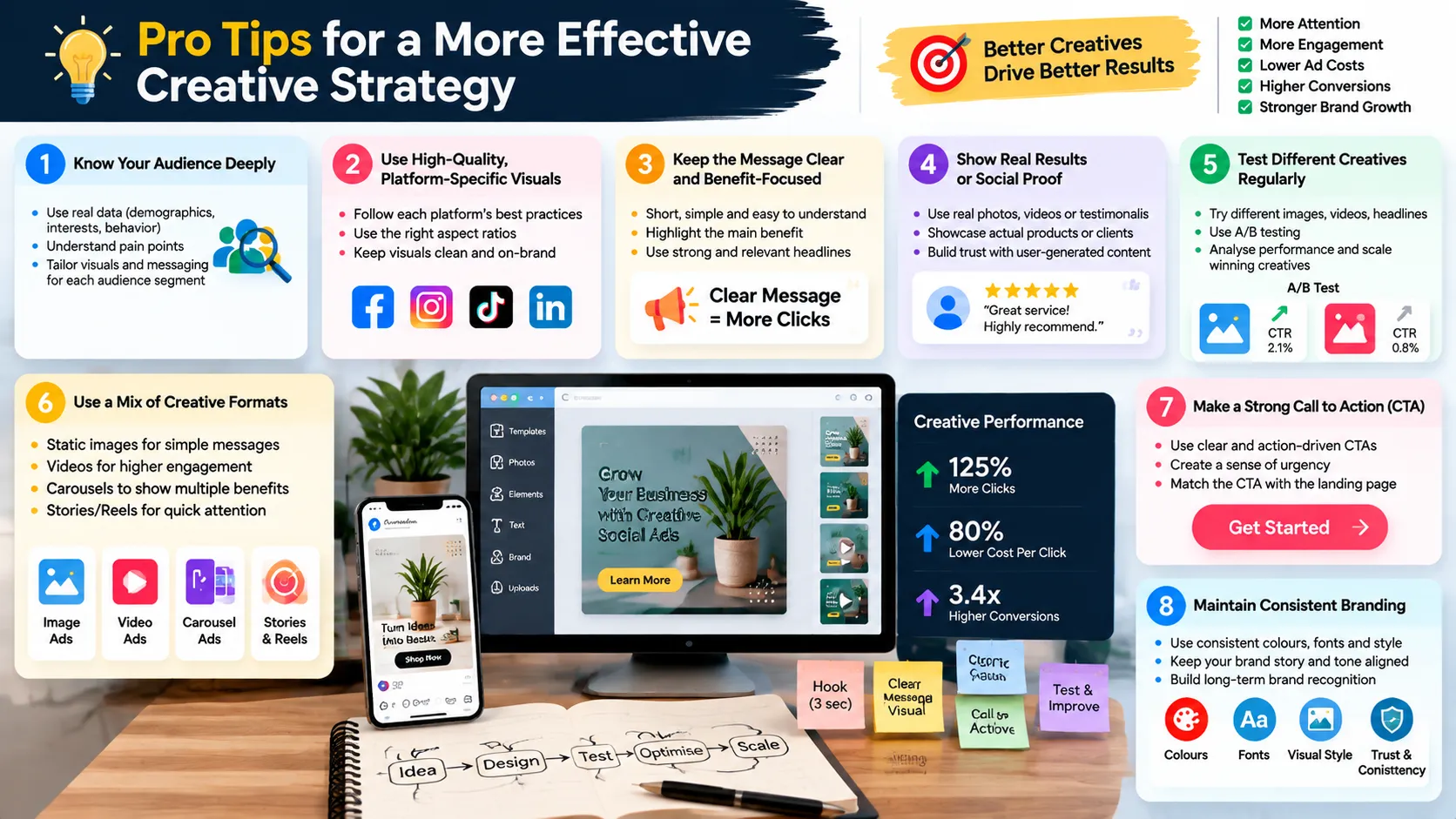
Start with a repeatable system rather than an endless stream of isolated designs. A well-managed creative library should contain approved brand assets, reusable templates, campaign messages, and examples of what the team has learned from previous tests.
Use performance data to identify questions worth investigating. If product demonstrations generate qualified enquiries, explore different demonstrations, audiences, and offers rather than copying the same video indefinitely.
Build feedback into the production process. Sales teams may know which objections prevent purchases. Customer support may understand which product features confuse users. Those insights can inform stronger educational content and more persuasive creative.
Sprout Social’s visual content strategy guide emphasizes the importance of a consistent visual language and a documented brand approach. Its 2026 Social Media Content Strategy Report also explores audience preferences and the differences between platforms. The report’s survey findings cover consumers in the United States, United Kingdom, and Australia, so businesses should validate those insights against their own target markets.
For paid campaigns, a clear digital advertising strategy should define the message, audience, budget, destination, measurement approach, and testing plan before launch.
A practical digital ad strategy also recognises when a campaign needs better creative, when the offer needs refinement, and when the problem lies beyond the advertisement itself.
Businesses comparing providers should look beyond promises about impressions or follower growth. Ask how the work will be scoped, how creative will be reviewed, what performance data will be available, and how the team will decide what to improve next.
Recommended Supporting Content for a Stronger Creative Cluster
This pillar can become the central guide for a wider collection of educational articles. Each supporting article should answer a distinct question and link back to the main resource when that connection helps readers.
Useful supporting topics include Social Media Carousel Design: Structure and Best Practices, which can explain how to organize information across slides; How to Test Different Ad Creatives, which can cover testing methods and interpretation; and Short-Form Video Content Strategy for Businesses, which can explore video planning, scripts, and distribution.
Additional supporting resources could cover UGC and Creator-Style Ads for Small Businesses, including permissions and disclosure considerations, and Explainer Videos and Motion Graphics for Business Growth, including when animation makes a complex message easier to understand.
Once these articles are published, connect them through contextual internal links. Until then, do not create links to unpublished URLs.
This structure allows the main article to explain the overall system while supporting articles address specific implementation questions. It also gives readers a natural route from educational information to relevant creative services when they need professional support.
Conclusion
A successful social media design strategy connects audience research, consistent visual identity, persuasive advertising creative, and useful video content with measurable business objectives. Focus on clear messages, platform-appropriate design, meaningful testing, and a relevant customer journey rather than vanity metrics. Contact GrowthAxis Solutions to discuss a creative system tailored to your audience, campaigns, and growth goals.
Frequently Asked Questions
1. What is a social media design strategy?
A social media design strategy is a plan for creating consistent, audience-focused visual content that supports business goals. It defines the brand’s visual style, content themes, creative formats, platform requirements, and performance measures. It helps businesses create graphics, advertisements, and videos that communicate a clear message rather than publishing disconnected designs.
2. How does social media design help a business grow?
Social media design can help a business communicate its value, maintain a recognisable identity, explain products or services, and support campaign objectives. Its contribution depends on the quality of the message, audience relevance, distribution, and customer journey. Design alone cannot guarantee engagement, leads, or sales.
3. What is the difference between social media design and ad creative?
Social media design covers the visual presentation of organic posts, educational content, announcements, and other social assets. Ad creative is developed specifically for advertising objectives and may place greater emphasis on the offer, audience relevance, persuasive messaging, and conversion action. Both should follow the same brand identity while serving different purposes.
4. Which social media content formats should a small business use?
Small businesses can begin with a manageable mix of static graphics, carousels, short videos, and relevant promotional assets. The right combination depends on audience preferences, the product or service, production resources, and business goals. Test a few suitable formats, measure their results, and expand the mix when evidence supports doing so.
5. How can businesses create effective social media advertisements?
Start with one audience, one clear message, and one primary campaign objective. Use a relevant opening, explain the benefit, provide credible evidence where available, and include an appropriate call to action. Match the creative to the landing page and measure conversions or qualified enquiries rather than relying exclusively on impressions and reactions.
6. Why is short-form video important in social media marketing?
Short-form video can demonstrate products, explain processes, communicate brand personality, and deliver information in a compact format. Its suitability depends on the audience and objective. Strong openings, clear storytelling, readable captions, appropriate framing, and relevant calls to action can improve the viewing experience, but results should be measured rather than assumed.
7. What is the best aspect ratio for social media video advertisements?
A vertical 9:16 aspect ratio is a common starting point for full-screen placements such as TikTok, Instagram Reels, Facebook Reels, and YouTube Shorts. However, requirements and recommendations vary by placement and campaign type. Check each platform’s current specifications and safe zones before exporting the final video.
8. How should businesses measure social media creative performance?
Measure performance according to the campaign objective. Awareness campaigns may focus on reach, impressions, and video retention. Traffic campaigns can examine clicks and landing-page visits. Lead-generation campaigns should track qualified enquiries, conversion rates, and cost per lead. Ecommerce businesses may also examine attributed revenue and return on advertising spend.
9. How often should a business update its social media creative?
There is no universal schedule that works for every business. Review performance regularly and refresh creative when engagement, retention, conversion efficiency, or audience relevance declines. New offers, seasonal changes, product updates, and audience feedback may also justify revisions. Maintain enough testing discipline to learn which changes improve results.
10. Should a business hire a social media design agency?
An agency can be useful when a business lacks the time, design expertise, creative testing process, or production capacity needed to maintain consistent content. Before hiring one, clarify the required deliverables, brand guidelines, campaign goals, reporting, and revision process. GrowthAxis Solutions offers Social Media Design, Ad Creative, and Video Content services that can be scoped around a business’s needs.