
Keyword Research for SEO Content: A Practical Guide

Publishing articles without understanding what customers search for wastes valuable resources. Effective keyword research for SEO content connects real questions, search intent, and business goals.
Summary: This practical guide explains how to discover relevant keywords, assess search intent, compare research tools, analyze competitors, and prioritize content opportunities. You’ll learn to turn keyword data into useful articles, build stronger topic clusters, avoid common SEO mistakes, and measure results that support sustainable business growth.
What Is Keyword Research for SEO Content, and Why Does It Matter?

Keyword research identifies the words, questions, and phrases people enter into search engines when looking for information, products, services, or solutions. It helps businesses understand demand before investing time and money in content creation.
However, finding popular phrases is only the beginning.
Effective keyword research for SEO content connects three essential elements: what the audience needs, what search engines currently display, and what your business can genuinely provide.
Imagine owning a bookkeeping company in Chicago. You could publish an article explaining what bookkeeping means. That topic might attract students, job seekers, and curious readers. Alternatively, a guide explaining bookkeeping costs for Chicago small businesses could attract potential customers evaluating services.
Both subjects have value, but their commercial potential differs significantly.
This distinction matters because relevant traffic can generate more business value than larger volumes of unrelated traffic.
According to Google’s SEO Starter Guide, useful, well-organized content should anticipate the different terms audiences use to describe their needs. Google also explains that its systems can understand related wording without requiring every variation to appear repeatedly.
Therefore, keyword selection should support the reader’s experience rather than dictate unnatural writing.
For companies developing content marketing for small business, a documented research process offers several advantages. It helps identify overlooked customer questions, organize editorial priorities, reduce competing articles, and create logical connections between educational resources and service pages.
A well-planned keyword strategy also supports other business growth strategies for small businesses, including customer education, lead generation, conversion optimization, and stronger brand positioning.
The ultimate goal is not to rank for the largest possible number of phrases. It is to become a genuinely useful destination for the questions your ideal customers ask.
How to Find the Right Keywords: A Step-by-Step Research Process
Successful keyword research for SEO content starts with audience knowledge, expands through trustworthy data sources, and ends with a manageable list of opportunities.
Follow these six steps before developing your next article.
- Step 1: Identify your customers and their problems. Start with actual customer conversations, enquiry forms, support requests, product reviews, and sales objections. A website-design agency might hear questions about WordPress pricing, website maintenance, loading speed, or ecommerce security. These questions become useful starting points because they connect to real demand.
- Step 2: Develop seed keywords. Write broad descriptions of your products, services, and audience needs. A bakery might begin with “custom birthday cakes,” “wedding cake prices,” and “gluten-free cakes.” Use these seeds to find keywords that reflect more specific requirements, budgets, locations, and purchase situations.
- Step 3: Expand ideas with research tools. Use Google Keyword Planner, Search Console, Google Trends, or specialized seo keyword research tools. Explore related queries, questions, and variations. Collect promising ideas without immediately assuming every suggestion deserves an article.
- Step 4: Inspect the search results. Search the most relevant phrases in your target location. Check whether the results emphasize tutorials, comparisons, products, directories, local businesses, or videos. The prevailing format often reveals what users expect, although mixed results may indicate more than one intent.
- Step 5: Evaluate opportunity and feasibility. Compare relevance, estimated demand, competition, click potential, and possible business value. A smaller, specific topic can offer a realistic starting point for a new website competing against established publishers.
- Step 6: Group topics and assign pages. Organize related queries by their underlying purpose. Create one comprehensive page when several phrases represent the same need. Develop separate pages when users expect meaningfully different answers.
The process should end with decisions, not merely a spreadsheet containing thousands of keywords.
For example, an accounting business researching “small business tax preparation” might discover questions about filing deadlines, deductible expenses, preparation costs, and choosing an accountant.
Some questions belong in an educational guide. Others deserve commercial service pages.
That distinction helps prevent unnecessary duplication and establishes a clearer customer journey.
A structured content marketing strategy can connect research, editorial planning, internal linking, and performance evaluation.
Review your research periodically because customer concerns, competing content, and search interfaces change.
Understanding Search Intent Before Writing an Article

Search intent describes the objective behind a query. Two people can search similar words while expecting very different experiences.
A person searching “how to calculate payroll taxes” probably wants instructions. Someone searching “payroll software pricing” may be comparing products. A person typing a particular software company’s name might simply want to reach its website.
Modern keyword research for SEO content must distinguish these situations before deciding what to publish.
Informational intent
Informational searches seek knowledge, explanations, or instructions.
Examples include “how does email marketing work?” and “why is my website loading slowly?”
These queries often call for clear definitions, walkthroughs, illustrations, troubleshooting advice, and relevant examples.
An educational article should resolve the reader’s question before presenting a sales offer.
Commercial investigation intent
Commercial searches involve evaluating possible solutions.
Examples include “best CRM for small retailers” or “SEO agency vs in-house specialist.”
Readers typically want comparisons, realistic pricing considerations, advantages, limitations, and selection criteria.
Trustworthy commercial content explains trade-offs instead of automatically recommending the most profitable option for the publisher.
Transactional and navigational intent
Transactional searches indicate readiness to take action, such as requesting a quote, purchasing a product, or booking a service.
Navigational searches indicate a desire to reach a specific brand, website, or destination.
A commercial service page generally serves these searches better than a lengthy informational tutorial.
Why the actual search results matter
A keyword’s wording cannot always reveal its complete intent. Search engines may display mixed results because users have different goals.
Review prominent organic listings and search features rather than trusting a tool’s category label alone.
If most results offer beginner tutorials, publishing a sales-oriented landing page may not match expectations.
If search results favor detailed comparison pages, a basic definition probably will not satisfy the audience.
The Ahrefs guide to keyword intent explains why identifying intent during research helps businesses avoid pursuing queries that do not suit their offerings.
Search Intent Mapping: Which Keyword Needs Which Page?
Use this framework to connect search behavior with a suitable content format.
| Example search query | Primary intent | Recommended page | Useful information to include |
|---|---|---|---|
| What is technical SEO? | Informational | Educational guide | Definition, examples, and common issues |
| How much does local SEO cost? | Commercial | Pricing guide | Cost factors, scope, and realistic expectations |
| Best CRM for small businesses | Commercial | Comparison article | Features, limitations, pricing, and selection criteria |
| Hire an SEO consultant in Toronto | Transactional | Relevant service page | Service scope, qualifications, process, and contact options |
| Google Search Console login | Navigational | Official destination | Clear access to the intended platform |
| Why is my website not indexed? | Informational | Troubleshooting guide | Diagnostic steps and possible causes |
| Ecommerce SEO services | Commercial/transactional | Service landing page | Deliverables, approach, suitability, and enquiry options |
The examples illustrate intent categories; they are not verified search-volume estimates.
One important lesson emerges from this table: not every keyword belongs in a blog post.
Search engines may favor service pages for queries with immediate commercial intent. Publishing an article instead can create a mismatch between the page and the visitor’s objective.
Similarly, combining unrelated questions into one oversized article can reduce clarity.
Use keyword research for SEO content to determine whether the reader expects a concise answer, a detailed tutorial, a product comparison, or a practical service.
This approach supports both discoverability and usability.
Which Keyword Research Tools Are Worth Using?
Different tools answer different questions. Some reveal existing website performance; others provide keyword ideas, competitive estimates, advertising forecasts, or changing search trends.
A business does not need every subscription to begin effective research.
Free and paid tools compared
| Tool | Primary purpose | Particularly useful for | Important limitation |
|---|---|---|---|
| Google Search Console | First-party organic search performance | Existing queries, clicks, impressions, and pages | Limited to properties you can access |
| Google Keyword Planner | Keyword discovery and advertising estimates | Demand estimates, location targeting, related ideas | Primarily designed for advertising |
| Google Trends | Relative search interest over time | Seasonality, geography, emerging topics | Relative interest is not absolute search volume |
| Ahrefs | Keyword and competitor analysis | Traffic potential, competing pages, topic discovery | Full functionality may require a paid plan |
| Semrush | Keyword discovery and competitive research | Search intent, keyword gaps, prioritization | Tool estimates are not guaranteed outcomes |
| Moz | Keyword opportunity and SERP analysis | Difficulty assessment and topic evaluation | Scores depend on its proprietary methodology |
| Mangools KWFinder | Keyword discovery and difficulty estimates | Accessible long-tail research workflows | Available features depend on the plan |
Businesses often search for the best keyword research tool, but no single platform serves every requirement equally well.
Google Search Console should usually be the starting point for an established website because it shows actual visibility in Google Search.
Google Keyword Planner can reveal related terms and approximate demand. However, its numbers describe historical searches and forecasts, not guaranteed organic traffic.
Google explains in its Keyword Planner documentation that average monthly search metrics depend on factors such as date range, targeting, and close variants. The platform also rounds volume data.
For competitor analysis, dedicated platforms can provide broader estimates of ranking keywords and competing pages.
When using an seo research tool, always check which country, language, device, and search engine its figures represent.
A company targeting Australia should not automatically prioritize keywords using US-only estimates.
Can free tools provide enough information?
Yes, particularly for smaller projects.
Combining Search Console, Keyword Planner, Google Trends, customer enquiries, and manual search-result reviews can create a useful foundation.
Paid keyword research tools become more valuable when teams need scalable competitor comparisons, historical data, clustering features, or more extensive reporting.
Searches for a keywords planner tool, key word tool, or seo keywords tool often reflect the same practical need: finding relevant search terms and evaluating their potential.
Choose based on the decisions the software helps you make, not simply the number of suggested keywords it generates.
How to Interpret Search Volume, Difficulty, and Business Value
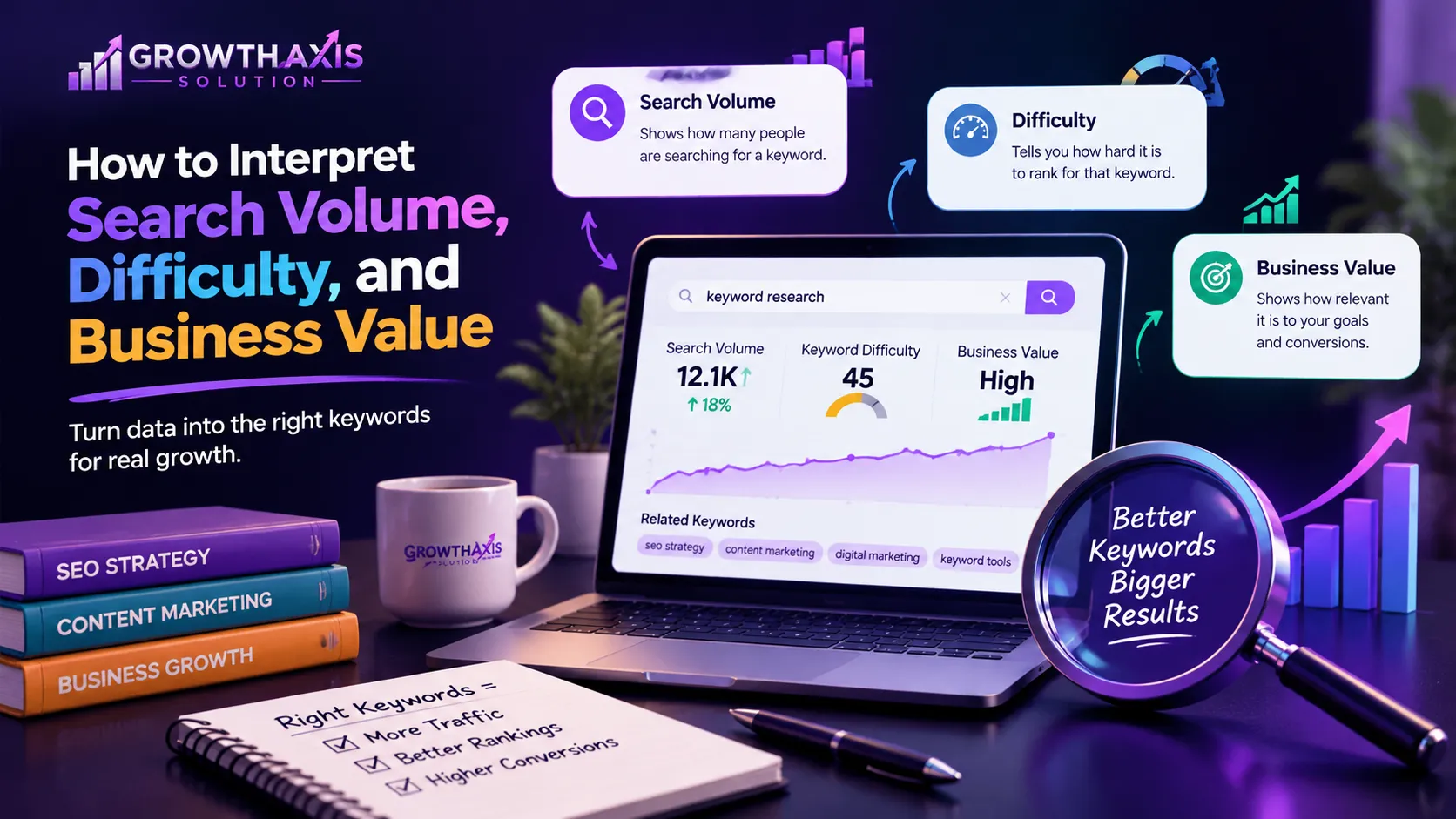
Keyword metrics provide clues, not certainty.
One of the most common research mistakes is selecting topics based almost entirely on monthly search estimates.
Effective keyword research for SEO content requires understanding what each metric represents and where its limitations begin.
Search volume is an estimate of demand
Keyword search volume usually describes the estimated average number of searches for a query during a specified period.
A phrase showing 2,000 estimated monthly searches does not mean a particular website can expect 2,000 visits.
Users may click competing results, advertisements, videos, or nothing at all. A page may also rank for related searches that contribute additional traffic.
Volume estimates can differ across tools because providers use different datasets and estimation methods.
Keyword difficulty estimates competition
Difficulty scores attempt to assess how challenging it might be to rank for a query.
Some providers emphasize link-related characteristics, while others incorporate additional competitive signals.
These scores are not Google ranking metrics, and values from different vendors are not directly interchangeable.
A low score cannot guarantee success. An established specialist website may outperform a general publisher on a topic where its genuine expertise is stronger.
Traffic potential differs from individual keyword volume
A well-structured page can appear for many related queries.
Ahrefs defines its Traffic Potential metric using the estimated organic traffic earned by the top-ranking page across its ranking keywords.
That makes topic-level research useful when several similar terms may belong on one page.
However, competitor traffic estimates remain estimates rather than direct access to another website’s analytics.
Business value should influence priority
Consider an illustrative example involving two topics for a bookkeeping company.
The first topic, “what does a bookkeeper do,” attracts broad informational interest. The second, “monthly bookkeeping services for restaurants,” addresses a narrower potential buying need.
Assume the broader topic has estimated demand of 4,000 monthly searches and the narrower topic has 150. These are hypothetical figures, not measured keyword data.
If the second query attracts a qualified restaurant owner looking for ongoing services, one customer might provide substantial value.
That does not make educational content useless. It means different topics serve different business objectives.
The best selection balances audience usefulness, realistic search opportunity, and the action visitors may take after reading.
How to Analyze Competitor Keywords and Find Content Gaps
Competitor analysis reveals how other websites satisfy similar searches.
It should never become a process of copying their headlines and replacing a few words.
Start by identifying search competitors, which may differ from direct business competitors.
For example, a local accounting firm might compete with major financial publishers for educational queries, even though those publishers do not offer accounting services in the same city.
Review the leading organic pages for each important topic, then examine their structure, explanations, examples, sources, and freshness.
A useful content gap is not merely a missing keyword.
It might be an unanswered customer question, an unclear explanation, a missing calculation, outdated guidance, a confusing comparison, or inadequate local context.
What can you learn from established SEO publishers?
The Semrush keyword research guide emphasizes discovery, competing keywords, business value, click potential, and AI-influenced search behavior.
The Ahrefs keyword research guide explores keyword ideas, intent, potential traffic, and prioritization.
Moz’s Beginner’s Guide to SEO explains demand, competition, long-tail opportunities, and suitable content formats.
These resources provide useful frameworks. Smaller businesses can add value by applying the principles to their own market with concrete decisions, budgets, customer examples, and realistic implementation constraints.
For example, rather than writing another general article about SEO, a commercial cleaning company could publish a detailed guide to preparing an office for after-hours cleaning.
That guide might explain building access, security arrangements, equipment restrictions, safety requirements, scheduling, and questions to ask a provider.
Its usefulness would come from relevant subject expertise, not from copying competitors’ keyword lists.
Turn competitor observations into original value
Record the specific question each competing page answers and identify where a reader might still need help.
Then use customer interviews, professional experience, reliable external sources, and practical demonstrations to improve the answer.
If competing pages contain outdated screenshots, verify current interfaces before creating new instructions.
If competitors use statistics without context, inspect the original source and explain the sample, geography, and limitations.
Strong seo research should produce more accurate, usable information—not simply longer articles.
Building a Keyword Priority Framework That Supports Revenue
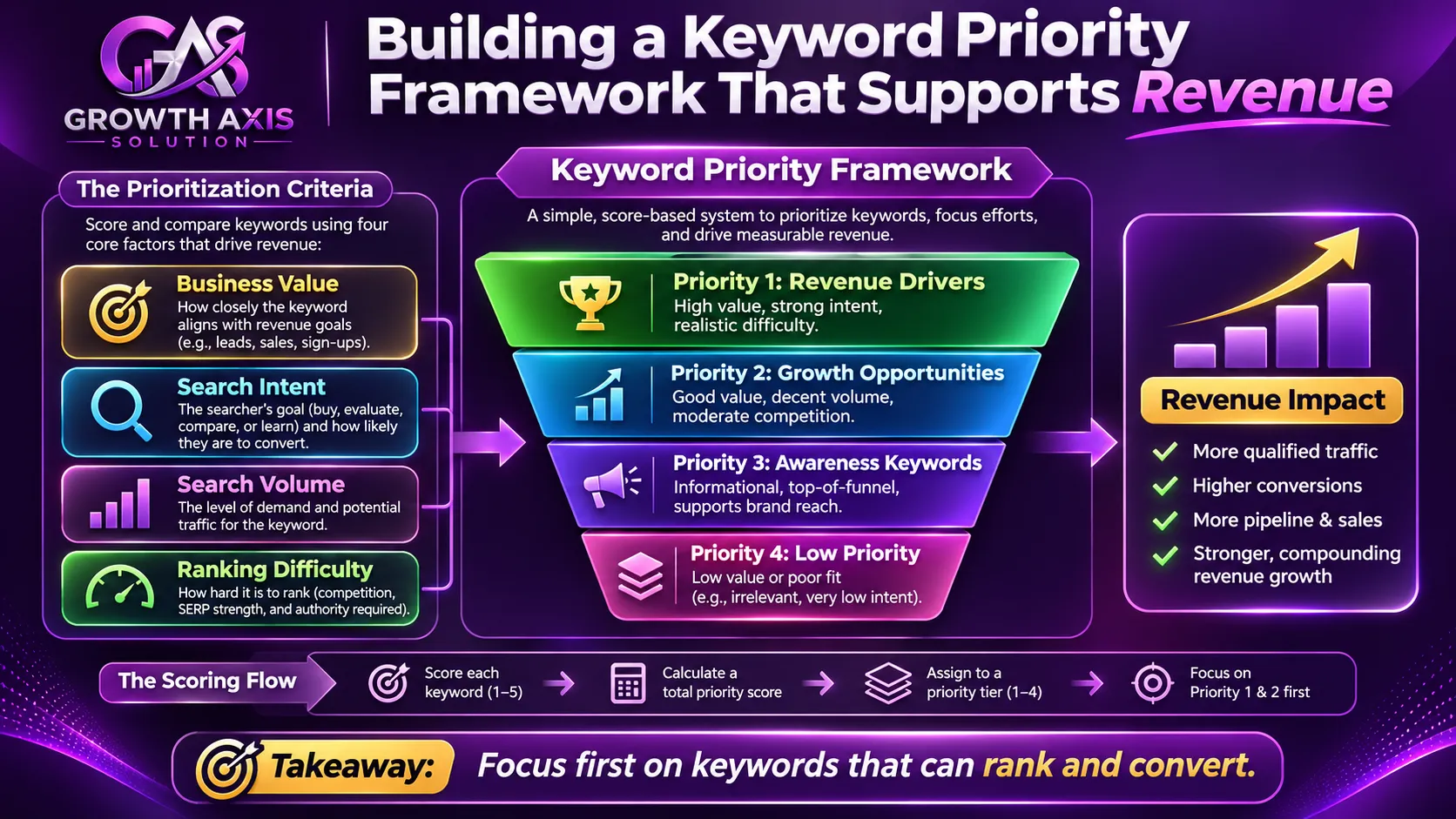
A huge keyword list can overwhelm small teams.
A simple scoring model turns research into manageable editorial decisions.
For each opportunity, rate five factors from one to five, where five represents the strongest score.
Consider business relevance, intent fit, realistic ranking opportunity, likely click potential, and evidence of demand.
For an illustrative weighted model, assign 30% to business relevance, 25% to intent fit, 20% to achievability, 15% to click potential, and 10% to evidence of demand.
Suppose an opportunity earns scores of four, five, three, four, and three respectively.
Its weighted score becomes:
(4 × 0.30) + (5 × 0.25) + (3 × 0.20) + (4 × 0.15) + (3 × 0.10) = 3.95 out of 5.
Another broad topic might earn scores of two, three, one, two, and five, producing 2.35 out of 5.
These are illustrative planning scores, not measured ranking probabilities.
The first opportunity would deserve earlier investigation under this model.
However, a formula should support judgment rather than replace it. A legally sensitive subject, an important customer-support question, or a new product launch may need attention even when its calculated score is modest.
Keyword research for SEO content becomes far more useful when a team can explain why one article deserves resources before another.
Review priorities monthly or quarterly, depending on publishing activity and market volatility.
How to Turn Keyword Research Into a Content Plan
Research only produces value when you translate it into helpful pages and useful journeys.
Each planned article should have a clear primary topic, an intended audience, a defined search intent, and a specific purpose.
For example, a company offering digital services might establish a broad educational resource about search engine optimization.
Related resources could then explain technical SEO audits, local visibility, content planning, and campaign measurement.
Each page would answer a distinct question while linking to closely related resources.
This forms a topical structure that helps visitors explore a subject without encountering unnecessary repetition.
Assign one primary purpose to each page
An article about choosing SEO keywords should teach research and selection.
A service page should explain what an agency delivers, who benefits, how the process works, and how to request assistance.
A comparison page should help readers evaluate realistic alternatives.
If several pages target effectively identical search intent, examine whether combining or differentiating them would produce a clearer experience.
Create a useful content brief
A practical brief identifies the audience’s central question, main keyword, related questions, suitable examples, verified sources, and any information that requires expert review.
It also specifies the next useful action.
That action might involve reading another guide, downloading a relevant worksheet, viewing a service page, or contacting a specialist.
For content teams, on-page SEO optimization can help align headings, page titles, content structure, and internal links with the chosen purpose.
Use internal links to guide the reader
Internal links should connect genuinely related information.
A section explaining indexing problems may naturally reference a technical SEO audit.
A discussion of location-specific queries may connect to local SEO services.
Avoid attaching the same commercial link to every paragraph.
Google’s guidance favors descriptive link text that helps people understand what they will find after clicking.
Quality internal linking improves navigation and helps visitors continue learning without creating a confusing network of repetitive anchors.
Keyword Research for Small Businesses Targeting Different Countries
International marketing requires more than adding the names of several countries to one article.
Search language, customer expectations, terminology, and commercial conditions can vary substantially between the United States, Canada, Australia, and the United Kingdom.
A business in the United States might search for “vacation rental management,” while an Australian audience might use different property-related terminology.
Even when users share a language, they may expect country-specific tax information, regulations, prices, service availability, or purchasing options.
Use geographic filters in research platforms to explore differences.
Then inspect country-specific search results and speak with people familiar with the target market.
For keyword research for SEO content, geographic relevance should influence examples, currencies, local references, and available services.
A global agency should not create dozens of nearly identical location pages merely to target every city.
Instead, develop distinct information when a location meaningfully changes the advice or the service.
For businesses comparing the best seo companies for small business, useful evaluation criteria include demonstrated market understanding, clear deliverables, access to reporting, realistic timelines, and transparent account ownership.
Businesses researching the best seo services for small business should also consider their current website condition and customer acquisition priorities.
A smaller specialist project may be more appropriate than a broad retainer covering services the company does not yet need.
Keyword Research in the Age of AI Search

Search behavior now includes conventional results, AI-generated summaries, conversational tools, videos, communities, and specialized platforms.
This wider environment changes how businesses evaluate opportunities.
Some straightforward questions may receive answers directly within search results, reducing the need for a website visit.
Other subjects—such as complicated comparisons, professional decisions, original research, and detailed tutorials—may still encourage users to explore external pages.
The modern keyword research for SEO content process should therefore consider both demand and likely reader engagement.
A phrase with high estimated search volume may offer limited click opportunities if the answer appears immediately on the results page.
By contrast, a specific problem requiring a calculator, worksheet, professional explanation, or detailed example may offer stronger reasons to visit a website.
Do AI search features require different SEO fundamentals?
Google’s AI features documentation states that established SEO practices remain relevant for AI Overviews and AI Mode. It does not require an additional special optimization to become eligible for these features.
Focus on accessible pages, accurate information, original evidence, and helpful answers.
Avoid inventing statistics or claiming that repeating question-based phrases will guarantee AI citations.
Question research remains valuable because real customers describe problems conversationally.
Instead of targeting only “website speed optimization,” investigate questions such as “Why does my online store load slowly on mobile?” and “What should I fix before buying a faster hosting plan?”
Those questions reveal context that short keyword labels sometimes hide.
Why original experience matters
A generic definition adds limited value when thousands of existing pages already explain the same concept.
A detailed example based on a genuine customer problem, properly anonymized where necessary, can provide more useful information.
Google’s people-first content guidance encourages original information, credible sourcing, and clear evidence of expertise.
Businesses should show how recommendations work, explain limitations, and identify who provided the expertise.
Do not fabricate case studies, testimonials, research results, or professional credentials.
Common Keyword Research Mistakes to Avoid
Even experienced marketers can make mistakes when research becomes a race to collect keywords rather than solve customer problems.
The following issues deserve particular attention:
- Choosing keywords exclusively by volume. A popular query may attract people who have no interest in your services. Evaluate intent and relevance alongside demand.
- Targeting unrealistic competition. A new website may struggle against established sources on broad topics. Begin with opportunities that match your expertise and resources.
- Creating separate pages for every keyword variation. Closely related expressions often belong in one strong resource. Excessive duplication can create confusing site architecture and competing pages.
- Ignoring existing search performance. Search Console may reveal opportunities where relevant pages already receive impressions but need clearer content or better alignment.
- Using outdated research. Customer language, product features, competitors, and search presentation can change. Recheck important topics before major revisions.
- Forcing exact-match keywords into every paragraph. Google warns against keyword stuffing. Readability, meaning, and useful information should determine natural wording.
- Publishing without a business objective. A page may generate visits without supporting customer education, enquiries, retention, or brand credibility. Define its role before production.
- Trusting automated metrics without investigation. Tool estimates, intent labels, and difficulty scores cannot replace reviewing actual competing pages and customer needs.
Avoiding these problems helps keep keyword research for SEO content grounded in practical decisions.
An article should exist because it answers an important question—not because a software tool suggested another variation.
Expert Insights: How to Measure and Improve Your Keyword Strategy

The value of research becomes clearer after publication.
Begin with Google Search Console’s Performance report.
It provides impressions, clicks, click-through rate, and average position, with dimensions including queries, pages, countries, and devices.
These metrics help identify whether a page attracts relevant searches and whether search visibility changes over time.
But rankings and visits tell only part of the story.
Connect organic landing pages with meaningful actions such as completed enquiries, bookings, purchases, or qualified consultation requests.
A page attracting 200 relevant visits and five promising enquiries may provide more value than a page generating 2,000 unrelated visits.
A realistic measurement example
Imagine a professional services website publishing six articles over three months.
Four articles answer common educational questions. Two address commercial decisions and link to relevant service pages.
After publication, the company reviews organic visibility, engagement, enquiries, and actual customer outcomes.
Suppose one commercial guide receives 300 organic visits and generates six qualified enquiries, while an educational guide receives 1,200 visits but generates one.
Those numbers are hypothetical.
They illustrate why qualified outcomes matter more than traffic totals when comparing business value.
The educational guide may still support awareness and trust. Its success should reflect its intended purpose rather than an arbitrary requirement to generate immediate sales.
Measure the complete customer journey
Businesses investing in content marketing for small businesses should review which articles support product discovery, service comparisons, email subscriptions, sales discussions, or repeat engagement.
Keyword research for SEO content works best when editorial and sales teams share observations.
Customer questions may reveal missing topics. Website analytics may identify pages needing stronger explanations. Search Console may surface relevant queries that the existing content only partially addresses.
These signals can inform revisions without requiring an entirely new article each time.
A disciplined review process is more sustainable than constantly producing content without examining its performance.
Conclusion
Keyword research for SEO content works when audience needs, trustworthy data, search intent, and business objectives guide every decision. Start with real customer questions, evaluate opportunities carefully, and publish genuinely useful answers. Measure qualified outcomes rather than rankings alone. Need a practical content strategy? Contact GrowthAxis Solutions to discuss your next steps.
Frequently Asked Questions
1. What is keyword research for SEO content?
Keyword research for SEO content is the process of identifying search queries that relate to your audience and using them to plan useful website content. It involves discovering relevant phrases, understanding search intent, estimating demand, evaluating competition, and selecting an appropriate page format.
The most valuable research connects a user’s question with a trustworthy answer.
For example, a software company may discover that prospective customers frequently ask about integration costs. A detailed guide can answer that question and help buyers make informed decisions.
The goal is meaningful visibility, not simply repeating popular search phrases.
2. How do beginners find SEO keywords for a website?
Start by writing down your main services, customer problems, and frequently asked questions.
Enter these ideas into Google Keyword Planner or another research platform to discover related terms.
Review your target search results to understand what content users expect. Then compare relevance, competition, and likely business value.
For existing keywords for website planning, Search Console can reveal queries where your pages already appear.
Beginners should prioritize a small number of well-matched opportunities instead of attempting to rank for every possible topic.
3. What is the best free keyword research tool?
Google Keyword Planner and Google Search Console make a useful combination.
Keyword Planner helps discover related terms and review estimated search demand. Search Console provides actual performance information for websites you manage.
Google Trends adds insight into changing and seasonal interest.
No single tool offers every answer. The best keyword research tool depends on whether you need new ideas, competitive insight, geographic information, or existing performance data.
For beginners, understanding the limitations of free data is more important than purchasing several subscriptions immediately.
4. How many keywords should one SEO article target?
There is no universal number.
A strong article usually addresses one primary search purpose while naturally covering related questions, concepts, and terminology.
For example, a guide about improving mobile website speed may explain image compression, hosting, caching, and performance measurement because those subjects help answer the main question.
It does not need separate paragraphs dedicated to repeating every keyword variation.
Modern SEO keyword research should focus on complete topical coverage and useful organization rather than meeting an arbitrary keyword count.
5. Is keyword density still important for SEO?
Keyword density measures how frequently a phrase appears relative to the total word count. It can help editors notice excessive repetition, but Google does not prescribe a universal ideal percentage.
A page should include its main topic clearly in relevant places, such as the title and introductory explanation.
However, forcing a phrase into sentences to reach a percentage can damage readability.
Google’s SEO guidance warns against keyword stuffing.
Use natural language, precise terminology, and related expressions where they genuinely improve understanding. The reader’s experience should take priority.
6. What is the difference between keyword research and keyword analysis?
Keyword research focuses on discovering possible search topics.
Keyword analysis evaluates those opportunities to decide which ones deserve attention.
For example, research might reveal twenty related searches about business insurance.
Analysis would consider search intent, demand, ranking competition, content requirements, and relevance to your offerings.
Together, the processes help create a focused publishing plan.
A useful analysis ends with practical decisions about which pages to create, update, combine, or postpone rather than simply producing a longer keyword list.
7. Should small businesses target low-volume keywords?
Yes, when those queries reflect meaningful customer needs.
A low-volume phrase can represent a specific purchasing requirement or a problem that few competitors explain well.
For example, a highly specialized B2B service may receive relatively few searches but attract valuable commercial enquiries.
Do not assume every low-volume query deserves a separate article.
Instead, investigate the underlying intent, verify demand through available customer evidence, and group closely related questions where appropriate.
Smaller topics can support a sustainable content strategy when they connect naturally with your expertise.
8. How often should businesses update their keyword research?
Review important keyword opportunities regularly, especially when publishing new content, launching products, expanding locations, or noticing meaningful performance changes.
A quarterly review can provide a practical starting point for many smaller organizations.
Fast-changing industries may require more frequent evaluation.
Use Search Console to spot emerging queries, declining visibility, and pages that attract the wrong audience.
Also review customer conversations and competitor changes.
Updating the research does not mean rewriting every article. Prioritize changes that improve accuracy, usefulness, or alignment with current search intent.
9. Can keyword research improve conversions and sales?
Yes, when it helps attract visitors whose needs match what the business offers.
Informational keywords may introduce potential customers to a brand, while commercial and transactional queries can support purchasing decisions.
For instance, a company offering website maintenance could publish educational troubleshooting advice alongside a clear commercial page explaining maintenance packages.
The educational resource answers questions. The service page helps visitors evaluate professional assistance.
Better keyword-to-page alignment can create more relevant enquiries, although conversions also depend on pricing, trust, usability, and follow-up.
10. Should I hire an agency for keyword research and content SEO?
An agency can help when your business lacks time, research expertise, or the resources to coordinate content planning, technical improvements, and measurement.
Evaluate providers through their methodology, reporting transparency, communication, and understanding of your target audience.
Avoid relying solely on claims about being the best seo company small business owners can hire.
Ask how the provider connects keyword opportunities to real customer needs, chooses content formats, and evaluates results.
A reputable agency should explain realistic expectations, ownership of deliverables, and what your budget can reasonably support.