How to Optimize Content for Google AI Overviews and AI Mode
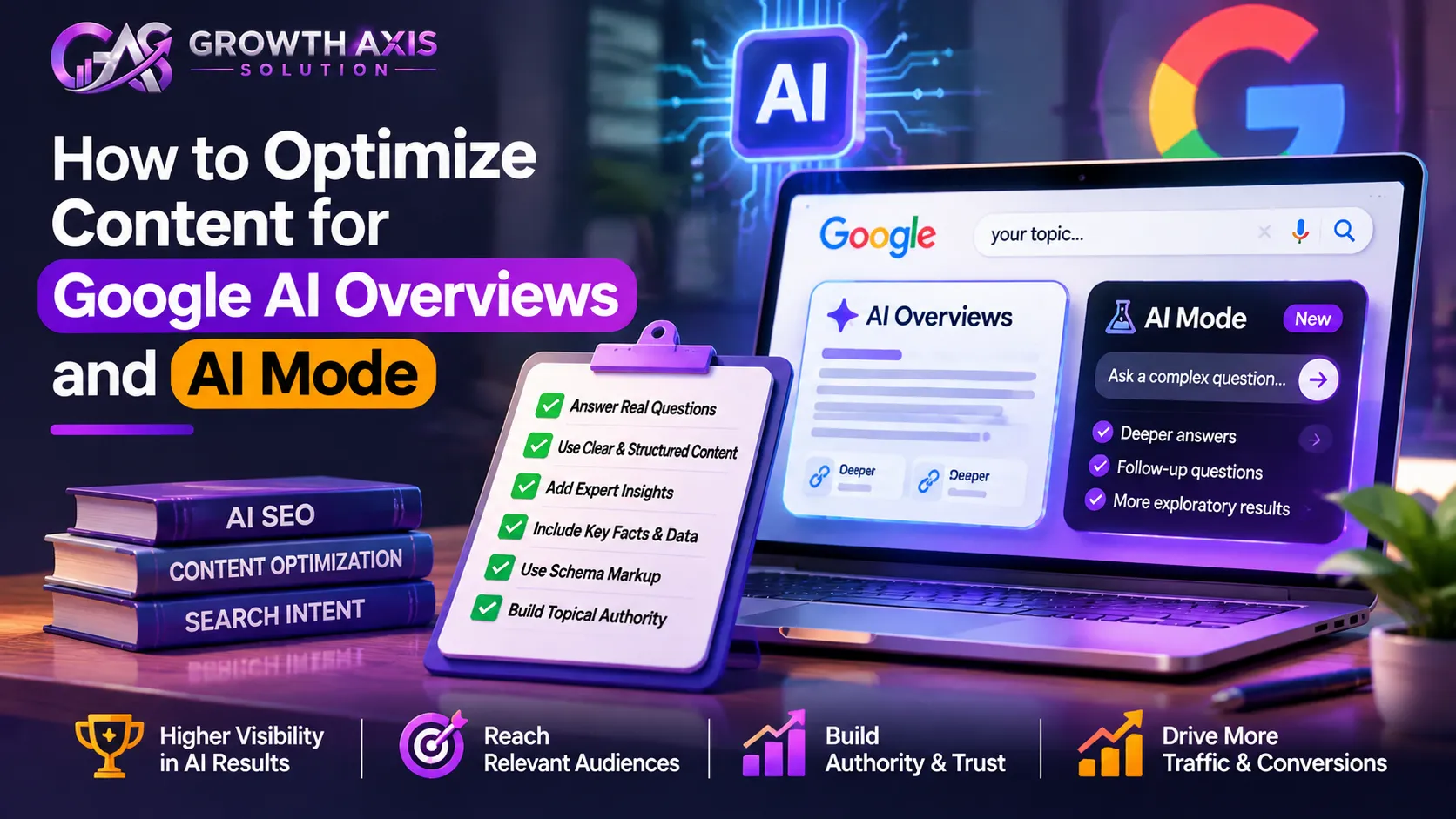
Search is becoming conversational. To optimize content for Google AI Overviews and AI Mode, businesses must publish original, trustworthy information that answers real customer questions.
Google’s AI search experiences are changing how people discover websites, compare businesses, and make decisions. This guide explains how AI Overviews and AI Mode work, what Google’s 2026 guidelines require, how to create citation-worthy content, improve technical accessibility, and measure AI search visibility with practical strategies for businesses.
What Are Google AI Overviews and AI Mode?
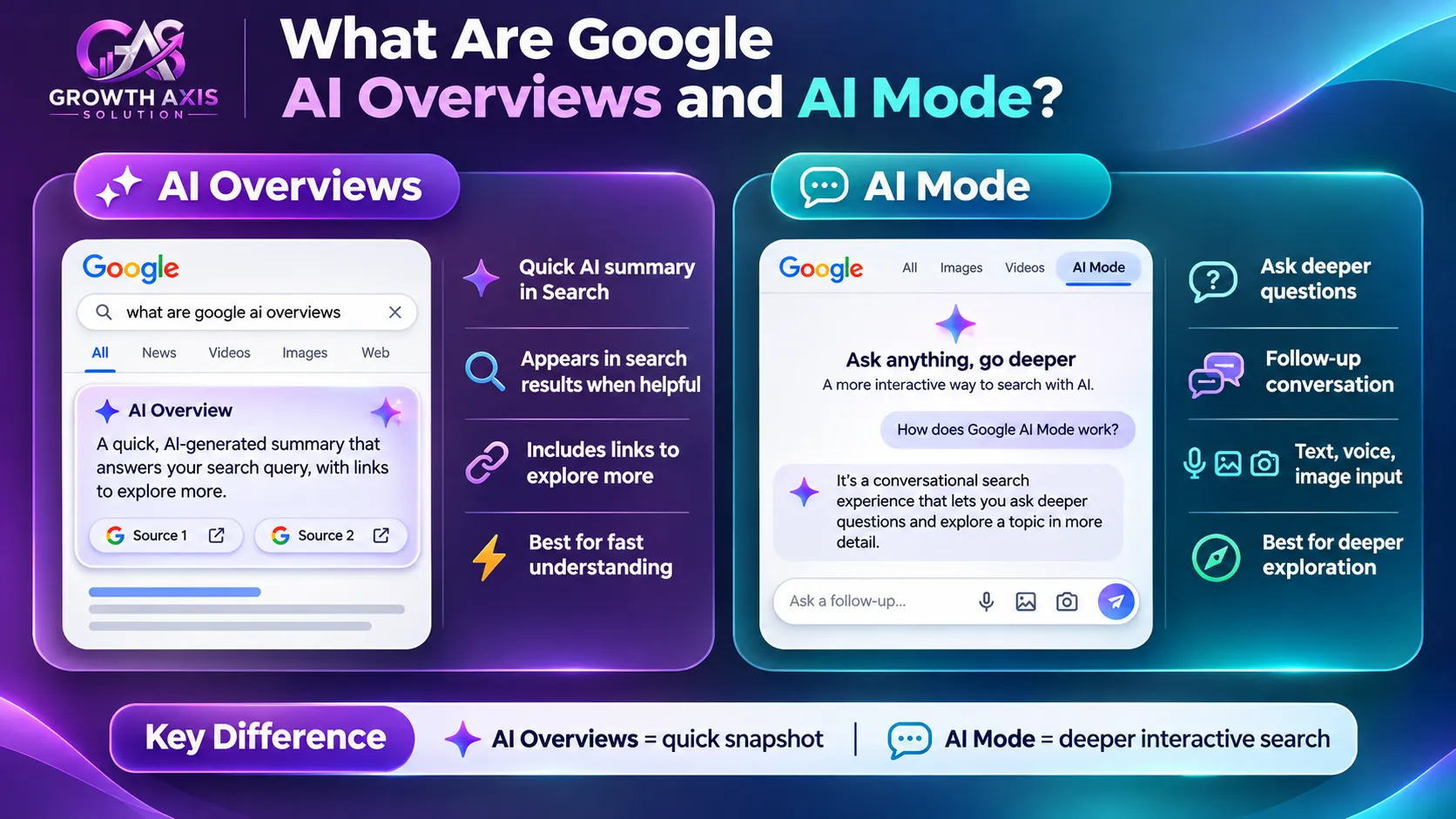
Google AI Overviews and AI Mode are generative search experiences that help users explore information through AI-generated responses and links to relevant websites.
Although both use Google’s AI capabilities, they serve different purposes.
AI Overviews appear within conventional Google Search results when Google’s systems determine that an AI-generated summary would help answer a query. They combine information from relevant sources and provide links that allow users to explore supporting information.
AI Mode offers a more conversational experience. Users can ask complex questions, explore different perspectives, and continue with follow-up questions without restarting their search.
For example, someone researching digital marketing might initially ask:
“What is SEO, and how can it help a small business?”
They might then ask:
“How much does SEO cost for a new ecommerce website?”
“Should I invest in SEO or Google Ads first?”
“Which SEO activities should I prioritize with a limited budget?”
These connected questions illustrate why businesses need more than pages targeting isolated keywords.
To optimize content for Google AI Overviews, publishers should understand the complete information need behind a search. A useful page should explain the main subject while addressing relevant supporting questions.
Google’s official guide to generative AI features explains that its AI experiences use established Search systems to retrieve relevant information and generate responses.
The opportunity is not simply to appear in another search feature. It is to become a useful source when potential customers research a problem, compare solutions, and evaluate businesses.
Google AI Overviews vs AI Mode: Understanding the Differences
Understanding these experiences helps content teams create pages that support different search journeys.
| Feature | Google AI Overviews | Google AI Mode |
|---|---|---|
| Search experience | AI-generated summary within Search | Conversational AI search experience |
| How users access it | Appears automatically when Google’s systems consider it useful | Users actively enter the AI Mode experience |
| Main purpose | Summarize information and provide supporting links | Explore complex questions and connected topics |
| Search behavior | Often starts with a specific question | Encourages detailed prompts and follow-up questions |
| Information presentation | Concise synthesized answers with links | Longer conversational responses with supporting sources |
| Research opportunities | Individual questions and related information needs | Multiple connected questions and deeper exploration |
| Content opportunity | Useful explanations, evidence, and relevant supporting information | Comprehensive coverage of related topics and specific use cases |
| Optimization foundation | Technical SEO, relevance, quality, and accessibility | The same foundational SEO principles |
One important distinction is that AI Overviews and AI Mode may use different models and retrieval techniques. Therefore, the sources appearing in one experience may not always appear in the other.
Google continues to develop these experiences. Its January 2026 update introduced a more seamless transition from AI Overviews into conversational follow-up searches.
Google also announced in May 2026 that AI Mode had surpassed one billion monthly users, demonstrating the growing scale of conversational search. Google’s AI Search announcement.
For businesses, the practical lesson is straightforward: optimize content for Google AI Overviews while building a website that can also answer the deeper questions people explore through AI Mode.
What Google’s 2026 Guidelines Say About AI Search Optimization
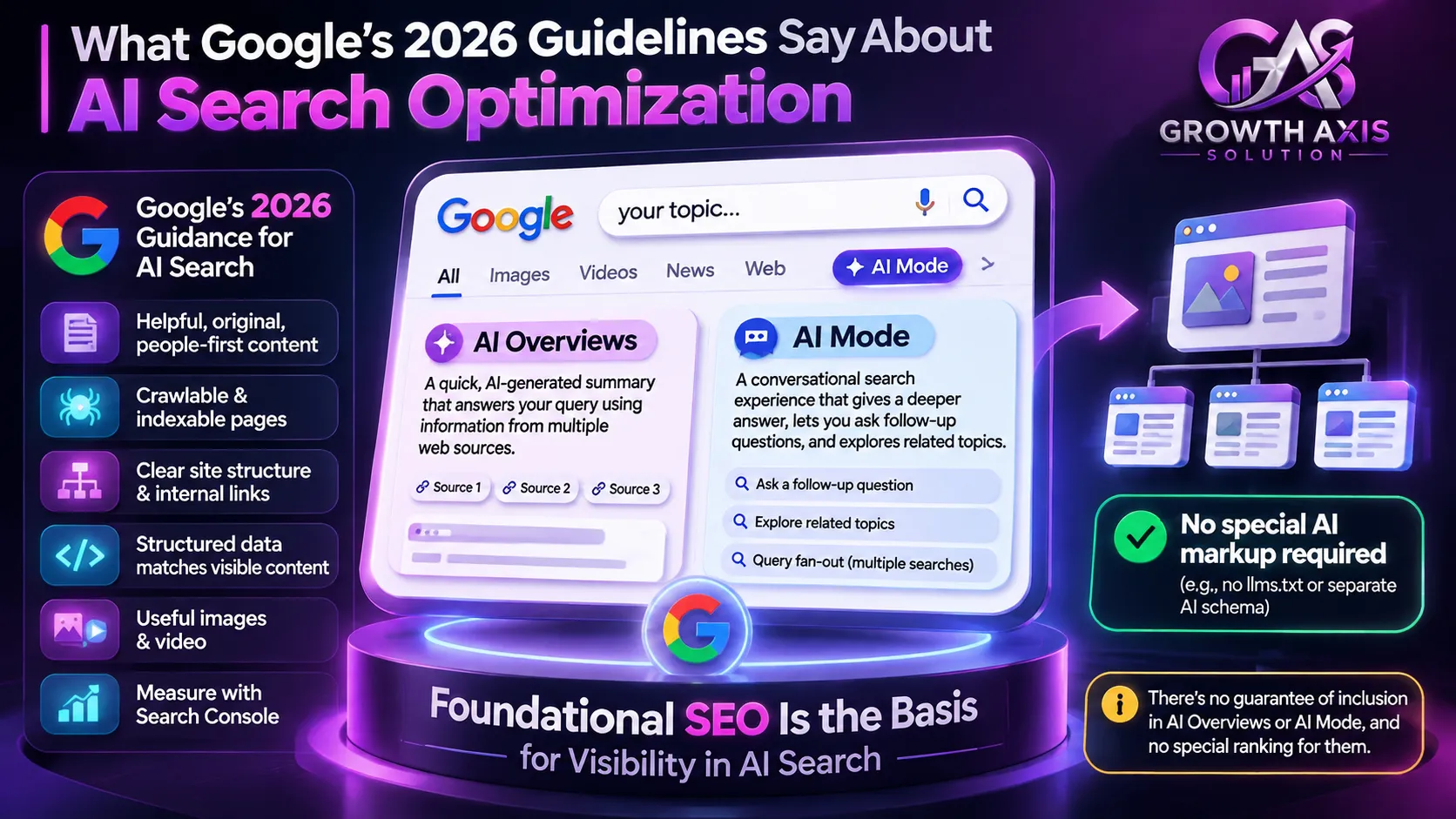
Google published its dedicated guide to optimizing websites for generative AI search in May 2026 and updated it on July 10, 2026.
The guidance makes one point particularly clear: traditional SEO remains essential.
Google’s generative search experiences rely on its established Search ranking and quality systems. They retrieve relevant information from the Search index and use AI techniques to synthesize responses.
Two important concepts explain this process.
Retrieval-Augmented Generation (RAG)
Retrieval-Augmented Generation allows AI systems to retrieve relevant information from external sources instead of relying exclusively on previously learned information.
In Google’s Search environment, this involves retrieving relevant pages from its index and using information from those pages to support generated responses.
This makes crawlability, indexing, relevance, and content quality important foundations.
Query Fan-Out
Query fan-out means that an AI system can expand a user’s original question into several related searches.
For example, someone searching for a digital marketing agency might trigger related information needs concerning pricing, services, experience, industry specialization, and customer results.
A website that addresses relevant supporting questions may provide useful information for different parts of the resulting response.
This is an important reason to optimize content for Google AI Overviews beyond a single keyword.
Google explains these concepts in its official generative AI optimization documentation.
The same documentation emphasizes original, useful information, clear technical structure, good page experience, and trustworthy content.
It does not promise that any particular formatting technique will guarantee inclusion.
A Practical Process to Optimize Content for Google AI Overviews
A repeatable workflow helps businesses improve existing pages and develop new resources without creating unnecessary content.
The following approach connects search intent, editorial quality, technical accessibility, and business objectives.
- Step 1: Research the questions your audience actually asks. Start with customer enquiries, Google Search Console, People Also Ask, industry discussions, and competitor content. Identify the questions customers ask before purchasing, during evaluation, and after choosing a service. When you optimize content for Google AI Overviews, these questions help reveal the information users expect rather than simply providing a list of keywords.
- Step 2: Study the current search results. Search your target topics in the countries you serve. Examine the pages appearing in organic results and AI-generated responses. Notice the explanations, sources, comparisons, and examples that contribute useful information. Look for gaps that your business can fill through better research or practical experience.
- Step 3: Create an answer-focused content structure. Introduce the subject clearly, answer the main question early, and organize supporting information under descriptive headings. Give each section a clear purpose. A reader should understand the central point even when encountering an individual section independently.
- Step 4: Add evidence and original information. Include verified statistics, real examples, documented processes, expert explanations, and original observations. Explain where information comes from and when it applies. Avoid repeating generic information that readers can find on hundreds of other websites.
- Step 5: Improve technical accessibility. Confirm that Google can crawl, render, index, and display your important pages. Review robots.txt, canonical tags, page status codes, internal links, and JavaScript rendering. Check that important information appears in accessible text rather than existing only inside images or inaccessible interactive elements.
- Step 6: Connect related pages through internal links. Build meaningful connections between educational articles, service pages, case studies, and supporting resources. Use descriptive anchor text so visitors understand where each link leads. Relevant internal links help readers explore your expertise and improve website navigation.
- Step 7: Review performance and update information. Monitor search visibility, AI impressions, qualified traffic, and conversions. Refresh outdated information when prices, features, regulations, or industry practices change. Focus on improvements that make the page more useful rather than changing wording simply to appear different.
This process provides a practical foundation for improving organic and AI-powered discovery.
Technical SEO Requirements for AI Search Visibility
High-quality content cannot perform well if search engines cannot access or understand the page.
Google’s official documentation states that a page must be indexed and eligible to appear with a snippet in regular Google Search to qualify as a supporting link in AI Overviews or AI Mode.
There are no additional technical requirements specifically for these features.
Use the following technical review to identify problems before investing in more content.
| Technical element | What to check | Recommended action |
|---|---|---|
| Robots.txt | Important content is not blocked | Review crawler access rules |
| Noindex directives | Important pages remain eligible for indexing | Check page-level meta robots settings |
| Snippet eligibility | Pages can appear with normal search snippets | Review restrictive preview directives |
| HTTP status | Important pages return successful responses | Fix relevant 404 and server errors |
| XML sitemap | Important canonical URLs are included | Submit and maintain an accurate sitemap |
| Canonical tags | Preferred page versions are clear | Resolve duplicate URL conflicts |
| JavaScript rendering | Important information appears after rendering | Test with Google’s URL Inspection tool |
| Internal links | Important pages are discoverable | Add contextual links from relevant pages |
| Mobile experience | Content works across screen sizes | Improve usability and loading performance |
| Search generative AI control | Website inclusion is enabled | Review Search Console settings |
Check your Search generative AI control
Google introduced a dedicated Search generative AI control in Search Console. As of August 31, 2026, it has rolled out worldwide.
Website owners can manage whether their content may appear in generative AI features, including AI Overviews and AI Mode.
The default setting includes website content. However, it is worth checking whether someone previously changed this setting.
Visit:
Google Search Console – Search Generative AI Control
Review the setting under:
Settings → Search generative AI
If your website is intentionally excluded, its content will not appear as a link or provide grounding information in the affected Search generative AI experiences.
Technical SEO is therefore a sensible first priority when you optimize content for Google AI Overviews.
For a deeper technical review, businesses can explore Technical SEO services from GrowthAxis Solutions.
Create Original Content That AI Systems Have a Reason to Reference
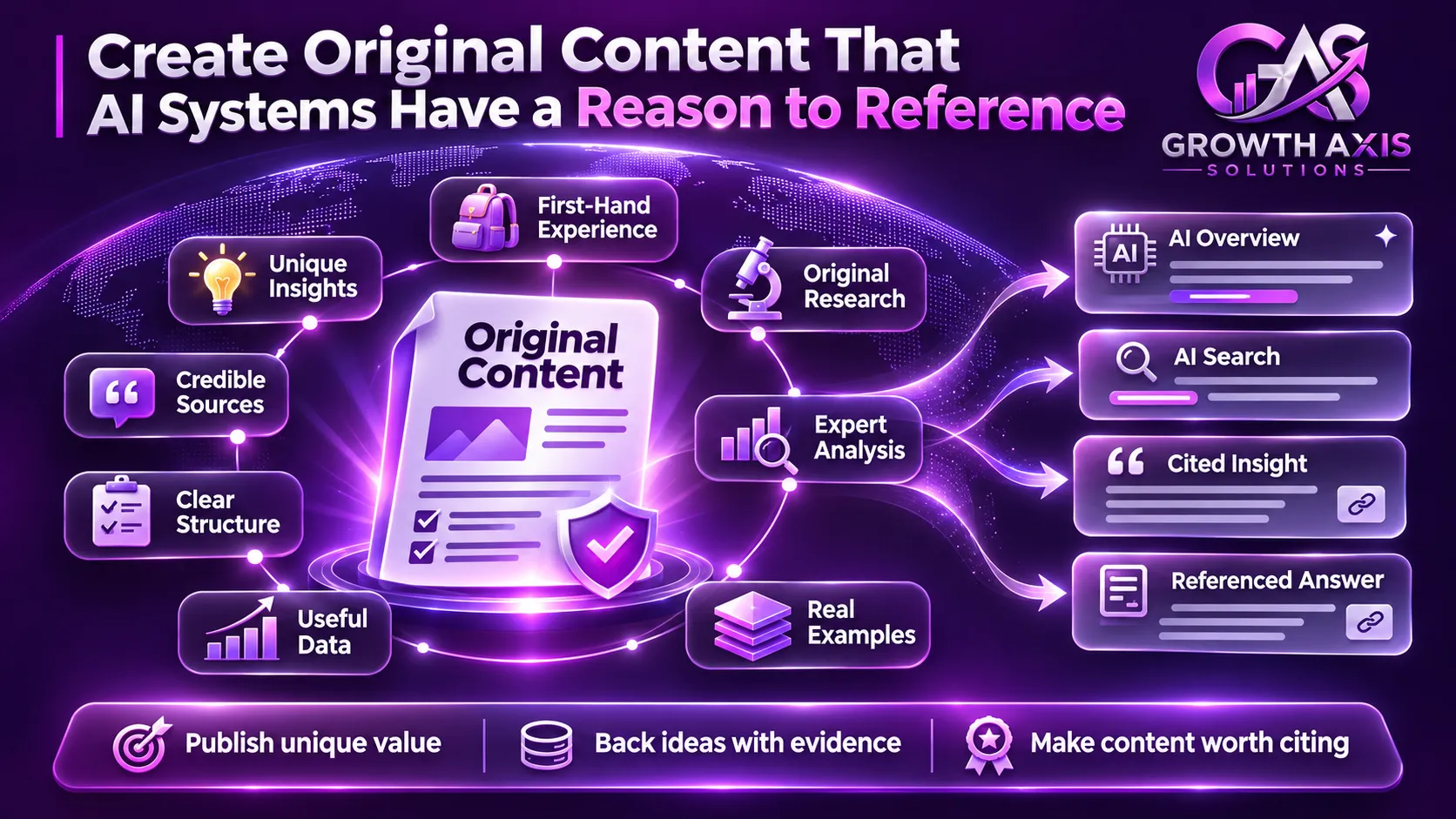
One of the biggest challenges in modern search is the increasing availability of similar information.
Businesses can publish dozens of articles about the same subjects without contributing anything particularly useful.
Google’s 2026 guidance places strong emphasis on valuable, non-commodity content. It encourages publishers to provide unique perspectives, firsthand experience, and information that goes beyond commonly available explanations.
This principle should influence every content decision.
Move beyond generic explanations
Consider a company offering website development.
A basic article might explain that a responsive website adjusts to different screen sizes.
That information is useful, but it offers limited differentiation.
A stronger article could explain how mobile navigation, image sizes, form design, and checkout processes affect the experience of customers using a particular type of website.
The second article provides more specific information and gives readers practical reasons to trust the publisher’s expertise.
Use original evidence
When appropriate, include:
- Firsthand project observations.
- Original research and survey findings.
- Realistic industry comparisons.
- Documented implementation processes.
- Customer questions and recurring challenges.
- Verified performance measurements.
- Expert commentary and practical recommendations.
Never invent statistics, case studies, or customer results.
If a company does not have original research, it can still provide useful value through carefully verified examples and clear explanations of professional decisions.
To optimize content for Google AI Overviews effectively, ask whether your article provides something meaningful that another publisher cannot simply reproduce by rewriting existing information.
Explain how conclusions were reached
A statistic without context can mislead readers.
Whenever you use research, explain the source, publication date, sample, and relevant limitations.
For example, a study of US desktop searches should not be presented as evidence of identical search behavior across Australia, Canada, and the United Kingdom.
This level of transparency strengthens trust and makes the content more useful for professional decision-making.
How to Use Query Fan-Out to Build Stronger Topic Coverage
A single search can represent several connected information needs.
This is particularly important for AI Mode, where users often ask follow-up questions and explore a subject from multiple angles.
Suppose someone searches:
“How can a small business improve its website’s Google visibility?”
The underlying information needs may include:
Understanding technical SEO, identifying valuable keywords, improving service pages, developing useful content, building relevant authority, and measuring organic performance.
A website that addresses these connected subjects can provide a stronger learning experience than one page that only repeats the original search phrase.
Develop topic clusters around real customer needs
Start with one central topic and identify its meaningful supporting subjects.
For example, an agency focusing on AI search could develop a content cluster around:
- Google AI Overviews and AI Mode.
- Technical requirements for AI search visibility.
- Answer Engine Optimization.
- Generative Engine Optimization.
- AI content quality and originality.
- Measuring generative AI search performance.
Each article should have a distinct purpose.
Connect these resources through contextual internal links so readers can move naturally from an introduction to more specialized explanations.
However, do not create a separate article for every possible query variation. Google specifically warns against producing unnecessary pages primarily to manipulate generative search results.
The objective is to cover the subject properly, not maximize the number of URLs.
This is a central principle when you optimize content for Google AI Overviews and develop a sustainable topical strategy.
Structure Content for Clear Answers and Better Readability
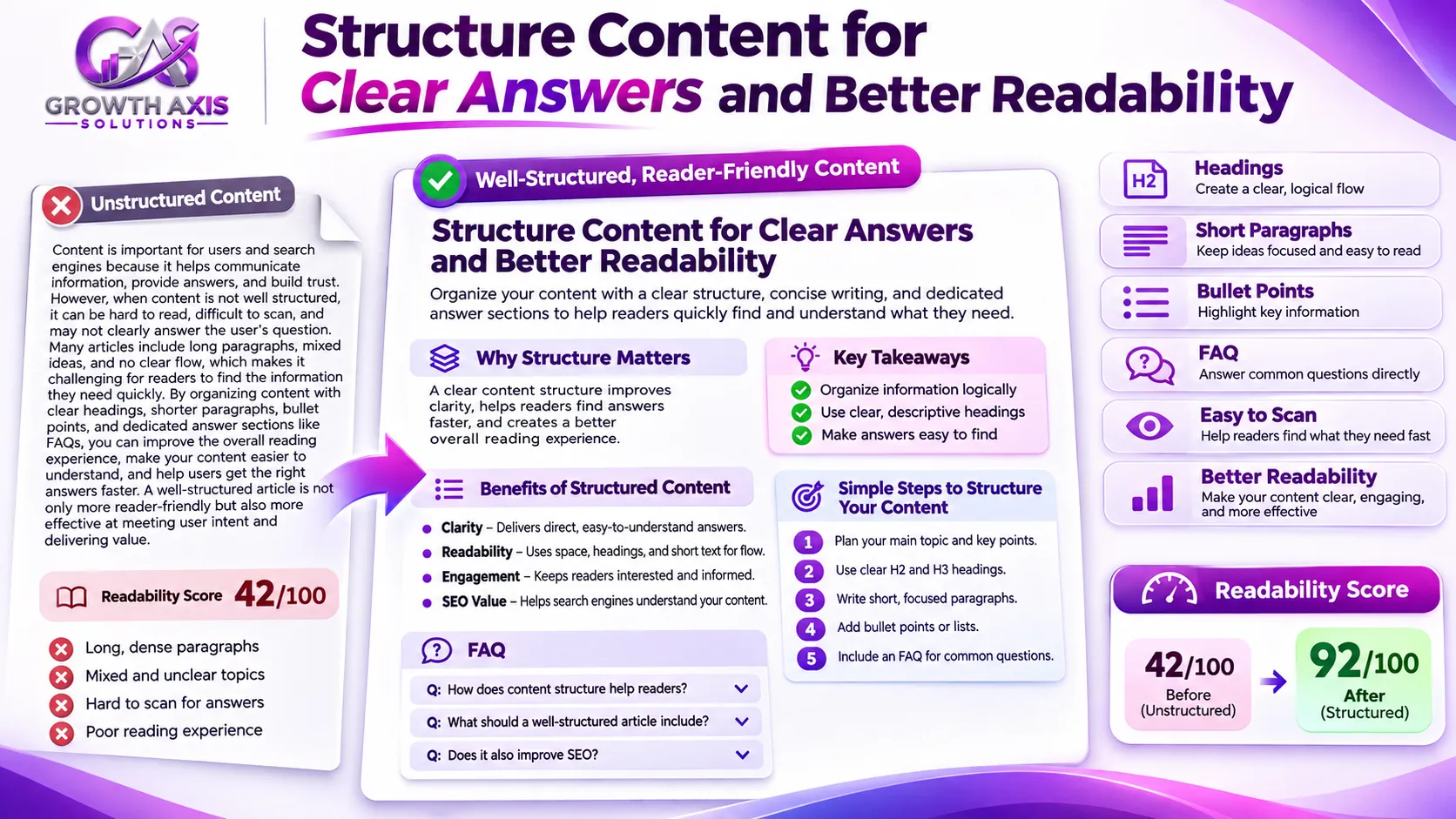
Content structure influences how people navigate information.
It also helps search systems understand the relationship between different sections.
A well-written page should communicate its central message without requiring readers to interpret vague headings or search through unrelated paragraphs.
Answer the main question early
If a section asks what AI Overviews are, begin with a clear definition.
Then explain how they work, provide an example, and discuss the practical implications.
Avoid lengthy introductions that delay the actual answer.
Use descriptive headings
A heading should explain what the next section covers.
For example:
“How Does AI Mode Change the Search Experience?”
is more informative than:
“Important Things to Know.”
Use H2 headings for major topics and H3 headings for supporting subjects.
Do not insert keywords into headings where they make the wording unnatural.
Write self-contained explanations
A useful paragraph should communicate a complete thought.
For example:
“Google’s Generative AI Performance Report helps website owners monitor impressions from AI Overviews and AI Mode. It also provides page, country, device, and date dimensions.”
This explanation makes sense independently.
Avoid using vague statements such as “This improves visibility” without clarifying what “this” refers to.
Use tables and examples when they improve understanding
Tables work well for comparisons, specifications, processes, and measurements.
Examples help readers understand how recommendations apply in real situations.
FAQs can address important questions that deserve direct answers.
However, do not force every article into the same template. To optimize content for Google AI Overviews, choose a structure that fits the subject and helps people understand it.
Google does not require publishers to divide every page into tiny sections or use a particular paragraph length.
Build Experience, Expertise, Authority, and Trust
Trust is particularly important when content influences business decisions.
A website should make it clear who provides its information, what evidence supports its recommendations, and why readers should consider its advice.
Google’s quality framework includes Experience, Expertise, Authoritativeness, and Trustworthiness, commonly called E-E-A-T.
Although E-E-A-T is not a single direct ranking score, its principles provide useful editorial standards.
Demonstrate relevant experience
If your company has completed a project, explain the problem, approach, and lessons learned.
Avoid presenting hypothetical scenarios as actual client results.
Establish clear authorship
Use meaningful author biographies and explain relevant professional experience.
For technical or specialized subjects, identify the person responsible for reviewing important claims.
Support claims with trustworthy sources
Link to original research, official documentation, recognized industry publications, and relevant professional resources.
Useful external references include:
Microsoft Bing Webmaster Guidelines
Use external references where they support the discussion. Do not add links simply to increase the number of outbound links.
Maintain consistent business information
Keep your company name, services, contact details, and professional descriptions consistent across your website and legitimate business profiles.
For GrowthAxis Solutions, this means maintaining clear relationships between its SEO services, content marketing, website development, and AI search capabilities.
Relevant third-party mentions can help customers understand a brand, but fabricated reviews, paid manipulative mentions, and irrelevant directory submissions are not a sustainable authority strategy.
Does Schema Markup Help Google AI Overviews?
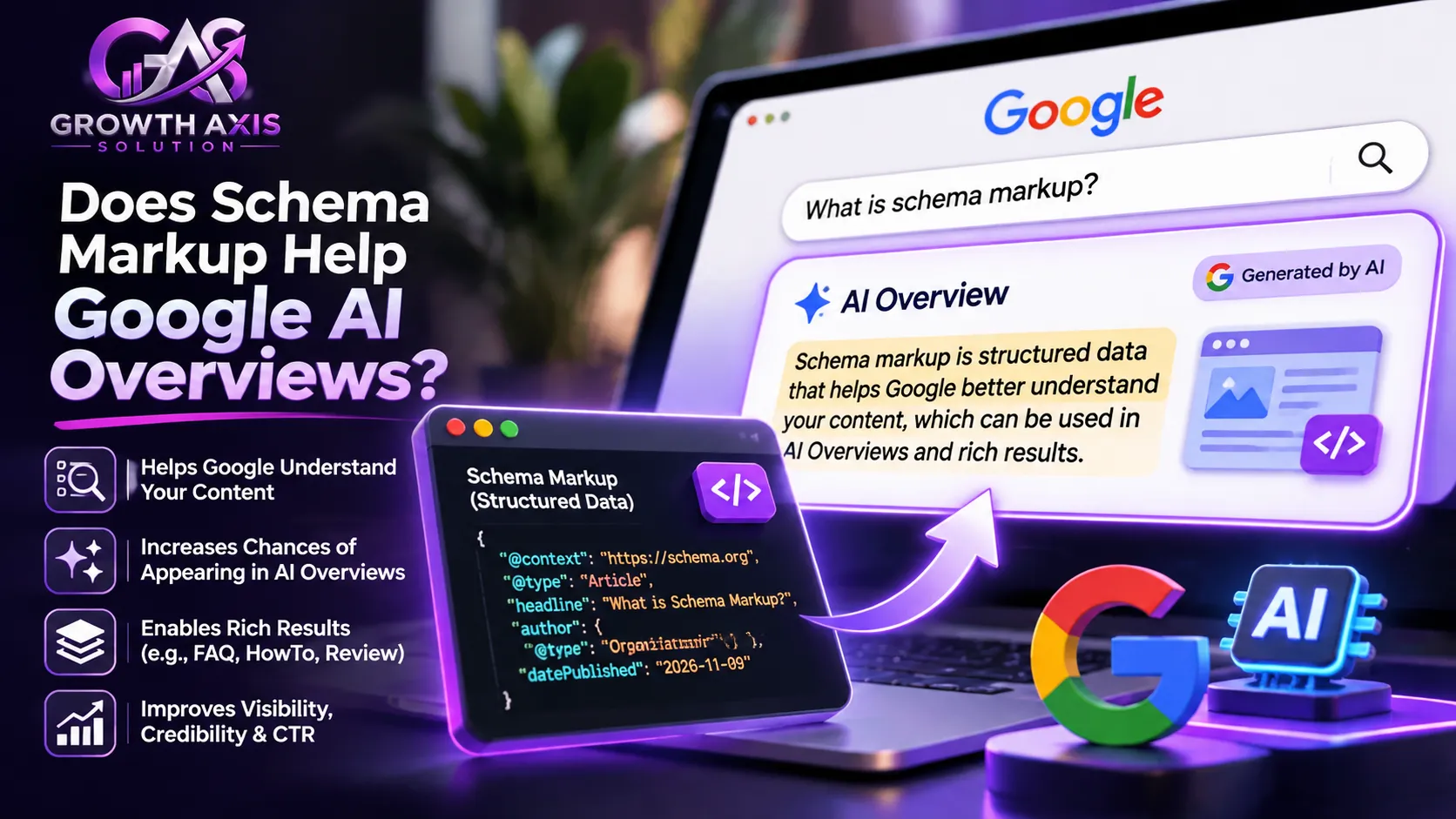
Structured data helps search engines interpret information about pages, products, organizations, articles, and other entities.
However, there is an important distinction between using schema correctly and assuming it guarantees AI visibility.
Google’s official 2026 generative AI documentation explicitly states that no special schema.org markup is required to appear in AI Overviews or AI Mode.
You do not need to create a special AI schema or add machine-readable files solely for Google generative search.
Which structured data should websites use?
Use relevant schema types when they accurately describe visible page information and support an appropriate Google Search feature.
For example:
Article or BlogPosting: Helps describe editorial content and relevant publication information.
Organization: Describes a business or organization.
Product: Provides structured product information for eligible product experiences.
BreadcrumbList: Describes a page’s position within website navigation.
Always ensure that structured data reflects information visitors can actually see.
Validate appropriate markup with Google’s Rich Results Test and the Schema Markup Validator.
What about FAQ schema?
FAQ sections can help readers understand a subject and find answers to related questions.
However, FAQ schema does not guarantee an AI Overview citation or a special ranking advantage.
Google’s restrictions on FAQ rich results also mean publishers should not assume that adding FAQ markup will produce an expanded search listing.
To optimize content for Google AI Overviews, prioritize accurate answers and useful explanations first. Implement structured data as part of a sound overall SEO strategy, not as a shortcut.
Is llms.txt necessary?
No. Google says that llms.txt and similar AI-specific files are not required for visibility in its generative Search features.
You may choose to maintain such files for other systems that use them, but Google Search does not treat them as a special ranking or visibility signal.
Use Images, Videos, and Visual Information Effectively
Search experiences increasingly combine text with visual information.
Google’s generative AI guidance encourages publishers to use relevant, high-quality images and videos when they genuinely improve the experience.
For example, a website development guide could include screenshots showing how to inspect mobile performance.
A marketing article could use an original diagram to explain the relationship between discovery, consideration, and conversion.
An ecommerce guide could include product demonstrations and clear specifications.
Make visual content useful
Use descriptive image filenames and appropriate alternative text.
Keep important information available in readable text rather than placing essential explanations exclusively inside images.
For videos, provide accurate titles, descriptions, and transcripts when appropriate.
Avoid using decorative graphics that do not contribute to understanding.
For product-focused websites, keep product details accurate and maintain relevant Merchant Center information.
Local businesses should also keep their Google Business Profile information current.
These practices support a better overall search experience and provide additional opportunities for discovery.
How to Measure AI Overviews and AI Mode Performance
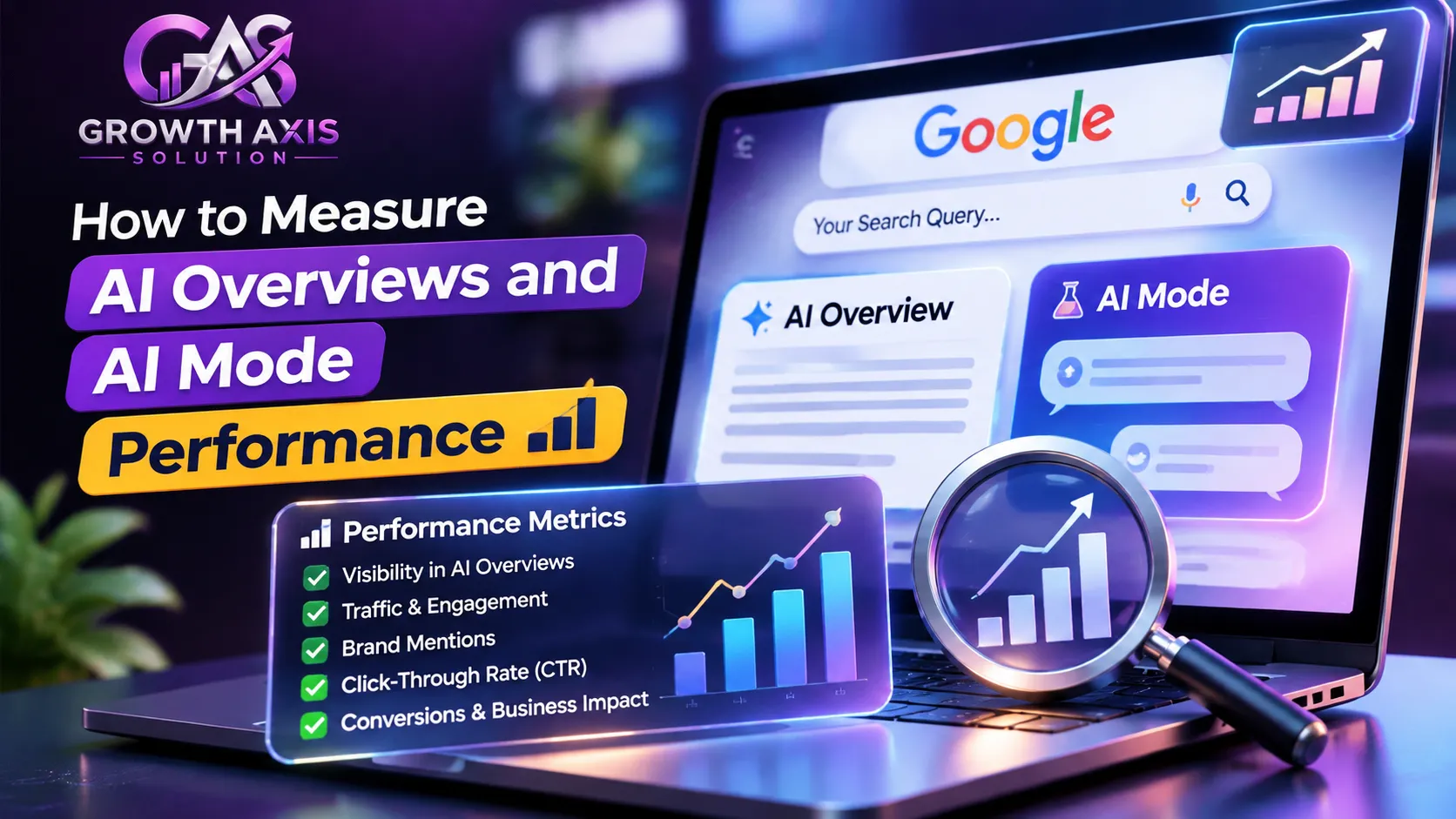
A successful strategy needs reliable measurement.
Traditional organic rankings alone do not describe the complete picture of modern search visibility.
Google introduced a dedicated Generative AI Performance Report in Search Console in June 2026. The report became available worldwide on August 31, 2026.
It provides information about website impressions within supported generative AI experiences, including AI Overviews and AI Mode.
What can you measure?
The report provides several useful dimensions.
Impressions: How often links to your website appeared in generative AI search experiences.
Pages: Which website URLs received AI search impressions.
Countries: Where those impressions originated.
Devices: Whether users saw your links on desktop, tablet, or mobile.
Dates: How impressions change over time using available reporting periods.
Access the Generative AI Performance Report.
One important limitation: the report focuses on impression visibility. It does not provide a complete picture of revenue, leads, or customer behavior.
Combine Search Console with Google Analytics
Google Analytics helps connect website visits with meaningful actions.
Monitor relevant landing-page sessions, enquiries, purchases, engagement, and conversions.
Compare performance before and after significant content improvements.
If your website receives more AI search impressions but fewer direct visits, investigate whether users find their answers within the search experience or whether your page needs a stronger reason to earn a click.
Do not treat every traffic decline as evidence that content quality has fallen.
Monitor AI visibility across different questions
You can also manually test representative searches in AI Overviews and AI Mode.
Record the question, location, date, visible sources, and whether your website or brand appears.
Repeat the tests over time because AI responses and cited sources can change.
Third-party AI visibility platforms may help organize this work, but their estimates should not be confused with Google’s internal ranking data.
A complete measurement approach should evaluate visibility, brand discovery, qualified visits, and actual business outcomes.
Common Mistakes to Avoid When Optimizing for AI Search
Businesses often waste time following techniques that sound attractive but lack reliable support.
Avoid these mistakes when developing your strategy:
- Writing exclusively for AI systems: Do not sacrifice natural explanations to make content appear machine-generated or artificially optimized. Write for people first.
- Repeating keywords excessively: Exact-match phrases should appear naturally. Excessive repetition can make an article difficult to read and may create keyword-stuffing problems.
- Publishing mass-produced articles: Creating hundreds of pages with little original value can violate Google’s scaled content abuse policies.
- Assuming schema guarantees citations: Structured data has legitimate uses, but Google does not require special schema for AI Overviews.
- Ignoring technical accessibility: Even excellent content cannot qualify as a supporting link if it is not indexed and eligible for a normal search snippet.
- Creating unnecessary content chunks: Google does not require publishers to split every article into tiny passages or follow a fixed paragraph-length formula.
- Buying artificial mentions: Manipulative backlinks, fake reviews, and fabricated brand recommendations can undermine trust.
- Ignoring content freshness: Outdated prices, features, examples, and statistics reduce usefulness and can mislead readers.
- Measuring success through rankings alone: Track AI impressions, organic traffic, qualified enquiries, and conversions to understand actual business impact.
The strongest way to optimize content for Google AI Overviews is to improve the information itself, maintain technical accessibility, and evaluate results honestly.
What Small Businesses Should Prioritize for AI Search Visibility
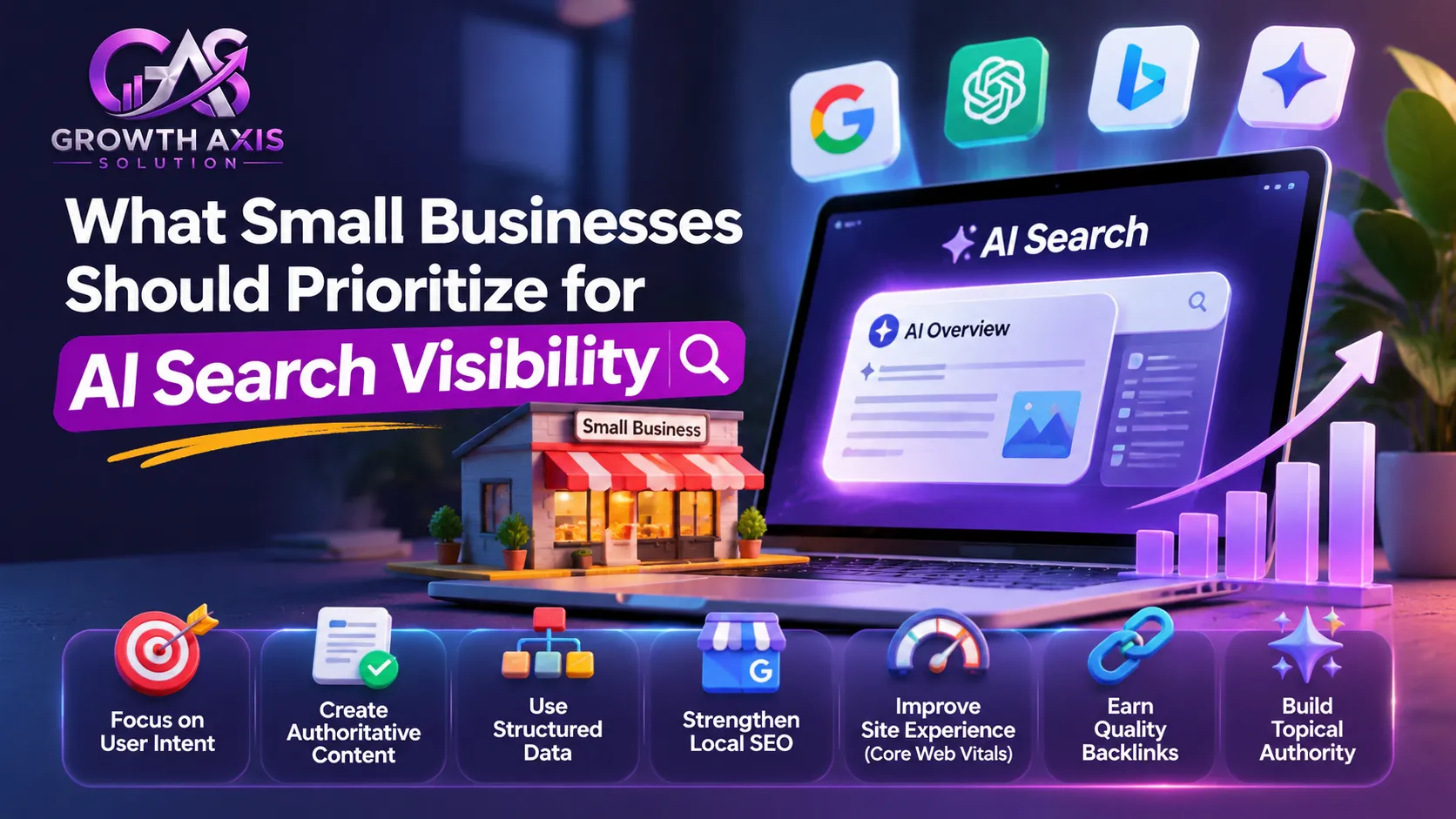
Small businesses often operate with limited budgets and smaller marketing teams.
They cannot produce endless content or compete with every major publisher.
A focused strategy is therefore essential.
The best ways to market a small business depend on its audience, product, market, and available resources. Search-focused content can become a useful part of that strategy when it addresses questions connected to genuine customer needs.
Start with your most important services
Create clear service pages explaining what you offer, who benefits, how the process works, and what customers can expect.
Support those pages with relevant educational articles.
For example, an agency offering SEO and AI search services could publish resources about technical SEO, search intent, AI Overviews, content quality, and website performance.
This approach supports content marketing for small business owners who want to attract relevant prospects rather than generate unrelated traffic.
A connected editorial plan can also support broader business growth strategies for small businesses by improving brand discovery and customer education.
Choose the right SEO partner
Businesses searching for the best SEO companies for small business should evaluate expertise, transparency, technical capability, and reporting.
The phrase best SEO company small business may appear in searches, but the real decision should involve finding a provider that understands the company’s market and business model.
When comparing the best SEO services for small business, examine the actual scope, implementation responsibilities, and expected deliverables.
The best SEO services small business owners choose should solve identifiable problems rather than sell unnecessary activities.
Connect content with other marketing channels
Content marketing for small businesses works best when it supports a complete customer journey.
Organic search can introduce people to your brand. Educational articles can build trust. Service pages can explain your offering. Paid campaigns and social platforms can help distribute relevant information.
Digital advertising for small businesses can complement organic marketing, especially when a company needs to test demand or promote a time-sensitive offer.
Likewise, the best ways to market small business audiences may include email, video, social media, referrals, and search visibility.
GrowthAxis Solutions connects these activities through its four core service areas: Digital Marketing, SEO & AI Search, Web Development, and Creative Studio.
Relevant services include:
AI Search Optimization – Improving website and brand discoverability across AI-powered search experiences.
Generative Engine Optimization (GEO) – Strengthening brand clarity, useful information, and citation opportunities.
Answer Engine Optimization (AEO) – Structuring important information around customer questions and clear answers.
AI Content Optimization – Improving content quality, evidence, topical relevance, and structure.
Content Marketing – Planning useful content around audience needs and business goals.
These services can work independently or together, depending on the website’s current condition and marketing priorities.
A Practical 30-Day Action Plan for Better AI Search Visibility
A structured implementation plan makes it easier to move from research to measurable improvements.
Days 1–7: Audit your website. Review indexing, crawlability, internal links, page experience, existing content, and Search Console settings. Identify your most important commercial and educational pages.
Days 8–14: Research information needs. Analyze customer questions, relevant search results, competitor content, and supporting queries. Select a small number of meaningful opportunities.
Days 15–21: Improve existing content. Rewrite unclear explanations, add original examples, verify statistics, improve headings, and connect related resources. Give priority to pages that already attract relevant search impressions.
Days 22–30: Measure and refine. Check technical eligibility, review generative AI impressions where available, monitor organic performance, and evaluate qualified enquiries. Document changes and establish a realistic ongoing improvement schedule.
This is an implementation framework, not a guaranteed timeline for AI citations.
New content and technical changes may require additional time before Google recrawls and evaluates the updated pages.
The important thing is to build a repeatable system rather than chase temporary optimization trends.
Conclusion
To optimize content for Google AI Overviews and AI Mode, focus on original information, technical accessibility, clear explanations, and trustworthy evidence. Google’s 2026 guidance confirms that strong SEO fundamentals remain essential. Build useful topic coverage, measure generative search visibility, and connect discovery with business outcomes. Contact GrowthAxis Solutions to develop your AI search strategy.
Frequently Asked Questions
1. How do I optimize content for Google AI Overviews?
Start by creating helpful, original content that directly answers relevant customer questions. Ensure Google can crawl and index your pages, organize information with descriptive headings, provide trustworthy evidence, and connect related resources through internal links.
Google does not guarantee inclusion through a particular writing format or optimization technique. Focus on satisfying search intent and providing information that deserves to be referenced.
2. Is AI Mode different from Google AI Overviews?
Yes. AI Overviews appear automatically within conventional Google Search results when Google’s systems consider an AI-generated summary useful.
AI Mode is a conversational search experience that users actively access. It supports complex questions, related searches, and follow-up conversations.
Both rely on Google’s established Search systems, but their models, retrieval techniques, and generated responses can differ.
3. Does traditional SEO still matter for AI Overviews?
Yes. Google’s official 2026 guidance confirms that established SEO practices remain relevant to generative AI search.
Your pages need to be accessible, indexable, relevant, and eligible to appear in regular Search results. Helpful content, internal linking, good page experience, and technical accessibility remain important foundations.
AI search optimization should complement traditional SEO rather than replace it.
4. Do I need llms.txt to appear in Google AI Overviews?
No. Google does not require llms.txt or other special AI-specific files for visibility in AI Overviews or AI Mode.
You can maintain such files for other systems that use them, but Google Search does not treat them as a special ranking signal.
Spend your resources on content quality, indexing, site structure, and accurate information instead.
5. Does FAQ schema improve AI Overview visibility?
FAQ sections can improve the reader experience by answering common questions clearly.
However, Google does not require FAQ schema for AI Overviews or AI Mode, and adding it does not guarantee citations.
Use structured data when it accurately represents visible information and supports an appropriate search feature. Do not treat schema as a shortcut to AI visibility.
6. How long does it take to appear in Google AI Overviews?
There is no guaranteed timeline.
Technical improvements may become visible after Google recrawls and processes affected pages. New content may take considerably longer to gain search visibility.
Your chances depend on content relevance, technical eligibility, competition, and Google’s retrieval systems. Monitor performance over time rather than expecting immediate inclusion after publication.
7. Does content length matter for Google AI Overviews?
Google does not prescribe an ideal word count for AI search visibility.
A short article can be useful when it completely answers a narrow question. A longer guide makes sense when readers need detailed explanations, comparisons, examples, and supporting evidence.
Choose the length that best satisfies the subject. Do not add unnecessary paragraphs simply to reach a word-count target.
8. How can I check whether my website appears in AI Overviews?
Use Google Search Console’s Generative AI Performance Report.
Google rolled out this report worldwide on August 31, 2026. It provides impressions for AI Overviews and AI Mode, together with page, country, device, and date information.
You can also manually test relevant searches and record whether your website appears among the supporting sources.
9. Can AI-generated content appear in Google AI Overviews?
Yes. Using AI tools does not automatically prevent content from appearing in Google Search or generative AI features.
However, generating large volumes of pages without original value, useful information, or proper fact-checking can create quality and spam-policy problems.
Use AI to support research and organization, but ensure published information is accurate, relevant, genuinely helpful, and appropriately reviewed.
10. What is the difference between AEO, GEO, and AI SEO?
SEO focuses on improving visibility in search engines through technical optimization, useful content, and relevant authority.
AEO, or Answer Engine Optimization, focuses on making information clear and useful for question-answering experiences.
GEO, or Generative Engine Optimization, focuses on improving how brands and their information are discovered, understood, and referenced by generative AI systems.
These approaches overlap substantially. For Google specifically, its official guidance continues to emphasize established SEO fundamentals rather than requiring a separate optimization system.